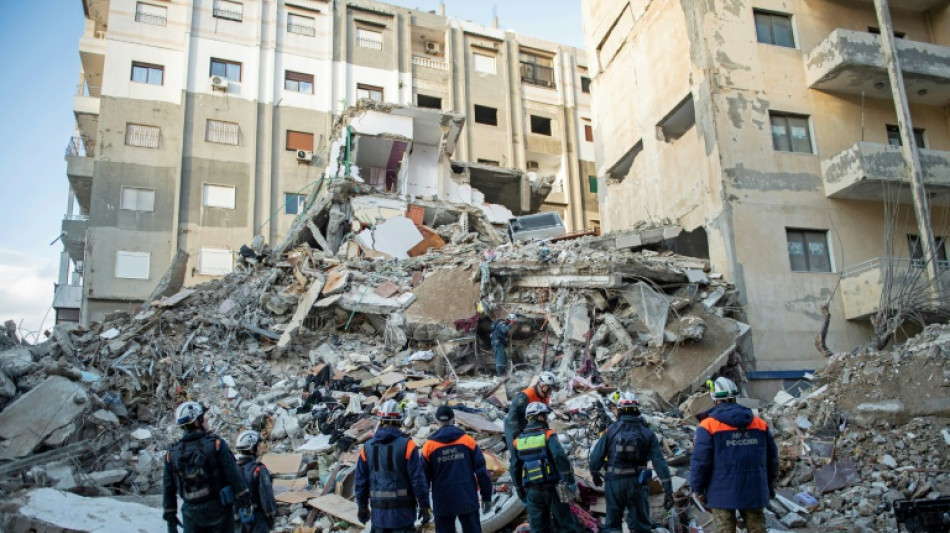
Why first 72 hours are crucial for Turkey-Syria quake rescues / Photo: - - AFP

 Warren coy over whether Fury-Joshua will be in UK or US

 Taiwan blocks key bridge in drill for potential Chinese invasion
 Migrant children risk abuse on streets of Ceuta, aid groups warn

 Oil price shoots up as stocks tread water

 British Grand Prix stays on MotoGP calendar until 2028

 Britain's EasyJet flies into US hands as takeover confirmed

 Real Madrid sign Ivory Coast winger Yan Diomande

 How online disinformation fuelled Ceuta migrant surge

 Inevitable AI Group Raises $6M From Aleph to Launch AI-Native SaaS Companies

 Suspected Ebola death on boat heading for DR Congo capital

 England selector North not 'hung up' on Stokes absence

 UK Anti-Doping confirm former world champ Parker's ban lifted

 French winemakers dread 'smoky taste' after wildfires

 Stocks diverge with earnings, tech in focus

 England recall batsman Lawrence for Pakistan series
 Siemens shares plunge on disappointing guidance raise

 New Australia coach Kiss gives Japan starts to Ross, Amatosero

 'Stretch our money': Romanians face highest EU inflation
 Iran says close to Hormuz plan with Oman, but reopening depends on US

 Messi scores twice to set Leagues Cup record in Miami victory

 Asian stocks mostly down with tech firms back under pressure
 Back to the future as world champion Springboks host All Blacks

 India youth protests highlight mistrust in 'lapdog' media
 Pacific islands alarmed by Trump-backed push for deep-sea mining
 Erratic rains dictate menu at three-star Michelin restaurant in Brazil

Time was running out for survivors buried in the rubble of the earthquake in Turkey and Syria, as search efforts near the crucial 72-hour mark, a rescue response expert said Wednesday.
More than 90 percent of earthquake survivors are rescued within the first three days, said Ilan Kelman, a professor of disasters and health at University College London.
But that number can vary significantly depending on the weather, aftershocks and how quickly rescue teams and equipment can arrive at the scene -- all factors which are currently going against efforts in Turkey and Syria.
Over 11,200 people have been killed and thousands more injured after the earthquake struck southeastern Turkey and neighbouring Syria at 04:17 am (0117 GMT) on Monday.
With the 72-hour window closing early Thursday morning, Kelman told AFP why this timeframe is so important.
- Injuries, temperature, water -
"Generally, earthquakes do not kill people, collapsing infrastructure kills people," said Kelman, who has published research on quake rescue responses.
The most pressing factor is getting medical attention to people crushed under collapsed buildings before "their bodies fail" or they bleed out, he said.
Weather is also a key factor, and "it is completely against us" in Turkey and Syria, Kelman said.
The quake-hit regions have suffered through freezing temperatures as well as rain and snow since Monday.
"This very sadly means that hypothermia is possible, and people are probably unfortunately perishing due to the weather," Kelman said.
Those who do manage to survive the cold and their injuries still need food and water.
Without water, many people "will start dying at the three, four, five day mark," Kelman said.
Aftershocks, which hit without warning in the days after an earthquake, can further collapse buildings, posing "a huge and frightening risk" to both survivors and those trying to rescue them, he added.
The quake-hit regions have been shaken by relentless aftershocks, including a massive 7.5 magnitude tremor on Monday.
- Getting help to the scene -
Kelman said that normally "the vast majority of survivors are brought out within 24 hours by local teams, often using no more than their hands or a shovel."
Dozens of nations have pledged to send search and rescue teams as well as relief supplies to Turkey and Syria.
But the quake occurred in "a remote area, in a conflict zone, which is very difficult to get into," Kelman said.
It generally takes at least 24 hours for international rescue teams to arrive, get set up and start working.
"At that point, a good number of the people who could have survived have already perished," Kelman said.
For areas stricken by conflict near the Syrian border, access is trickier still.
"And as far as I've seen, rescue teams have not even fully assessed many of the areas in the main conflict zones, or many of the temporary settlements for displaced people," Kelman said.
- How to find survivors? -
Once on the scene, there are a range of ways that rescue teams can find earthquake survivors, including dogs which sniff through rubble.
A particularly famous team of quake rescue dogs from Mexico is on its way to Turkey, Kelman pointed out.
Robots and drones are also increasingly being used to get into small spaces too dangerous for humans.
Once a survivor is found, rescuers must decide how best to get them out.
Huge equipment such as cranes may be needed to lift slabs of collapsed buildings.
Or sometimes it is necessary to amputate a limb "which is crushed under a pillar or a piece of masonry," Kelman said.
- Before the 72 hours starts -
Kelman emphasised that "ultimately, a successful rescue operation starts decades before the earthquake to try to stop the infrastructure collapsing in the first place".
"If we would see levels of investment in disaster prevention that we are seeing in disaster response, we would not be in this situation."
H.Portela--PC