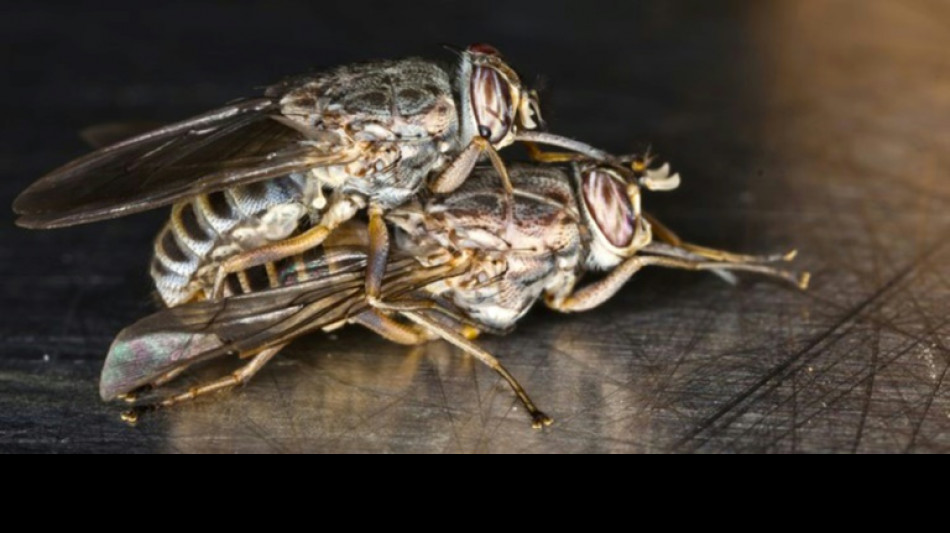
Discovery of tsetse fly mating behavior may help curb sleeping sickness / Photo: Geoffrey Attardo - EUREKALERT!/AFP

 2 killed, 13 wounded in bus blast near Syrian capital: state media

 All Blacks skipper Taylor cautiously recovering from calf strain

 UN chief denounces Russia, Ukraine for civilian deaths

 UEFA turn up the pressure on Infantino and repeat boycott threat

 Rodri approves Barcelona transfer talks with Man City: Barca source to AFP

 Venezuela unable to tally missing from cataclysmic quakes

 Le Court sprints to stage six Tour de France Femmes win

 Doping body says Parker's positive cocaine test caused by nutritionist

 UEFA says boycott of World Cups stands despite FIFA backdown on private investment

 Rheinmetall sales keep surging despite cancelled naval frigate project

 Pogacar teammate Del Toro gets new UAE deal after Tour podium

 Stocks tread water with earnings, tech in focus

 Inevitable AI Group Raises $6M From Aleph to Launch AI-Native SaaS Companies

 Forlan named new Uruguay head coach

 UEFA chief Ceferin: 'Underdog' leader taking fight to FIFA's Infantino

 Salah completes move to Turkey's Trabzonspor

 UK clears Paramount's takeover of Warner Bros

 North Korea fires ballistic missile: South Korea military

 'Don't have to hide': Thai IDs, legal work give hope to Myanmar refugees

 Stocks mixed with tech firms back under pressure

 How Blundell's old school tactic ended England's 'Bazball' era

 Israel reports troop deaths as Lebanon talks underway in Rome

 Seeds Rybakina, Pegula, Gauff reach third round at WTA Toronto

 Police raid South Korea FA in probe into World Cup coach appointment

 Low water on Germany's Rhine river threatens new blow to economy

Researchers have identified chemicals in tsetse flies that control their mating behavior, a discovery that may well aid the fight against the disease-causing insects in sub-Saharan Africa.
"It could be used in traps to make them more effective in trapping tsetse flies," said John Carlson, a biology professor at Yale University and one of the authors of a study published Thursday in the journal Science.
Trypanosomiasis, also known as sleeping sickness, is caused by parasites transmitted by the tsetse fly. It affects humans and domestic animals.
The disease threatens millions of people in dozens of countries in sub-Saharan Africa.
Animal trypanosomiasis, known as Nagana, kills some three million cattle each year, an annual cost of $1.2 billion, according to a companion article in Science.
It is considered a major cause of rural poverty and the authors warned that the geographic range of the tsetse fly is expected to grow as a result of climate change.
For the study, the researchers focused on pheromones, chemical compounds an animal releases that affect the behavior of others of the same species.
Pheromones allow insects to identify each other in an environment where there are potentially thousands of other species.
The Yale researchers identified volatile sex pheromones that had not previously been isolated in tsetse flies despite more than a century of study.
Pheromones are currently used to control a wide variety of other insect pests such as moths.
Pantry moths, for example, can be caught using sticky traps baited with a plastic disc soaked with an attractive pheromone.
- 'The flies stop moving' -
For the study, the researchers soaked tsetse flies in liquid and then used a gas chromatograph-mass spectrometer to identify specific chemicals.
One of them, methyl palmitoleate (MPO), acted as an aphrodisiac, attracting male tsetse flies.
In tests, male tsetse flies were attracted to decoys -- knots in yarn doused with MPO -- and, unusually, to females of another tsetse fly species.
Olfactory neurons on the antennae of the flies were found to increase their firing rates in response to MPO.
"Not only is MPO an attractant, but it causes tsetse flies to freeze -- the flies stop moving," Carlson said.
Current traps for tsetse flies use animal odors but MPO tends to last longer and could "enhance the effectiveness of traps," he said.
Carlson said field tests using MPO were getting underway in Kenya.
The type of pheromone identified in the study may not be effective against all types of tsetse flies, however.
The study focused on the species Glossina morsitans, a major vector of the disease in cattle, not on Glossina fuscipes, which causes the most human cases of the disease.
But Carlson said he was optimistic that the research methods used could lead to identifying pheromones from other tsetse species.
L.E.Campos--PC