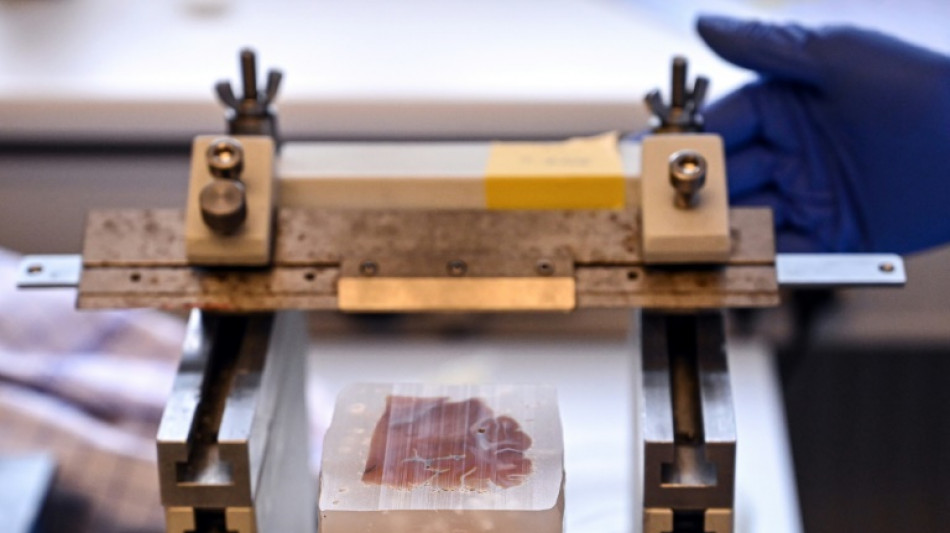
Grey area: chilling past of world's biggest brain collection / Photo: Sergei GAPON - AFP

 2 killed, 13 wounded in bus blast near Syrian capital: state media

 All Blacks skipper Taylor cautiously recovering from calf strain

 UN chief denounces Russia, Ukraine for civilian deaths
 UEFA turn up the pressure on Infantino and repeat boycott threat

 Rodri approves Barcelona transfer talks with Man City: Barca source to AFP

 Venezuela unable to tally missing from cataclysmic quakes

 Le Court sprints to stage six Tour de France Femmes win

 Doping body says Parker's positive cocaine test caused by nutritionist

 UEFA says boycott of World Cups stands despite FIFA backdown on private investment

 Rheinmetall sales keep surging despite cancelled naval frigate project

 Pogacar teammate Del Toro gets new UAE deal after Tour podium

 Stocks tread water with earnings, tech in focus

 Inevitable AI Group Raises $6M From Aleph to Launch AI-Native SaaS Companies

 Forlan named new Uruguay head coach

 UEFA chief Ceferin: 'Underdog' leader taking fight to FIFA's Infantino

 Salah completes move to Turkey's Trabzonspor

 UK clears Paramount's takeover of Warner Bros

 North Korea fires ballistic missile: South Korea military

 'Don't have to hide': Thai IDs, legal work give hope to Myanmar refugees

 Stocks mixed with tech firms back under pressure

 How Blundell's old school tactic ended England's 'Bazball' era

 Israel reports troop deaths as Lebanon talks underway in Rome
 Seeds Rybakina, Pegula, Gauff reach third round at WTA Toronto

 Police raid South Korea FA in probe into World Cup coach appointment

 Low water on Germany's Rhine river threatens new blow to economy

Countless shelves line the walls of a basement at Denmark's University of Odense, holding what is thought to be the world's largest collection of brains.
There are 9,479 of the organs, all removed from the corpses of mental health patients over the course of four decades until the 1980s.
Preserved in formalin in large white buckets labelled with numbers, the collection was the life's work of prominent Danish psychiatrist Erik Stromgren.
Begun in 1945, it was a "kind of experimental research," Jesper Vaczy Kragh, an expert in the history of psychiatry, explained to AFP.
Stromgren and his colleagues believed "maybe they could find out something about where mental illnesses were localised, or they thought they might find the answers in those brains".
The brains were collected after autopsies had been conducted on the bodies of people committed to psychiatric institutes across Denmark.
Neither the deceased nor their families were ever asked permission.
"These were state mental hospitals and there were no people from the outside who were asking questions about what went on in these state institutions," he said.
At the time, patients' rights were not a primary concern.
On the contrary, society believed it needed to be protected from these people, the researcher from the University of Copenhagen said.
Between 1929 and 1967, the law required people committed to mental institutions to be sterilised.
Up until 1989, they had to get a special exemption in order to be allowed to marry.
Denmark considered "mentally ill" people, as they were called at the time, "a burden to society (and believed that) if we let them have children, if we let them loose... they will cause all kinds of trouble," Vaczy Kragh said.
Back then, every Dane who died was autopsied, said pathologist Martin Wirenfeldt Nielsen, the director of the collection.
"It was just part of the culture back then, an autopsy was just another hospital procedure," Nielsen said.
The evolution of post-mortem procedures and growing awareness of patients' rights heralded the end of new additions to the collection in 1982.
A long and heated debate then ensued on what to do with it.
Denmark's state ethics council ultimately ruled it should be preserved and used for scientific research.
- Unlocking hidden secrets -
The collection, long housed in Aarhus in western Denmark, was moved to Odense in 2018.
Research on the collection has over the years covered a wide range of illnesses, including dementia, schizophrenia, bipolar disorder and depression.
"The debate has basically settled down, and (now people) say 'okay, this is very impressive and useful scientific research if you want to know more about mental disease'," the collection's director said.
Some of the brains belonged to people who suffered from both mental health issues and brain illnesses.
"Because many of these patients were admitted for maybe half their life, or even their entire life, they would also have had other brain diseases, such as a stroke, epilepsy or brain tumours," he added.
Four research projects are currently using the collection.
"If it's not used, it does no good," says the former head of the country's mental health association, Knud Kristensen.
"Now we have it, we should actually use it," he said, complaining about a lack of resources to fund research.
Neurobiologist Susana Aznar, a Parkinson's expert working at a Copenhagen research hospital, is using the collection as part of her team's research project.
She said the brains were unique in that they enable scientists to see the effects of modern treatments.
"They were not treated with the treatments that we have now," she said.
The brains of patients nowadays may have been altered by the treatments they have received.
When Aznar's team compares these with the brains from the collection, "we can see whether these changes could be associated with the treatments," she said.
G.Machado--PC