No longer a death sentence: Four decades of living with HIV / Photo: Marco BERTORELLO - AFP/File

 Battling Norrie survives match point to oust de Minaur at Montreal

 Venezuela's political transition talks start: AFP

 Real Madrid extend Vinicius deal, sign Diomande in title bid boost

 PSG sign France midfielder Akliouche from Monaco

 CONMEBOL 'expresses concern regarding repeated unilateral actions' by FIFA

 Warren coy over whether Fury-Joshua will be in UK or US

 Taiwan blocks key bridge in drill for potential Chinese invasion

 Migrant children risk abuse on streets of Ceuta, aid groups warn

 Oil price shoots up as stocks tread water

 British Grand Prix stays on MotoGP calendar until 2028

 Britain's EasyJet flies into US hands as takeover confirmed

 Real Madrid sign Ivory Coast winger Yan Diomande

 How online disinformation fuelled Ceuta migrant surge

 Forex Expo Dubai Announces Opportunity to Win Up to 150 Grams of Gold This September 2026

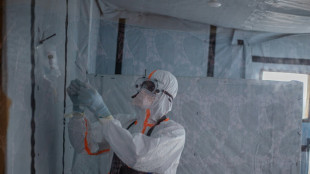 Suspected Ebola death on boat heading for DR Congo capital

 England selector North not 'hung up' on Stokes absence

 UK Anti-Doping confirm former world champ Parker's ban lifted

 French winemakers dread 'smoky taste' after wildfires

 Stocks diverge with earnings, tech in focus

 England recall batsman Lawrence for Pakistan series

 Siemens shares plunge on disappointing guidance raise

 New Australia coach Kiss gives Japan starts to Ross, Amatosero

 'Stretch our money': Romanians face highest EU inflation

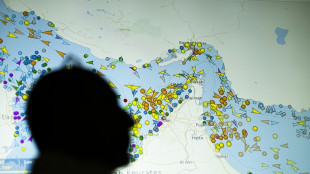 Iran says close to Hormuz plan with Oman, but reopening depends on US

 Messi scores twice to set Leagues Cup record in Miami victory

Forty years after the discovery of HIV, AFP looks at how far we have come in fighting a deadly virus that was once shrouded in fear and shame but is now treated as a manageable chronic condition.
- 1981: First alert -
In June 1981, US epidemiologists report five cases of a rare form of pneumonia in gay men in California.
It is the first alert about Acquired Immune Deficiency Syndrome (AIDS), still unknown and unnamed.
Doctors then identify "opportunistic infections" among intravenous drug users and in haemophiliacs and Haitian residents in the United States.
The term AIDS appears for the first time in 1982. The disease is wrongly presented as a "homosexual disorder".
- 1983: Identifying HIV -
In January 1983, researchers in France, Francoise Barre-Sinoussi and Jean-Claude Chermann, working under Luc Montagnier, identify the virus that "might be" responsible for AIDS.
Their discovery is published on May 20 in the journal Science.
The following year, US specialist Robert Gallo is said to have found the "probable" cause of AIDS, the retrovirus HTLV-III.
The two viruses turn out to be the same, and in May 1986 it becomes officially known as the Human Immunodeficiency Virus, or HIV.
- 1987: Anti-retroviral treatment -
In March 1987, the first anti-retroviral treatment known as AZT is authorised in the US. It is expensive and has severe side effects.
The United States and France agree that Gallo and Montagnier should get joint credit for discovering HIV. But the 2008 Nobel prize goes to Barre-Sinoussi and Montagnier.
- Early 1990s: Fallen stars -
In July 1985, US actor Rock Hudson announces he has AIDS. His death three months later is the first high-profile AIDS death.
A host of other stars succumb to the disease, including legendary pianist Liberace (February 1987), British singer and Queen frontman Freddie Mercury (November 1991), and the Russian dancer and choreographer Rudolf Nureyev (January 1993).
In 1994, AIDS becomes the leading cause of death among Americans aged between 25 and 44.
- 1995-96: New approach -
Two new classes of drugs signal the start of combinations of different anti-retroviral therapies.
Called tri-therapies, they provide the first effective treatment for HIV.
1996 is the first year in which the number of AIDS deaths declines in the United States. While US numbers decline, they rocket in Africa, where AIDS is the biggest killer by 1999.
- 2001: Generic medicine -
In 2000, UNAIDS and five major drug companies sign a deal to distribute affordable treatments in poorer countries.
A year later, the World Trade Organization changes intellectual property rules to allow developing countries to make generic versions of patent-protected HIV treatments.
In 2004, the country with the world's highest HIV caseload, South Africa, ends years of AIDS denialism and makes anti-retroviral treatments available through the public health system.
- 2010: First cure -
Timothy Ray Brown, an American man who had been living with HIV for over a decade, is cured of the virus after undergoing cancer treatment.
Brown underwent two bone marrow transplants containing a mutation of a gene that blocks HIV from attacking host cells.
- 2012: Preventive pill -
In July 2012, the first-ever daily pill to help prevent HIV infection is approved by US regulators. Truvada is a pre-exposure prophylaxis, or PrEP, taken by high-risk people who are HIV-negative in order to prevent them from being infected.
- 2017: Treatment spreads -
For the first time, more than half of all people living with HIV are receiving anti-retroviral treatment.
The proportion rises to three-quarters: 28.7 million people are being treated out of 38.4 million who are infected, according to UNAIDS in 2021.
- 2020-2021: Covid setback -
The Covid-19 pandemic disrupts access to health systems, testing and treatment, slowing progress in the fight against AIDS, which in 40 years has killed 40.1 million people.
In 2021, 650,000 AIDS deaths and 1.5 million new infections are recorded.
UNAIDS hopes to end AIDS as a public health threat by 2030.
L.Mesquita--PC