Glimmers of hope, but Doomsday Clock stuck at 100 seconds to midnight

 Germans vote in elections threatening fresh blow to Merz

 US fears rapid escalation in Mideast after Houthis attack Riyadh

 Japan triathlete Hojo wins first gold of Asian Games

 IOC president impressed by 'beautiful' Asian Games wooden huts

 First Asian Games gold goes to Japan as China's 13-year-old Yu lights up pool

 Data centre command hub keeps AI up and running

 Pope Leo in France: the issues on the table

 Packing for a pope: behind the scenes on foreign trips

 Republicans find transgender issues a powerful political weapon in midterm campaigning

 German state elections threaten new shock waves for Merz

 Chile's Bachelet quits race to be next UN chief

 Raphinha treble fires perfect Barca to win at Sevilla

 Thiam makes winning heptathlon return at Decastar meet

 Czechs beat USA to qualify for Davis Cup finals

 Dortmund sink Stuttgart to climb to Bundesliga summit

 Trump says will not tolerate attempts to slow AI growth

 'It has to stop': runners protest women's murders in S.Africa district

 Fire erupts near Riyadh airport as Houthis claim strikes

 Cuba works to restore power after another blackout

 England thrash Sri Lanka again to return to top of T20 rankings

 Arsenal thrashed by Brighton, sorry Spurs lose again

 South Korea, Austria qualify for Davis Cup finals

 Seare shocks Ingebrigtsen to win world 5km gold

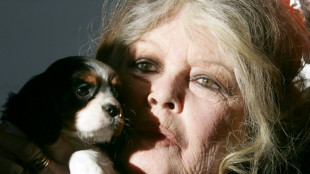 Brigitte Bardot widower slams sale of star's belongings

 Aston Villa compound Tottenham's misery despite late rally

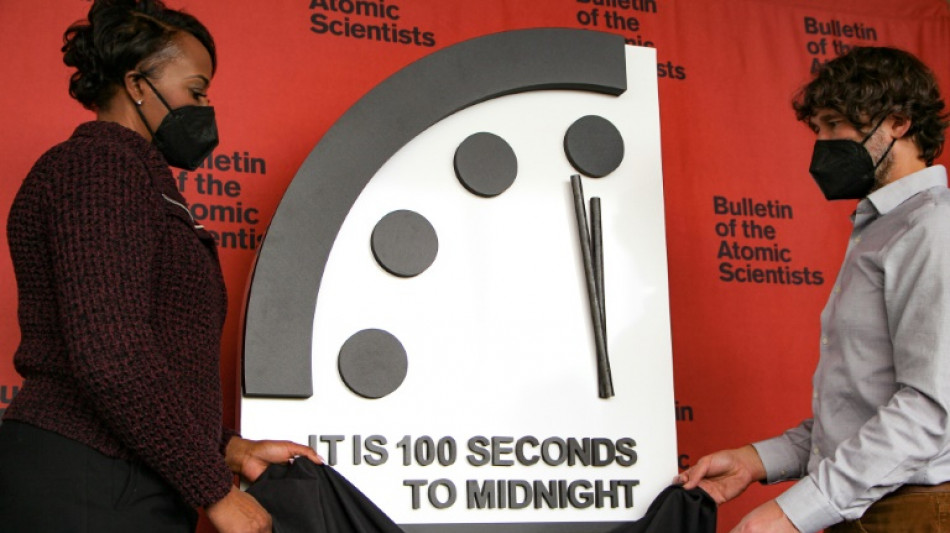
The "Doomsday Clock," representing the judgment of leading science and security experts about perils to human existence, remains at 100 seconds to midnight this year, with advances like Covid-19 vaccines balanced by rising misinformation and other threats.
Bulletin of the Atomic Scientists president Rachel Bronson declared Thursday the world was no safer this year than two years ago, when the clock's hands were moved to their current position.
"If humanity is to avoid an existential catastrophe, one that would dwarf anything it has yet seen, national leaders must do a far better job of countering disinformation, heeding science and cooperating," she told reporters on the 75th anniversary of the clock's initial unveiling.
The fact that it hasn't shifted closer to midnight does not imply threats have stabilized, the group said in a full statement.
"On the contrary, the Clock remains the closest it has ever been to civilization-ending apocalypse because the world remains stuck in an extremely dangerous moment."
The Bulletin was founded in 1945 by Albert Einstein, J Robert Oppenheimer and other scientists who worked on the Manhattan Project which produced the first nuclear weapons.
The idea of the clock symbolizing global vulnerability to catastrophe followed in 1947.
Its time is set by the organization's board, with the support of its board of sponsors, which includes 11 Nobel laureates.
In its statement, the Bulletin noted hopeful developments at the start of 2021, including the renewal of the New START arms control agreement between the United States and Russia.
But international tensions continue to loom ominously, including most recently over Ukraine. The United States, Russia and China meanwhile continue their march to develop hypersonic weapons.
- Nice words, but little climate action -
No country meanwhile remains immune to threats to democracy, the Bulletin said, "as the January 6, 2021 insurrection at the US Capitol demonstrated."
More than 10 percent of those charged with crimes related to the riot were active or retired service members, underscoring extremism in the military.
On climate, COP26 in Glasgow offered positive rhetoric but relatively little action.
Encouragingly, several countries announced net-zero carbon dioxide targets by 2050, but getting there would require immediate divestment from fossil fuels, investment in renewables, upgrading infrastructure and shifting land use and agriculture practices.
"The past year has seen a staggering onslaught of climate disasters," said Raymond Pierrehumber, a professor of physics at the University of Oxford.
"We've had the heat dome over North America, worldwide fires, drought, floods, but this is just a sample of what is to come if we don't get the emissions of carbon dioxide to zero."
And while Covid-19 has focused the world's scientific attention, governments must be prepared for other biological threats -- from weapons programs to the rise in antibiotic resistance, which the Bulletin said could trigger a new pandemic within a decade.
The Bulletin particularly highlighted how disinformation -- much of it stoked by politicians in high office -- is undermining faith in science and handicapping the world's ability to confront its challenges.
"A particularly invidious threat is the intentional undermining of the public's ability to sort out what's true from what's patently false by information warfare," said Sharon Squassoni, co-chair of the board and a research professor at George Washington University.
"This subverts our ability to arrive at consensus on the solutions needed to achieve positive change," she added.
The Bulletin called on Washington and Moscow to expand the scope of nuclear reduction, and for the world's leading polluters to accelerate decarbonization.
"China should set an example by pursuing sustainable development pathways -- not fossil fuel-intensive projects" in its global infrastructure initiative known as Belt and Road, it said.
The United States and other leading countries should meanwhile heighten cooperation through the World Health Organization to reduce biological risks.
This would involve improving monitoring of animal-human interactions, increasing international disease surveillance, and ramping up production and distribution of medical supplies.
P.Queiroz--PC