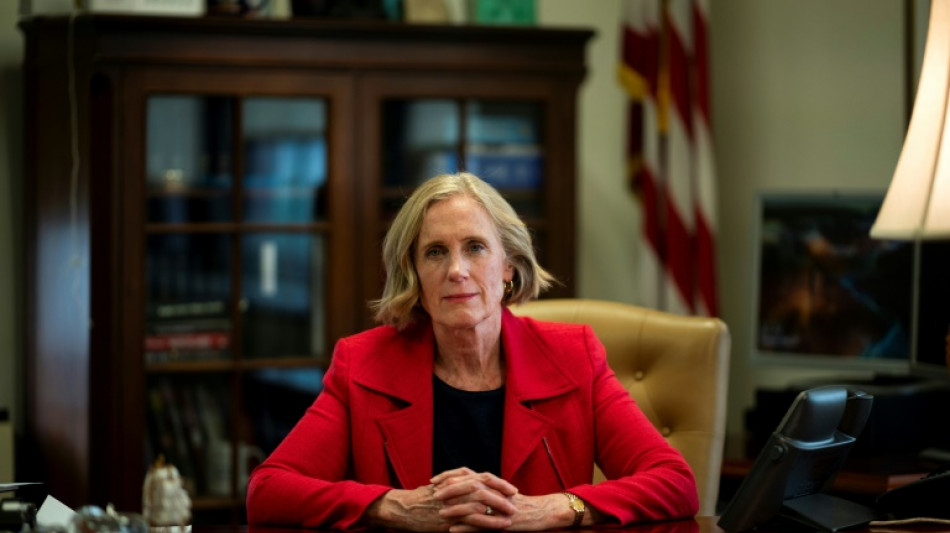
Fentanyl pill surge worries New York drug prosecutor / Photo: Johannes EISELE - AFP

 Battling Norrie survives match point to oust de Minaur at Montreal

 Venezuela's political transition talks start: AFP

 Real Madrid extend Vinicius deal, sign Diomande in title bid boost

 PSG sign France midfielder Akliouche from Monaco

 CONMEBOL 'expresses concern regarding repeated unilateral actions' by FIFA

 Warren coy over whether Fury-Joshua will be in UK or US

 Taiwan blocks key bridge in drill for potential Chinese invasion

 Migrant children risk abuse on streets of Ceuta, aid groups warn

 Oil price shoots up as stocks tread water

 British Grand Prix stays on MotoGP calendar until 2028

 Britain's EasyJet flies into US hands as takeover confirmed

 Real Madrid sign Ivory Coast winger Yan Diomande

 How online disinformation fuelled Ceuta migrant surge

 Forex Expo Dubai Announces Opportunity to Win Up to 150 Grams of Gold This September 2026

 Suspected Ebola death on boat heading for DR Congo capital

 England selector North not 'hung up' on Stokes absence

 UK Anti-Doping confirm former world champ Parker's ban lifted

 French winemakers dread 'smoky taste' after wildfires

 Stocks diverge with earnings, tech in focus

 England recall batsman Lawrence for Pakistan series

 Siemens shares plunge on disappointing guidance raise

 New Australia coach Kiss gives Japan starts to Ross, Amatosero

 'Stretch our money': Romanians face highest EU inflation

 Iran says close to Hormuz plan with Oman, but reopening depends on US

 Messi scores twice to set Leagues Cup record in Miami victory

As America's illegal drug market continues to expand, from heroin and fentanyl to the "zombie drug" known as tranq, AFP spoke with New York's special narcotics prosecutor Bridget Brennan.
Here are her responses:
- Q: What developments are you seeing in fentanyl trafficking? -
"Fentanyl itself has had different variations called analogs. What we've seen most recently is some deadly combinations. Xylazine is now being mixed with fentanyl. And xylazine is not an opioid, it's a sedative. It's an animal tranquilizer. And it works on the body differently. And that combination of xylazine and fentanyl is proving to be not only deadly, but it is very destructive.
"Now what we're seeing is fentanyl pressed into pills, often in Mexico, and sometimes in the US. What we have seen is a real explosion in the number of pills that we've seized. Last year, here in New York City, my office alone seized almost a million fentanyl pills (up 425 percent from 2021). And it continues to expand."
- Q: How are the pills dispersed? -
"The pills are distributed through social media, through websites. They may have the markings of a Xanax prescription, oxycodone prescription, (Attention Deficit Disorder drug) Adderall -- another prescription which incidentally has been in short supply in the US.
"That's one way the criminal organizations look to expand their market. That concerns me quite a bit, because those people who might be buying through social media, through the websites may be far more naive than the people who are buying on the street. And they also may have no tolerance for fentanyl."
"They actually may think that they're buying Adderall but they're really getting fentanyl. And if they have no tolerance whatsoever, it certainly could be fatal."
- Q: What is being done to combat the threat?
"The best thing we can do is take as much supply off the market as possible. The other very important thing is to try to shut down the supply of money that's going back to Mexico, and now going back to China.
"There are many ways to attack the problem, but the most important thing is the one thing we can control somewhat in the US. And that is to decrease the demand for the drugs, decrease the number of people who want to use the drugs, and treat those people who are suffering from addictions to the drugs.
"The other thing that I would like to see is an effective prevention program. Messaging, honest messaging that explains what these drugs are, explains the consequences of using them in simple words, and not trying to terrify people but trying to educate people and especially children.
"Often, abuse of drugs starts when people are quite young. And if you can educate them as we've done with cigarettes, if we can use those same kinds of tools and educate them, then ultimately we'll see the demand diminish."
- Q: Is there anything hampering the fight? -
"The trend that worries me the most is that we seem to be unable to work effectively with Mexico to control the production and distribution of the drugs. We need a more effective strategy to work with the Mexican government.
"The other problem is the more we buy drugs the more we empower the cartels, which corrupt the government there, and really harm the lives of the Mexican people. And so it's just a circular problem.
"The other thing is how to break our cycle here. We'd like to lay all the blame on Mexico but we're the ones using the drugs. And we need to break that cycle.
"The US has decreased the number of treatment programs. You don't see many very straightforward, clear, well done prevention campaigns in the US either anymore. So we're not focusing on all the aspects of this problem."
F.Cardoso--PC