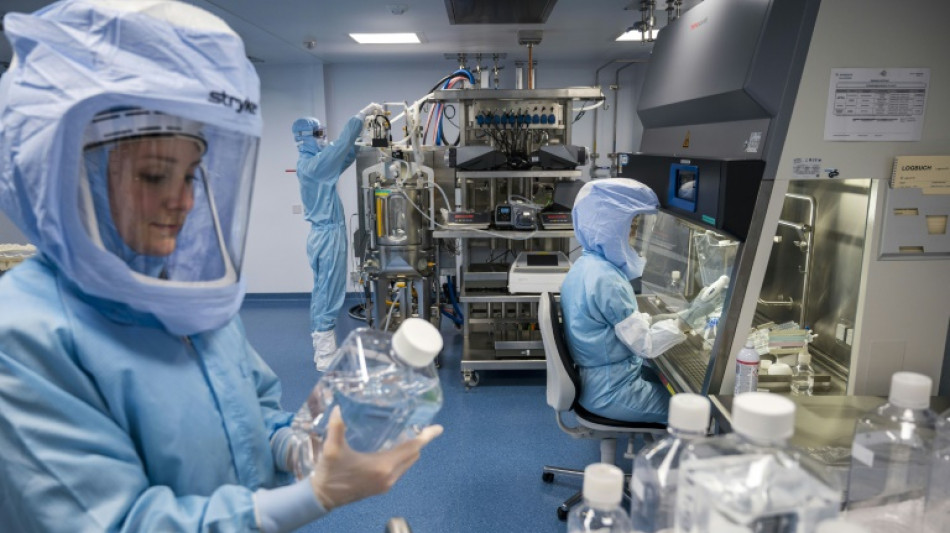
From Covid to cancer: High hopes for Nobel mRNA vaccines / Photo: Thomas Lohnes - AFP/File

 Battling Norrie survives match point to oust de Minaur at Montreal
 Venezuela's political transition talks start: AFP

 Real Madrid extend Vinicius deal, sign Diomande in title bid boost

 PSG sign France midfielder Akliouche from Monaco

 CONMEBOL 'expresses concern regarding repeated unilateral actions' by FIFA

 Warren coy over whether Fury-Joshua will be in UK or US

 Taiwan blocks key bridge in drill for potential Chinese invasion

 Migrant children risk abuse on streets of Ceuta, aid groups warn

 Oil price shoots up as stocks tread water

 British Grand Prix stays on MotoGP calendar until 2028

 Britain's EasyJet flies into US hands as takeover confirmed

 Real Madrid sign Ivory Coast winger Yan Diomande

 How online disinformation fuelled Ceuta migrant surge

 Forex Expo Dubai Announces Opportunity to Win Up to 150 Grams of Gold This September 2026

 Suspected Ebola death on boat heading for DR Congo capital

 England selector North not 'hung up' on Stokes absence

 UK Anti-Doping confirm former world champ Parker's ban lifted

 French winemakers dread 'smoky taste' after wildfires

 Stocks diverge with earnings, tech in focus
 England recall batsman Lawrence for Pakistan series
 Siemens shares plunge on disappointing guidance raise

 New Australia coach Kiss gives Japan starts to Ross, Amatosero

 'Stretch our money': Romanians face highest EU inflation

 Iran says close to Hormuz plan with Oman, but reopening depends on US

 Messi scores twice to set Leagues Cup record in Miami victory

The coronavirus pandemic brought global renown to the mRNA technology that underpins vaccines from Pfizer/BioNTech and Moderna, and on Monday earned a Nobel Prize for two scientists who have been key to its development.
Katalin Kariko of Hungary and Drew Weissman of the United States won the Nobel Medicine Prize for their work on "nucleoside base modifications that enabled the development of effective mRNA vaccines against COVID-19".
These types of jabs are new but researchers have been working for decades to try to figure out how to use messenger RNA (ribonucleic acid) for other vaccinations and to treat illnesses from AIDS to cancer.
- How does it work? -
Messenger RNA's job in the body is to help deliver specific instructions from DNA to cells.
In the case of the Pfizer/BioNTech and Moderna jabs, lab-generated mRNA tells human cells to create antigens -- proteins that are similar to ones found in the Covid-19 virus.
Thanks to those antigens, a person's immune system learns how to fight the virus and neutralise Covid if it enters the body.
After the cells create these proteins, the body breaks down the mRNA instructions and gets rid of them.
Such direct communication with cells is revolutionary -- classic vaccines aimed to provoke an immune response by injecting a neutralised form of a virus or antigens into the system.
- Where did this come from? -
The first big breakthrough, in the late 1970s, was in using mRNA to make test-tube cells produce proteins.
A decade later, scientists were able to get the same results in mice, but mRNA still had two major drawbacks as a medical tool.
For one thing, cells in live animals resisted synthetic mRNA, provoking a dangerous immune response.
On top of that, mRNA molecules are fragile, making them difficult to deliver to the system without altering them.
In 2005, Kariko and Weissman of Penn State University published a groundbreaking study showing that a lipid -- or fat molecule -- envelope could safely deliver mRNA without negative effects.
The research caused a buzz in the pharmaceutical community and start-ups dedicated to mRNA therapies began to pop up around the world.
- What else can mRNA do? -
Scientists have worked on developing mRNA jabs for illnesses like seasonal flu, rabies and Zika, as well as those that have remained vaccine-resistant until now, including malaria and AIDS.
Researchers have also started testing personalised treatments on cancer patients, using samples of the proteins in their tumours to create specialised mRNA.
This then triggers the immune system to target specific cancer cells.
"The mRNA platform is versatile," University of Pennsylvania biochemist Norbert Pardi told AFP. "Any protein can be encoded as mRNA so there are many potential applications."
E.Paulino--PC