Shanghai to lock down in phases to rein in Covid-19 outbreak

 Drones hit Moscow as Russians go to the polls

 New England boss Fleming says 'wrong' to ask Stokes to end retirement

 Germans vote in elections threatening fresh blow to Merz

 US fears rapid escalation in Mideast after Houthis attack Riyadh

 Japan triathlete Hojo wins first gold of Asian Games

 IOC president impressed by 'beautiful' Asian Games wooden huts

 First Asian Games gold goes to Japan as China's 13-year-old Yu lights up pool

 Data centre command hub keeps AI up and running

 Pope Leo in France: the issues on the table

 Packing for a pope: behind the scenes on foreign trips

 Republicans find transgender issues a powerful political weapon in midterm campaigning

 German state elections threaten new shock waves for Merz

 Chile's Bachelet quits race to be next UN chief

 Raphinha treble fires perfect Barca to win at Sevilla

 Thiam makes winning heptathlon return at Decastar meet

 Czechs beat USA to qualify for Davis Cup finals

 Dortmund sink Stuttgart to climb to Bundesliga summit

 Trump says will not tolerate attempts to slow AI growth

 'It has to stop': runners protest women's murders in S.Africa district

 Fire erupts near Riyadh airport as Houthis claim strikes

 Cuba works to restore power after another blackout

 England thrash Sri Lanka again to return to top of T20 rankings

 Arsenal thrashed by Brighton, sorry Spurs lose again

 South Korea, Austria qualify for Davis Cup finals

 Seare shocks Ingebrigtsen to win world 5km gold

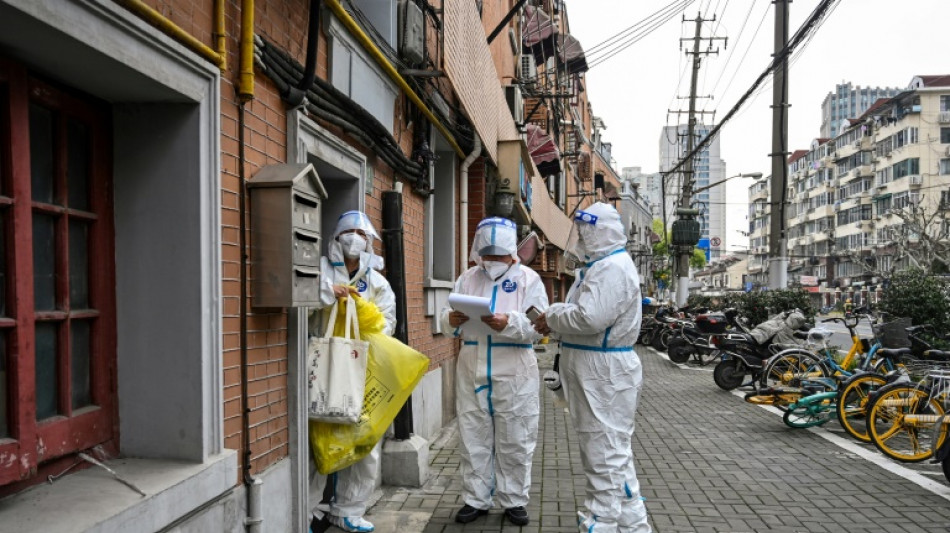
Shanghai will launch a phased lockdown to curb an Omicron-fuelled Covid-19 outbreak that has hit China with its highest caseloads since the early days of the pandemic, the city government said Sunday.
China's biggest city will lock down its eastern half from Monday until Friday, officials said, followed by a similar lockdown of its western side beginning on April 1.
The metropolis of 25 million has in recent days become the leading hotspot in a nationwide outbreak that began to gain pace in early March.
Although recent case numbers remain insignificant in a global context, they are China's highest since the first weeks of the pandemic, which first emerged in the city of Wuhan in late 2019.
China's National Health Commission on Sunday reported more than 4,500 new domestically transmitted cases, down by more than 1,000 from the previous day but still far higher than the double-digit daily tallies usually seen over the past two years.
Millions of residents in affected areas across the country have been subjected to citywide lockdowns.
Shanghai, however, had thus far avoided a full lockdown, with officials saying it was imperative to keep the eastern Chinese port and financial hub running, for the good of both the national and global economies.
But with case counts climbing, the city government said in a public notice that the two-part lockdown was being implemented "to curb the spread of the epidemic, ensure the safety and health of the people" and root out cases of infection "as soon as possible".
The city's sprawling eastern half, known as Pudong, which includes the main international airport and financial district, would be locked down for testing beginning Monday morning and ending April 1.
On April 1, the city's western half, known as Puxi and featuring the historic Bund riverfront, will lock down until April 5, the government added.
Residents were told to stay indoors during the lockdowns, and all business employees and government personnel not involved in the supply of essential services were advised to work from home.
Those involved with providing vital services such as gas, electricity, transport, sanitation and the supply of food would be exempt from the stay-at-home order.
The announcement said buses, taxis and the city's extensive subway system would cease operations, but made no mention of activity at its massive port, or any impact on air travel or rail service in and out of Shanghai.
On Saturday, a member of the city's pandemic task force had vowed Shanghai would not shut down.
"If Shanghai, this city of ours, came to a complete halt, there would be many international cargo ships floating in the East China Sea," said Wu Fan, a medical expert on the task force, during a daily virus press briefing held by the city government.
"This would impact the entire national economy and the global economy."
China's government had previously kept the virus under control nationally through strict zero-tolerance measures including mass lockdowns of entire cities and provinces for even small numbers of cases.
But authorities have watched nervously as a deadly Hong Kong Omicron surge sparked panic buying and claimed a high toll of unvaccinated elderly in the southern Chinese city.
The variant's subsequent spread in mainland China has posed a dilemma for authorities wrestling with how forcefully to respond, with the zero-tolerance approach increasingly being questioned amid concerns over the economic impact and public "pandemic fatigue", especially considering Omicron's less severe symptoms.
Shanghai had sought to ease disruption with a targeted approach to the current outbreak marked by rolling 48-hour lockdowns of individual neighbourhoods combined with large-scale testing, but otherwise keeping the city running.
But the softer strategy has so far failed to dampen city case counts, and the localised lockdowns have provoked grumbling online and a run on groceries in some districts.
C.Cassis--PC