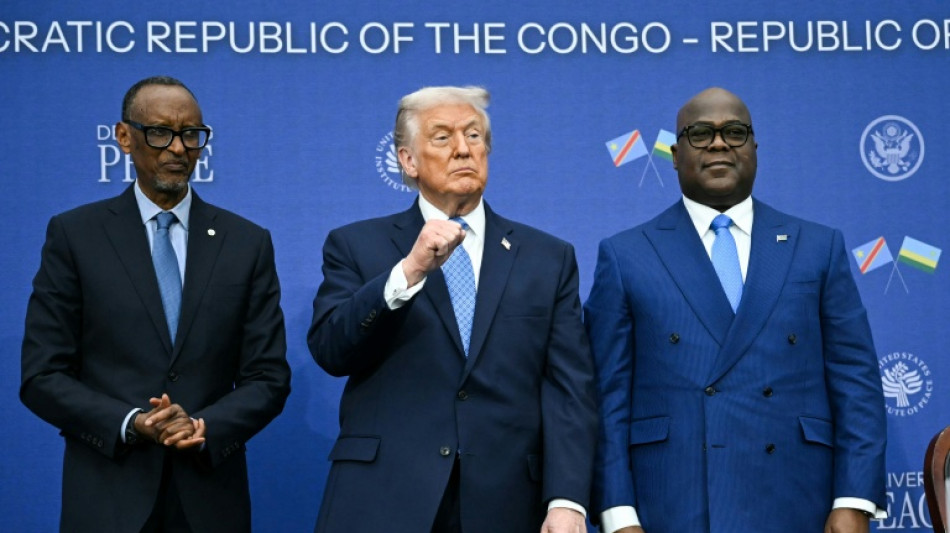
Signing up to DR Congo peace is one thing, delivery another / Photo: ANDREW CABALLERO-REYNOLDS - AFP

 Swiss voters expected to shun stricter neutrality
 Rapper-turned-PM faces first big test after Nepal disaster
 Tuchel seeks tonic to England World Cup 'scar' in Spain showdown
 'Helps me cope': Catholic baptisms rise among French youth

 Colombians in Santa Marta stay inside after violence wracks the city
 Iran airlines cancel flights as US sanctions hit
 Meta launches camera-free AI glasses amid privacy pushback
 Australian PM says OpenAI hacked government health website

 Xi arrives in US to personal Trump welcome
 Morocco elects new parliament amid social frustration, youth discontent
 Scheffler and Burns to face Im and Lee in Presidents Cup opener
 Crushing wins for Lyon and Barca in women's Champions League
 Rio breaks record for rainiest September amid powerful El Nino
 At UN, tech chiefs urge caution in AI development
 Russian strikes kill seven in Ukraine, Zelensky vows winter campaign
 Venezuelan shot by ICE needs urgent medical care, mother tells AFP
 Zelensky says Putin using fighters from 47 countries in Ukraine war
 Klopp calls on Germany to 'rise above ourselves' as new era begins

 Russian strikes kill seven in Ukraine as Russia vows no 'pause' to war

 ArcPoint Expands Globally with Institutional Intelligence Platform for Modern Investors

 Ronaldo focussing on 'present' ahead of Wales test

 Outgoing UN chief makes final climate push at New York summit
 Grief and pain flow at hearing for Canadian suicide poison vendor
 Ireland boss Hallgrimsson says timing of Israel remarks 'not clever'
 Weinstein resentenced to 15 years in prison for 2006 sex assault
Signing an accord is one thing but actual implementation of a peace deal inked Thursday in Washington to end the conflict in eastern Democratic Republic of Congo (DRC) promises to be highly complex amid ongoing intense fighting.
- Transactional diplomacy -
The Washington agreement comprises three components, the first not surprisingly concerning a cessation of hostilities via establishment of a ceasefire and a disarmament programme.
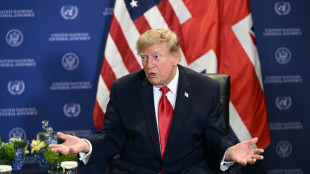
The second component of the text, signed by Congolese President Felix Tshisekedi and Rwandan President Paul Kagame during a ceremony presided over by US President and host Donald Trump, entails a framework for regional economic integration.
Washington is seeking to establish cooperation between Kinshasa and Kigali to trace and clean up the supply chains of critical minerals, notably coltan, cobalt, copper and lithium, to ensure access to what are strategic resources essential to high-tech industries.
The final component concerns the conclusion of bilateral agreements between the United States and the DRC and Rwanda on exploitation of those minerals, which are particularly abundant in the Congolese subsoil -- and which are currently mainly exploited by Chinese companies.
The DRC accounts, for example, for about 76 percent of the cobalt -- a critical element in lithium-ion battery technology -- mined globally last year.
For Trump, the potential financial gain is an obvious attraction.
"Everybody's going to make a lot of money," he said of an agreement that will pave the way for the United States to gain access to critical minerals in both DR Congo and Rwanda.
- Miraculous peace -
The US leader also said of the accord, which had been under negotiation since June, that "I think it's going to be a great miracle."
Even so, Friday saw intense fighting still ongoing in South Kivu province between the anti-DRC government armed group M23, which the UN says is Rwandan-commanded, and a Congolese army supported by pro-Kinshasa militias which are difficult to control.
Previous days had also seen fighting.
"Both sides are exchanging heavy gunfire" on the outskirts of Kamanyola, a Congolese town under M23 control bordering Rwanda and Burundi, according to several local sources contacted by AFP.
"We are still in houses under the beds," lamented Wenceslas Bisimwa, a local civil society representative.
"At the very moment the agreement is being signed, clashes continue on the ground," noted a pessimistic Amos Bisimwa, a civil society representative in Bukavu, South Kivu's provincial capital.
Some 60 Congolese civil society groups meanwhile warned in a joint declaration that the peace deal remains merely "on paper".
Resource-rich eastern DRC has been wracked by conflict for some 30 years but the violence reached new heights with the 2021 resurgence of the M23.
Conflict intensified in late January when the armed group took over two strategic regional towns -- first Goma, then Bukavu.
- Violated ceasefire -
Washington is not starting out from zero with this new accord.
During the more than three decades of successive conflicts, there have been various initiatives to restore peace in eastern DRC. Half a dozen ceasefires and truces have already been signed since 2021, only to be systematically violated thereafter.
Although the Washington agreement has been signed, the Congolese and Rwandan leaders did not go as far as to shake on it Thursday with Kinshasa still making implementation of any peace agreement conditional on the withdrawal of Rwandan troops from its territory.
For its part, Kigali, which has never explicitly acknowledged its presence on Congolese soil, is still demanding the neutralisation in eastern DRC of the Democratic Forces for the Liberation of Rwanda (FDLR), an armed group founded by former Rwandan Hutu officials involved in the 1994 Tutsi genocide.
In addition, the Washington agreement does not include the M23.
Negotiations between Kinshasa and the armed group were conducted simultaneously in Qatar, while a roadmap prior to a peace accord was inked in November.
Both parties also signed a declaration of principle backing a "permanent ceasefire" in Doha in July.
But the Congolese army and the M23 have since accused each other several times of violating this ceasefire.
strs-cld/cpy/cw/giv
T.Resende--PC