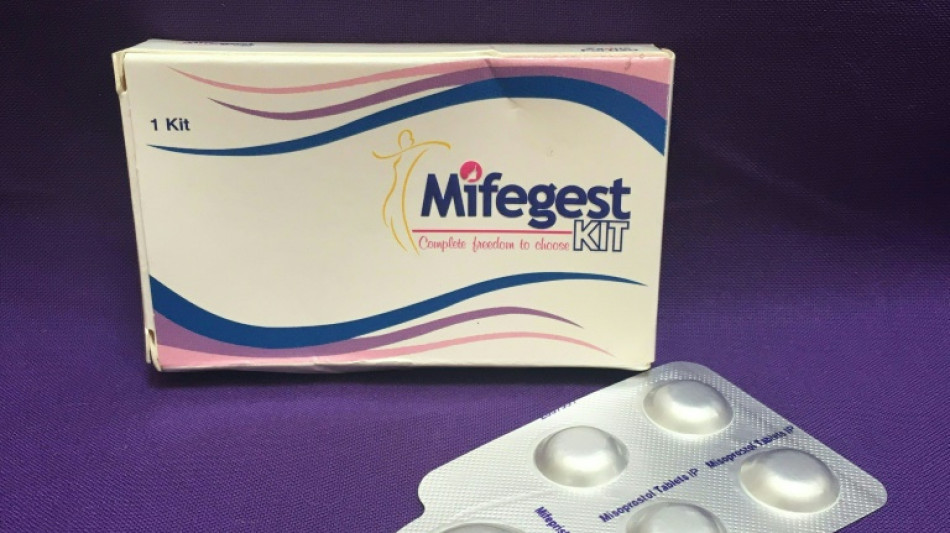
Abortion pill at the center of a US court battle / Photo: Handout - PLAN C/AFP/File

 2 killed, 13 wounded in bus blast near Syrian capital: state media

 All Blacks skipper Taylor cautiously recovering from calf strain

 UN chief denounces Russia, Ukraine for civilian deaths

 UEFA turn up the pressure on Infantino and repeat boycott threat

 Rodri approves Barcelona transfer talks with Man City: Barca source to AFP

 Venezuela unable to tally missing from cataclysmic quakes

 Le Court sprints to stage six Tour de France Femmes win

 Doping body says Parker's positive cocaine test caused by nutritionist

 UEFA says boycott of World Cups stands despite FIFA backdown on private investment

 Rheinmetall sales keep surging despite cancelled naval frigate project

 Pogacar teammate Del Toro gets new UAE deal after Tour podium

 Stocks tread water with earnings, tech in focus

 Inevitable AI Group Raises $6M From Aleph to Launch AI-Native SaaS Companies

 Forlan named new Uruguay head coach

 UEFA chief Ceferin: 'Underdog' leader taking fight to FIFA's Infantino

 Salah completes move to Turkey's Trabzonspor

 UK clears Paramount's takeover of Warner Bros

 North Korea fires ballistic missile: South Korea military

 'Don't have to hide': Thai IDs, legal work give hope to Myanmar refugees

 Stocks mixed with tech firms back under pressure

 How Blundell's old school tactic ended England's 'Bazball' era

 Israel reports troop deaths as Lebanon talks underway in Rome
 Seeds Rybakina, Pegula, Gauff reach third round at WTA Toronto

 Police raid South Korea FA in probe into World Cup coach appointment

 Low water on Germany's Rhine river threatens new blow to economy

A widely used abortion pill is at the center of the latest legal battle in America's ongoing debate over abortion.
The US Supreme Court on Wednesday said that it would weigh in on restrictions imposed by a lower court on the drug mifepristone.
Here is the background on the drug and its use:
- How widespread is abortion pill use? -
According to the Guttmacher Institute, the pill accounted for more than half -- 53 percent -- of the 930,160 abortions documented by the reproductive health research and policy organization in the United States in 2020.
While the number of so-called medication abortions has gone up dramatically in the United States in recent years, it is still not as prevalent as in several European nations.
In France, for example, medication abortions represented 70 percent of the total number of abortions in 2020.
- How does it work? -
The abortion pill is different from the "morning after" pill, which is taken by a woman after sexual intercourse to prevent becoming pregnant.
The abortion pill is taken to induce an abortion once a woman confirms that she is pregnant.
The process in fact involves more than one pill. The first, mifepristone, also known as RU 486, stops a pregnancy from proceeding normally by blocking production of the hormone progesterone.
Another drug, misoprostol, is taken up to 48 hours later and causes cramps, bleeding and the emptying of the uterus.
Abortion pills can be used at home and a medical setting is not required.
- When was the abortion pill approved? -
The US Food and Drug Administration (FDA) gave the green light to mifepristone and misoprostol in 2000 for use up to seven weeks of pregnancy.
It was later approved for use up to 10 weeks of pregnancy, after which a woman would need to undergo an abortion through other means, such as vacuum aspiration.
The average cost of a medication abortion at Planned Parenthood is $580 but it can cost up to $800.
- Is it safe and effective? -
Use of the abortion pill during the specified time period is considered to be safe and effective by medical experts.
Pregnancies are successfully terminated in more than 95 percent of cases where the pill is used, according to studies.
Serious complications -- excessive bleeding, fever, infection or allergic reaction -- which require a medical consult, are rare.
The abortion pill does not work for ectopic pregnancies, which account for around two percent of all pregnancies and occur when a fertilized egg grows outside the uterus.
- Where is the pill available? -
Around 20 US states have banned or severely restricted access to abortions, including medication abortions, since the Supreme Court's ruling in June 2022 overturning the constitutional right to the procedure.
But anti-abortion groups are seeking to restrict access to mifepristone nationwide, including in states where abortion has remained legal.
The case before the Supreme Court concerns limiting the use of mifepristone to the first seven weeks of pregnancy, instead of 10, and blocking it from being distributed by mail.
E.Paulino--PC