'Game changer': Gene therapy offers hope for children born deaf / Photo: Handout - Children's Hospital of Philadelphia/AFP/File

 2 killed, 13 wounded in bus blast near Syrian capital: state media

 All Blacks skipper Taylor cautiously recovering from calf strain

 UN chief denounces Russia, Ukraine for civilian deaths

 UEFA turn up the pressure on Infantino and repeat boycott threat

 Rodri approves Barcelona transfer talks with Man City: Barca source to AFP

 Venezuela unable to tally missing from cataclysmic quakes

 Le Court sprints to stage six Tour de France Femmes win

 Doping body says Parker's positive cocaine test caused by nutritionist

 UEFA says boycott of World Cups stands despite FIFA backdown on private investment

 Rheinmetall sales keep surging despite cancelled naval frigate project

 Pogacar teammate Del Toro gets new UAE deal after Tour podium

 Stocks tread water with earnings, tech in focus

 Inevitable AI Group Raises $6M From Aleph to Launch AI-Native SaaS Companies

 Forlan named new Uruguay head coach

 UEFA chief Ceferin: 'Underdog' leader taking fight to FIFA's Infantino

 Salah completes move to Turkey's Trabzonspor

 UK clears Paramount's takeover of Warner Bros

 North Korea fires ballistic missile: South Korea military

 'Don't have to hide': Thai IDs, legal work give hope to Myanmar refugees

 Stocks mixed with tech firms back under pressure

 How Blundell's old school tactic ended England's 'Bazball' era

 Israel reports troop deaths as Lebanon talks underway in Rome

 Seeds Rybakina, Pegula, Gauff reach third round at WTA Toronto

 Police raid South Korea FA in probe into World Cup coach appointment

 Low water on Germany's Rhine river threatens new blow to economy

A gene therapy that has allowed several children born deaf to hear for the first time is being hailed as a "game changer" that raises hopes of the first new treatment for hereditary deafness in decades.
Several medical teams around the world are trialling the procedure, which focuses on a rare genetic mutation that affects only a small number of the 26 million people with congenital deafness globally.
But several success stories announced this week are already being seen as a turning point.
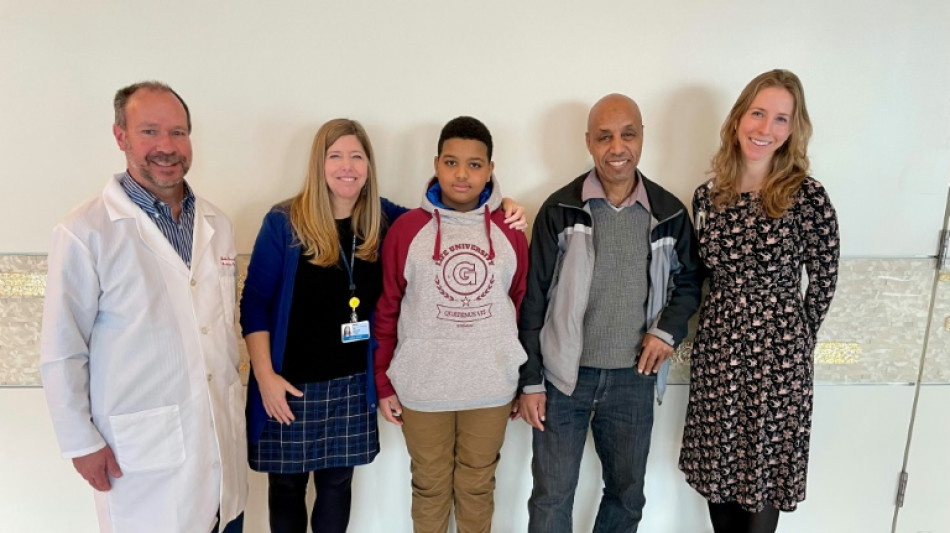
On Tuesday, the Children's Hospital of Philadelphia revealed that 11-year-old Aissam Dam, who was born deaf, was now "literally hearing sound for the first time in his life".
Aissam still has mild-to-moderate hearing loss, and may never learn to talk because the brain's window for acquiring speech closes around the age of five.
But a trial in China, the results of which were announced in The Lancet journal on Thursday, tested a similar treatment on six younger children.
Five gained the ability to hear, according to the findings of the trial that started in 2022, making it the first to have tested the gene therapy on humans.
Some of the children were already able to speak thanks to a cochlear implant -- which they now no longer need, study co-author Zheng-Yi Chen of the Massachusetts Eye and Ear hospital told AFP.
But one, a baby only a year old, had never been able to communicate verbally, Chen said.
Chen said that after the treatment, when the mother asked the baby "who am I?", the baby responded: "Mama."
When asked what a chicken sounds like, the baby responded: "Coo-coo."
"Everyone just cried with joy, it's really amazing," said Chen, adding that the baby was expected to grow up speaking normally.
Not since cochlear implants were invented 60 years has there been such an advance, Chen said, adding that the therapy "symbolises a new era in the fight against all types of hearing loss".
- How does it work? -
For now, the trials in China, the United States and another announced in France this week all use a similar technique to focus on people born with a mutation of the OTOF gene.
This defect means they can no longer produce the protein otoferlin, which is needed for hair cells in the inner ear to convert sound vibrations into electrical signals that can be sent to the brain.
The treatment involves injecting a harmless virus into the inner ear that smuggles in a working version of the OTOF gene, restoring hearing.
The French trial will focus on babies aged 12-31 months, in the hopes it can "enable the acquisition of language", said Nawal Ouzren, CEO of the firm Sensorion developing the treatment.
Natalie Loundon, a French doctor and hearing loss expert, called the technique "a game-changer, a technological advance that will revolutionise therapeutic care".
"The idea is to be able to offer this treatment to children rather than an implant, which is not always received well," she told AFP.
For the China-based trial, the researchers will continue to study the participants to find out if their improved hearing lasts.
Chen estimated that the treatment tested in that trial could be ready to apply for regulatory approval within three to five years.
- Targeting the other genes -
But this particular treatment will only help a fraction of those born deaf.
Around one in every 1,000 children are born deaf due to gene defects, but a lack of otoferlin is the cause of only around three percent of those cases.
More than 150 other genes have been discovered that trigger genetic hearing loss.
But Chen had some good news.
So far, the otoferlin treatment seems to work just as well in humans as it did in during trials on mice -- which is not always the case for such research.
Trials on mice targeting other gene defects that cause hearing loss have also been successful, Chen said.
Researchers therefore hope this first treatment opens the door to others.
France's Pasteur Institute, which pioneered the research on otoferlin, and Sensorion are already working on another therapy that focuses on a gene whose mutations are responsible for the most common forms of hereditary deafness.
P.Cavaco--PC