Arab Israelis flock to West Bank to choose babies' sex

 Drones hit Moscow as Russians go to the polls

 New England boss Fleming says 'wrong' to ask Stokes to end retirement

 Germans vote in elections threatening fresh blow to Merz

 US fears rapid escalation in Mideast after Houthis attack Riyadh

 Japan triathlete Hojo wins first gold of Asian Games

 IOC president impressed by 'beautiful' Asian Games wooden huts

 First Asian Games gold goes to Japan as China's 13-year-old Yu lights up pool

 Data centre command hub keeps AI up and running

 Pope Leo in France: the issues on the table

 Packing for a pope: behind the scenes on foreign trips

 Republicans find transgender issues a powerful political weapon in midterm campaigning

 German state elections threaten new shock waves for Merz

 Chile's Bachelet quits race to be next UN chief

 Raphinha treble fires perfect Barca to win at Sevilla

 Thiam makes winning heptathlon return at Decastar meet

 Czechs beat USA to qualify for Davis Cup finals

 Dortmund sink Stuttgart to climb to Bundesliga summit

 Trump says will not tolerate attempts to slow AI growth

 'It has to stop': runners protest women's murders in S.Africa district

 Fire erupts near Riyadh airport as Houthis claim strikes

 Cuba works to restore power after another blackout

 England thrash Sri Lanka again to return to top of T20 rankings

 Arsenal thrashed by Brighton, sorry Spurs lose again

 South Korea, Austria qualify for Davis Cup finals

 Seare shocks Ingebrigtsen to win world 5km gold

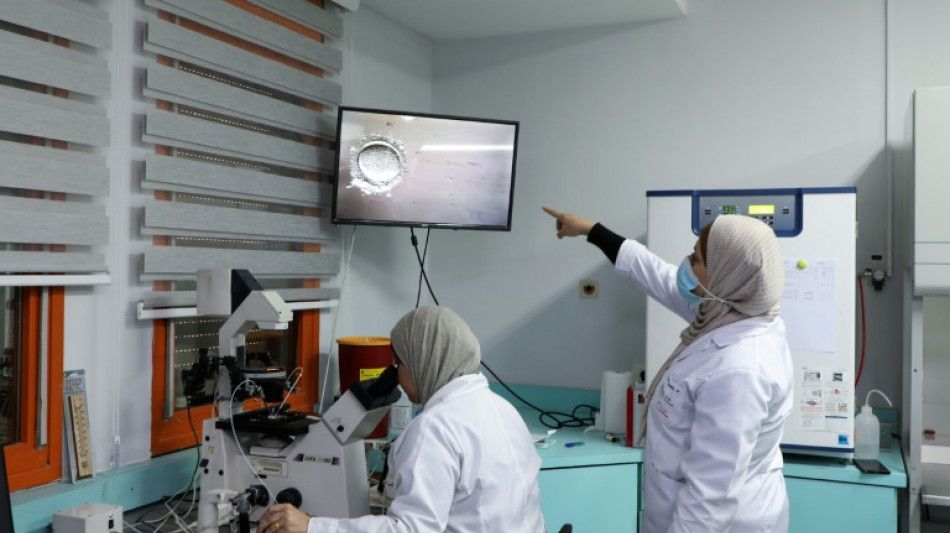
Palestinian fertility clinics in the West Bank are a magnet for would-be Arab Israeli parents seeking boys -- even when risky procedures can endanger the lives of both mother and child.
Yasmine and Jacki, a couple from Israel, have dreamed of having a boy.
Israeli laws strictly regulate selecting a child's sex. So the couple drove three hours from their home in the suburbs of Jerusalem to a clinic in Nablus in the occupied West Bank.
In the waiting room of the Dima Center, Yasmine, 27, glanced nervously at baby portraits on the wall, momentoes from grateful families who successfully conceived through the clinic's in-vitro fertilisation (IVF) programme.
British-trained clinic director Amani Marmash, estimated she holds about 20 consultations a day, half with Palestinians from the West Bank.
The other half are, like Yasmine, Palestinian citizens of Israel, whose forebears remained in what became Israel after 1948, while others fled or were driven from their homes.
Doctors said that most of their patients sought boys to carry on the family name and provide financial support.
"We are looking for a brother for our two daughters," said Jacki, 34. Both he and his wife provided pseudonyms because the subject of IVF remains taboo.
Israel has the highest rate of IVF per capita in the world and offers the treatment free of charge to women citizens up to the age of 45. Women undergoing IVF take hormones before having eggs surgically removed and fertilised outside the womb. The resulting embryos are then implanted in the uterus.
In Israel, as in many other countries, the process is strictly regulated. Israeli women must have had four daughters in order to implant only male embryos.
In the occupied West Bank, "we are barely asked anything," says Yasmine.
- Three to five embryos at a time -
On its Facebook page, the Dima Center highlights a 99.9 percent chance of success in gender selection, without saying that the overall success rate of conception by IVF is much lower.
"Select your baby's gender with the Dima Center and, God willing, your family will be completed with a boy and a girl," reads one post.
IVF has a 60 to 65 percent success rate, in the best cases, Marmash told AFP.
To make up for this, two to three "embryos are transferred into the uterus", said doctor Salam Atabeh, who also works at the clinic.
This practice contradicts international recommendations for just one or two embryos to be implanted, with the exception of three in women aged 40 and older.
A 2019 report on private clinics in the West Bank by the UN Population Fund (UNFPA) found doctors implant three to five embryos in 70 percent of cases, a practice that presents health risks for both mother and child.
Yasmine chose to implant three embryos to lift her chances after a first round failed.
Should the second attempt fail too, Yasmine said she would not hesitate to try a third time.
The operation can cost between 10,000 and 15,000 shekels (2,700 and 4,100 euros), a fortune for many Palestinians. The high cost encourages them to maximise the chances of pregnancy with each attempt.
- 'It's business' -
Dr. Atabeh said he takes care to inform his patients of the risks: ovarian hyperstimulation, premature labour, multiple births, as well as potential dangers for the child.
One gynaecologist told AFP she sees a dozen patients a month in an Israeli hospital for complications related to IVF procedures performed in the West Bank.
Although rare, ovarian hyperstimulation can lead to hospitalisation of the patient for breathing difficulties, nausea or kidney failure, the doctor said, speaking on condition of anonymity.
And after a multiple birth pregnancy, common when more than two embryos are transferred, newborns can spend weeks in intensive care.
"Some babies are handicapped for their whole lives," she said, citing blindness, deafness and flaws in brain development.
"When women come back with triplets and complications, Israel pays for it, not the clinics in the West Bank," she said.
In Ramallah, Hadeel Masri, who heads the women's health and gynaecology unit at the Palestinian health ministry, said the cash-strapped Palestinian Authority's inability to fund a public IVF option had left the sector entirely in private hands.
"We're just exposing women to these risks," she said.
Bassem Abu Hamad, professor of public health at Al-Quds University and a co-author of the UNFPA report said the clinics implant up to five embryos because they "need better results to make more money."
"It's business," he said.
S.Caetano--PC