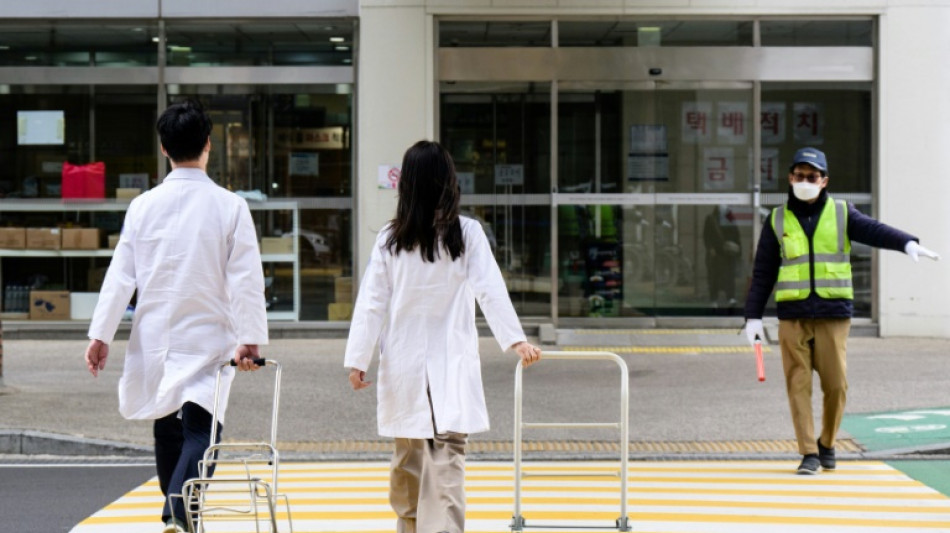
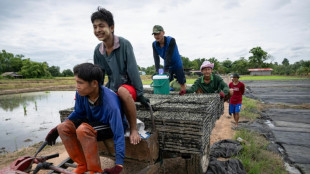
Quit medicine for farming? South Korean doctors speak out / Photo: Anthony WALLACE - AFP

 British Grand Prix stays on MotoGP calendar until 2028

 Britain's EasyJet flies into US hands as takeover confirmed

 Real Madrid sign Ivory Coast winger Yan Diomande

 How online disinformation fuelled Ceuta migrant surge
 Inevitable AI Group Raises $6M From Aleph to Launch AI-Native SaaS Companies
 Suspected Ebola death on boat heading for DR Congo capital

 England selector North not 'hung up' on Stokes absence
 UK Anti-Doping confirm former world champ Parker's ban lifted

 French winemakers dread 'smoky taste' after wildfires
 Stocks diverge with earnings, tech in focus
 England recall batsman Lawrence for Pakistan series
 Siemens shares plunge on disappointing guidance raise
 New Australia coach Kiss gives Japan starts to Ross, Amatosero
 'Stretch our money': Romanians face highest EU inflation
 Iran says close to Hormuz plan with Oman, but reopening depends on US
 Messi scores twice to set Leagues Cup record in Miami victory
 Asian stocks mostly down with tech firms back under pressure

 Back to the future as world champion Springboks host All Blacks
 India youth protests highlight mistrust in 'lapdog' media
 Pacific islands alarmed by Trump-backed push for deep-sea mining
 Erratic rains dictate menu at three-star Michelin restaurant in Brazil
 Zverev, Auger-Aliassime and Medvedev exit Montreal Masters

 Loar Holdings Inc. Reports Q2 2026 Record Results and Upward Revision to 2026 Outlook
 Embattled Infantino sees minnows Malawi reach WAFCON quarter-finals
 Seeds Rybakina, Pegula and Gauff advance at WTA Toronto event
From the outside, Seoul's main hospitals seem unchanged: ambulances pull up, patients walk in, staff in white coats walk around purposefully. But for weeks, South Korean healthcare has been struggling.
Surgeries have been cancelled, crucial chemotherapy sessions delayed, and it is nearly impossible to get a walk-in appointment since thousands of junior doctors walked off the job on February 20 in a standoff with the government over medical training reforms.
AFP spoke with those involved:
- Trainee doctors -
The medical reforms, which seek to train up more doctors, plus the government's "draconian" reaction to doctors' opposition is, junior medics say, enough to drive some of them out of the profession for good.
"After this situation is over, I plan to go to a rural area in Yeongdong, North Chungcheong Province, to cultivate grapes," Ryu Ok Hada, a trainee doctor who resigned, said.
Other doctors are thinking: "I could live a happier life by going to the United States and running a food truck. I could make people happy without feeling this level of humiliation," he told reporters.
Junior doctors say they are overworked and underpaid, and argue the reforms will erode service quality while doing nothing to fix core issues in healthcare provision.
"Even if a large number of doctors are produced, if they do not work in essential medical areas and instead move to private clinics or other fields, it does not align with the (government's) initial purpose," Park Dan, the head of the Korean Intern Resident Association, told local media.
- Patients -
Due to existing shortages of doctors and a concentration of medical professionals in the capital Seoul, patients like Jang Sung-ja, who has ovarian cancer, already have to travel hundreds of kilometers for treatment.
But since the doctors went on strike, her treatment has been paused.
"I live in Daegu and the hospital is in Seoul, and I'm just waiting to hear back from them after being informed that the session has been postponed," she said.
"The hospital doesn't really answer when you call them and my children are very worried about me."
Delays and a lack of clarity around treatment plans are increasingly common for patients with major illnesses, which patient advocacy group the Korea Severe Disease Association, says is unacceptable.
"Patients are still missing out on the golden time for treatment," they said in a statement, blaming both striking doctors and the government for the dire situation.
- The government -
For years, successive South Korean governments have attempted to increase medical school enrollment figures and create more doctors to ease shortages, but such reforms have always been abandoned in the face of staunch opposition from medics.
This time, the government is standing by its plan, saying that without rapid reforms the country will not have enough doctors to deal with its rapidly ageing population.
The reforms "cannot and should not be the subject of negotiation or compromise," President Yoon Suk Yeol said.
The plan will see 2,000 more students admitted to medical schools annually from next year to address what Seoul says is one of the lowest doctor-to-population ratios among developed nations.
Doctors who refuse to return to work face legal action, including the suspension of their medical licenses.
- Senior doctors -
Senior doctors have not joined the strikes -- but many have publicly sympathised with their junior colleague's plight, claiming the government training reforms will not do much to fix broader issues.
"Who would benefit the most when there is an excess of trainees in a field? It would be the directors of general hospitals, wouldn't it?" said Chung Jin-haeng, a professor at Seoul National University's college of medicine.
"With an abundance of inexpensive medical personnel, they can assign all of the night shifts to them," she told local media.
- Activists -
South Korea has a government-funded health insurance system which ensures no one will be denied life-saving treatment.
But activists say inequalities still exist.
The healthcare system's biggest problem is that most doctors are concentrated in Seoul, leading to access issues in rural areas.
The private sector also dominates provision, with state-run institutions accounting for just five percent of the total number of hospitals nationwide.
"Regardless of who wins this battle between doctors and the government, neither party has the ability to establish a truly essential alternative -- an enhanced public healthcare system," healthcare activist Yi Seo-young told AFP.
A.Santos--PC