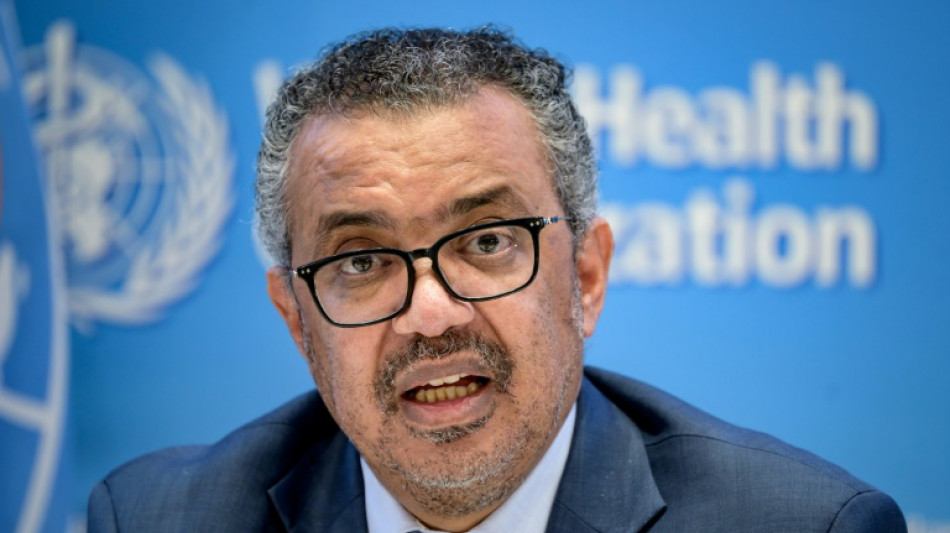
World treats crises affecting black, white lives unequally: WHO chief / Photo: Fabrice COFFRINI - AFP/File

 Drones hit Moscow as Russians go to the polls

 New England boss Fleming says 'wrong' to ask Stokes to end retirement

 Germans vote in elections threatening fresh blow to Merz

 US fears rapid escalation in Mideast after Houthis attack Riyadh

 Japan triathlete Hojo wins first gold of Asian Games

 IOC president impressed by 'beautiful' Asian Games wooden huts

 First Asian Games gold goes to Japan as China's 13-year-old Yu lights up pool

 Data centre command hub keeps AI up and running

 Pope Leo in France: the issues on the table

 Packing for a pope: behind the scenes on foreign trips

 Republicans find transgender issues a powerful political weapon in midterm campaigning

 German state elections threaten new shock waves for Merz

 Chile's Bachelet quits race to be next UN chief

 Raphinha treble fires perfect Barca to win at Sevilla

 Thiam makes winning heptathlon return at Decastar meet

 Czechs beat USA to qualify for Davis Cup finals

 Dortmund sink Stuttgart to climb to Bundesliga summit

 Trump says will not tolerate attempts to slow AI growth

 'It has to stop': runners protest women's murders in S.Africa district

 Fire erupts near Riyadh airport as Houthis claim strikes

 Cuba works to restore power after another blackout

 England thrash Sri Lanka again to return to top of T20 rankings

 Arsenal thrashed by Brighton, sorry Spurs lose again

 South Korea, Austria qualify for Davis Cup finals

 Seare shocks Ingebrigtsen to win world 5km gold
The WHO chief said Wednesday that the world was treating humanitarian crises affecting black and white lives unequally, with only a "fraction" of the attention on Ukraine given elsewhere.
World Health Organization's director-general Tedros Adhanom Ghebreyesus said the emergencies happening in other parts of the world were not being taken as seriously and hoped the international community "comes back to its senses".
"I don't know if the world really gives equal attention to black and white lives," Tedros told a news conference.
"The whole attention to Ukraine is very important of course, because it impacts the whole world.
"But even a fraction of it is not being given to Tigray, Yemen, Afghanistan and Syria and the rest. A fraction.
"I need to be blunt and honest that the world is not treating the human race the same way. Some are more equal than others. And when I say this, it pains me. Because I see it. Very difficult to accept but it's happening."
- Tigray siege -
Tedros, who is himself from Tigray, said the United Nations had determined that 100 trucks per day of life-saving humanitarian supplies needed to be going into the besieged northern region of Ethiopia.
The country's former health and foreign minister said that since a truce was declared, at least 2,000 trucks should have gone in, but only 20 have done so thus far.
Tedros said he was worried that the 20 trucks going in could be just a "diplomatic manoeuvre" on the part of the government in Addis Ababa.
"In effect, the siege by the Ethiopian and Eritrean forces continues," he said.
"To avert the humanitarian calamity and hundreds of thousands more people from dying, we need unfettered humanitarian access from those reinforcing the siege."
But Tedros said global attention was simply not being placed on such humanitarian crises.
"I hope the world comes back to its senses and treats all human life equally," he said.
"What is happening in Ethiopia is a tragic situation. People are being burned alive... because of their ethnicity.... Without any crime.
"So we need to balance. We need to take every life seriously because every life is precious."
- World crises -
The UN says hundreds of thousands of people are at risk of starvation in Tigray, where people have for months also faced fuel shortages and a lack of basic services such as electricity, telecommunications, internet and banking.
Across northern Ethiopia, the 17-month conflict has driven more than two million people from their homes, according to the UN, and left more than nine million people in need of food aid.
Thursday marks 50 days since Russia invaded Ukraine. More than a quarter of the Ukrainian population has been forced from their homes.
Moscow -- already accused by the West of widespread atrocities against civilians -- appears to be readying a massive offensive across Ukraine's eastern Donbas region.
The UN calls Yemen the world's worst humanitarian crisis.
The UN is also seeking its biggest-ever single-country appeal for funds for Afghanistan, which is on the brink of economic collapse, with more than 24 million people needing humanitarian assistance to survive.
Civil war erupted in Syria in 2011 after the violent repression of protests demanding regime change.
Around half a million people have been killed and millions have been displaced in the conflict, which has battered the country's economy.
T.Resende--PC