Raw cow's milk infected with bird flu sickens mice, shows study / Photo: JUSTIN SULLIVAN - GETTY IMAGES NORTH AMERICA/AFP/File

 US warns of rapid escalation in Mideast war

 Iran 'put hearts on the court' to win Asian Games basketball bronze

 School girl Yu helps China dominate in Asian Games swimming openers

 Myanmar win first Asian Games teqball gold as Spain great Puyol watches

 China's 13-year-old Yu scorches to first major gold at Asian Games

 Russians vote on last day of parliamentary elections

 Hong Kong pays final respects to former city leader Tung

 Typhoon put people off Asian Games opening ceremony, official says

 China's 13-year-old Yu cruises as Asian Games swimming begins

 AI 'warning shots' focus Beijing on national security risks

 Philippine tribe in limbo over US-led tech hub

 Leo XIV, first US pope transcends his restrained style

 Singer Ed Sheeran says Gaza situation 'unjustifiable' following controversy

 In 'Tenzing', a Sherpa mountaineer gets his due

 Ed Sheeran set to return to stage after Palestinian controversy

 Toulouse edge Vannes, Lyon beat Pau to take Top 14 summit

 Germans arrested for Louvre stunt in Mona Lisa hall

 Saudi-led coalition says Houthis fired ballistic missile at Riyadh

 France's debt climbs to highest since 1978: ministry

 McIlroy two shots off the lead at Wentworth after eagle on 18

 Martinez brace saves Inter in Serie A top-two clash with Roma

 Rosenior abused but guides Paris FC past old club Strasbourg

 Seven-try Lyon beat Pau, climb to Top 14 summit

 Brighton defeat a 'big lesson' against complacency for Arsenal, says Arteta

 Thousands protest inaction over climate crisis in Switzerland

Mice fed raw cow's milk infected with bird flu experienced high levels of the virus in their lungs, according to a study published Friday that suggests risk to humans who consume the drink.
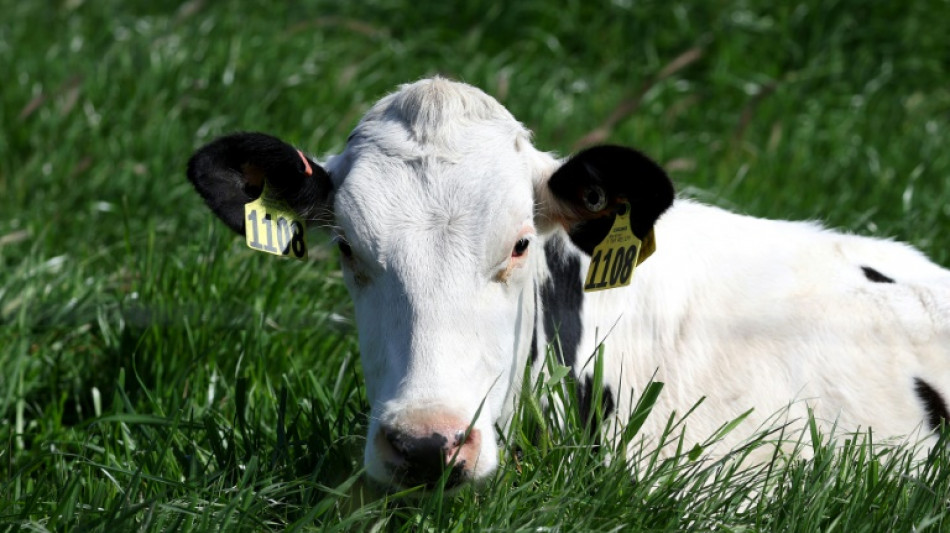
Over the past few years, a highly pathogenic avian influenza virus called HPAI H5N1 has spread to infect more than 50 animal species, including, from March, dairy cattle in the United States.
To date, 52 herds across the country have been affected, with two human infections involving farm workers who developed mild symptoms, including pink eye.
In the new study, published in the New England Journal of Medicine, researchers from the University of Wisconsin-Madison and Texas A&M fed droplets of raw milk from infected cattle to five mice.
The rodents developed signs of illness, including lethargy, and were then euthanized four days later to study their organs.
The researchers found high levels of virus in their nasal passages, trachea and lungs, and moderate-to-low levels of virus in other organs.
"An important consideration is that the consumption of raw, unpasteurized milk is becoming increasingly popular," said Rowland Kao, a professor of veterinary epidemiology at the University of Edinburgh, who was not involved in the research.
Raw milk laws vary by state in the US, with some permitting its sale in retail stores, others only allowing it to be sold on the farm it was produced, and others still prohibiting it altogether.
An official 2019 survey found that 4.4 percent of adults said they had consumed raw milk in the past year. Such consumers tended to be younger and lived in rural areas.
"While this study shows that mice can become systemically infected due to ingesting infected milk, this does not prove that the same is true for humans, though it does increase the possibility," added Kao.
In addition to the mice tests, the research confirmed that heating raw milk to high temperatures destroys nearly all virus after a few seconds, and completely destroys the pathogen after several minutes.
A recent nationwide survey of pasteurized milk found all samples were negative for viable virus, though inactivated virus, no longer capable of spreading or infecting a host, was found in about 20 percent of retail samples.
Finally, the researchers tested the effect of storing infected raw milk at fridge temperatures and found that the virus levels declined only slightly after five weeks, indicating that refrigeration alone is not sufficient to make raw milk safe.
L.Henrique--PC