Japan biochemist who discovered statins, Akira Endo, dies / Photo: Paul J. RICHARDS - AFP

 US warns of rapid escalation in Mideast war
 Iran 'put hearts on the court' to win Asian Games basketball bronze
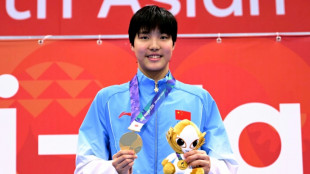
 School girl Yu helps China dominate in Asian Games swimming openers

 Myanmar win first Asian Games teqball gold as Spain great Puyol watches

 China's 13-year-old Yu scorches to first major gold at Asian Games

 Russians vote on last day of parliamentary elections

 Hong Kong pays final respects to former city leader Tung

 Typhoon put people off Asian Games opening ceremony, official says

 China's 13-year-old Yu cruises as Asian Games swimming begins

 AI 'warning shots' focus Beijing on national security risks

 Philippine tribe in limbo over US-led tech hub

 Leo XIV, first US pope transcends his restrained style

 Singer Ed Sheeran says Gaza situation 'unjustifiable' following controversy

 In 'Tenzing', a Sherpa mountaineer gets his due

 Ed Sheeran set to return to stage after Palestinian controversy

 Toulouse edge Vannes, Lyon beat Pau to take Top 14 summit

 Germans arrested for Louvre stunt in Mona Lisa hall

 Saudi-led coalition says Houthis fired ballistic missile at Riyadh

 France's debt climbs to highest since 1978: ministry

 McIlroy two shots off the lead at Wentworth after eagle on 18

 Martinez brace saves Inter in Serie A top-two clash with Roma

 Rosenior abused but guides Paris FC past old club Strasbourg

 Seven-try Lyon beat Pau, climb to Top 14 summit

 Brighton defeat a 'big lesson' against complacency for Arsenal, says Arteta

 Thousands protest inaction over climate crisis in Switzerland

Japanese biochemist Akira Endo, who discovered cholesterol-lowering statins, has died aged 90, his former student and colleague said on Tuesday.
Statins, which can prevent heart attacks or strokes, are among the most commonly prescribed drugs worldwide.
Keiji Hasumi, a professor who was a long-time associate of Endo, said the scientist had died on June 5.
"His work was truly great. Statins didn't exist before Endo," Hasumi told AFP. "It has the same value and impact as the discovery of penicillin."
Johns Hopkins Medicine says more than 200 million people take statins. Studies say the global market for them was worth $15 billion in 2023 and is expected to grow.
Endo experimented on thousands of microbes to reach his 1973 discovery of mevastatin -- an agent derived from penicillin that reduces so-called "bad" cholesterol in the blood.
The researcher "was a tough, strict person. He was insightful and perceptive," and "able to see the hidden essence of things", Hasumi said.
Endo was born in 1933 to a farming family in rural northern Japan.
His ambitions began early thanks to his grandfather, who was interested in medicine and became a "great home teacher", Endo said in a 2008 autobiographical essay.
As a student, Endo became interested in antibiotics like penicillin, "deeply impressed" by how many lives they had saved, his essay in the journal Nature Medicine said.
Endo carried out research in New York in the late 1960s, when coronary heart disease was the main cause of US deaths.
"I often saw ambulances coming to take elderly people who had suffered a heart attack to hospital", which "made me realise the importance of developing a cholesterol-lowering drug", he said.
Endo worked at the Tokyo University of Agriculture and Technology, which issued a statement expressing condolences over his death, and at Japanese drugmaker Sankyo, now a part of Daiichi-Sankyo.
He spent two years testing 6,000 strains of microbe in the search for a new drug that could help achieve his goal before finally finding mevastatin.
Conflicting reports on the benefits and potential harms of statins in recent years have prompted some people prescribed the drugs to stop taking them.
"Are statins safe? For most people, the answer is a resounding yes, according to a 2014 Johns Hopkins meta-analysis of 20 years worth of published research," the US university says.
Endo was a strong candidate for a Nobel Prize, but never won. In a report on his death, Japanese broadcaster NHK noted Endo had received other accolades, including being honoured as a Person of Cultural Merit by the government in 2011.
His discovery "was the result of many twists and turns", Hasumi said.
"He reached his goal by overcoming so many challenges, without which medicines cannot be created, I think I remember him saying."
A.S.Diogo--PC