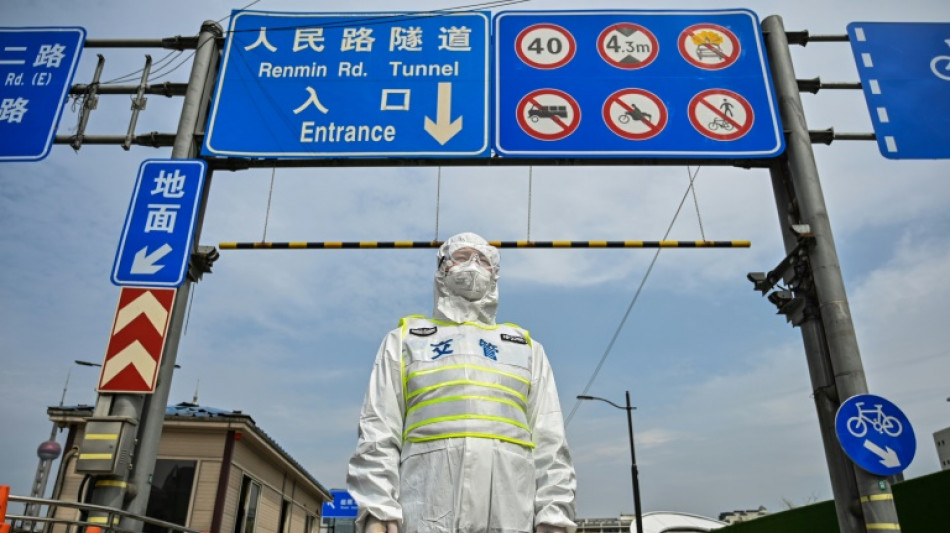
China's pursuit of zero Covid driving expats away / Photo: Hector RETAMAL - AFP

 Drones hit Moscow as Russians go to the polls

 New England boss Fleming says 'wrong' to ask Stokes to end retirement

 Germans vote in elections threatening fresh blow to Merz

 US fears rapid escalation in Mideast after Houthis attack Riyadh

 Japan triathlete Hojo wins first gold of Asian Games

 IOC president impressed by 'beautiful' Asian Games wooden huts

 First Asian Games gold goes to Japan as China's 13-year-old Yu lights up pool

 Data centre command hub keeps AI up and running

 Pope Leo in France: the issues on the table

 Packing for a pope: behind the scenes on foreign trips

 Republicans find transgender issues a powerful political weapon in midterm campaigning

 German state elections threaten new shock waves for Merz

 Chile's Bachelet quits race to be next UN chief

 Raphinha treble fires perfect Barca to win at Sevilla

 Thiam makes winning heptathlon return at Decastar meet

 Czechs beat USA to qualify for Davis Cup finals

 Dortmund sink Stuttgart to climb to Bundesliga summit

 Trump says will not tolerate attempts to slow AI growth

 'It has to stop': runners protest women's murders in S.Africa district

 Fire erupts near Riyadh airport as Houthis claim strikes

 Cuba works to restore power after another blackout

 England thrash Sri Lanka again to return to top of T20 rankings

 Arsenal thrashed by Brighton, sorry Spurs lose again

 South Korea, Austria qualify for Davis Cup finals

 Seare shocks Ingebrigtsen to win world 5km gold

Colin Chan spent more than a decade building a life in China, but enduring ever-changing Covid rules and five weeks of quarantine convinced the Singaporean that it was time to leave.
China's reluctance to budge on its strict zero-Covid policy is hastening the departure of expats from the world's second-largest economy, with business groups warning that unpredictable regulations were driving foreigners away.
When Chan returned to China from Singapore at the end of February, he was prepared for a long quarantine in Shanghai before he could head home to Beijing -- direct international flights to the capital are vastly reduced because of Covid.
But within days of reaching Beijing, he was told to stay at home for another two weeks, with a device installed on his door that sounded an alarm if it was opened.
"Restrictions seemed to be changing all the time," said Chan, who left China this month after completing these back-to-back quarantines.
He is among a wave of expats who have left, or are considering leaving China.
Over 80 percent of companies surveyed by the American Chamber of Commerce last month said China's virus policies had hit their ability to attract or retain foreign staff.
And the British Chamber said Wednesday that business risk was "at the highest level seen since 2020" when the virus was spreading rapidly in China during the early phase of the pandemic.
China's strategy of snap lockdowns, strict travel curbs and lengthy quarantines largely kept the virus at bay in the first two years of the Covid crisis, and allowed people to maintain a semblance of normal life.
But the fast-spreading Omicron variant shook that approach, as authorities scrambled to contain outbreaks with a rapidly changing mosaic of curbs that tested even the most seasoned expats' resolve.
More than a third of the firms surveyed by the American Chamber in March said their foreign staff had been reduced by at least 10 percent because of Covid curbs since the beginning of the pandemic.
- 'Crazy direction' -
Nowhere is this more evident than in Shanghai, whose 25 million residents are seething under a weeks-long lockdown that has seen food shortages, scattered protests and a stream of online vitriol.
The cosmopolitan economic powerhouse boasts a large overseas community of around 164,000 according to census data released last year. They work in a range of industries, from tech and finance to teachers at international schools.
But there are signs that even the hardiest of them may decide to leave.
One longtime British resident in Shanghai told AFP they planned to repatriate over worries that the latest lockdown marked the beginning of a "really crazy direction" in virus policies.
"Zero-Covid is like a belief now, a really fervent belief," they added, requesting anonymity as they had not informed their employer of their plans.
"It doesn't really matter that Covid's not that serious (now)... We have to get to zero."
Lockdown measures "will leave their marks in the long run", cautioned Jens Hildebrandt of the German Chamber of Commerce's North China branch.
Already, tight entry controls mean some multinationals have struggled for months to bring in new specialists as others leave.
This is also adding to supply chain struggles.
In a recent letter to China's State Council seen by AFP, the European Chamber warned that Omicron poses challenges that seemingly cannot be overcome with "the old toolbox of mass testing and isolation".
"The social and economic costs... to achieve this are rapidly mounting," the letter said.
"This is also having an unfortunate impact on China's image to the rest of the world."
Representatives of foreign business groups met with Commerce Minister Wang Wentao last week to raise problems that companies are facing, but it remains unclear if a swift easing of measures is forthcoming.
- 'Complete disaster' -
Chinese President Xi Jinping told the Davos-like Boao Forum on Thursday that "arduous efforts" are still needed to control the virus.
The Communist Party says its pandemic response has helped avert the public health crises seen in other countries.
But it has also left many exhausted.
Shanghai's lockdown has been a "complete disaster", said Rory Grimes, 40, who has lived in China for nine years.
The British education consultant has been sleeping on a makeshift bed for days since testing positive for the virus.
He is staying in a school classroom that has been converted into a mass quarantine facility.
"You don't feel like you're coming somewhere to be treated... There are no medical facilities here," he told AFP.
"It's about (Covid) targets rather than about logic anymore."
V.Fontes--PC