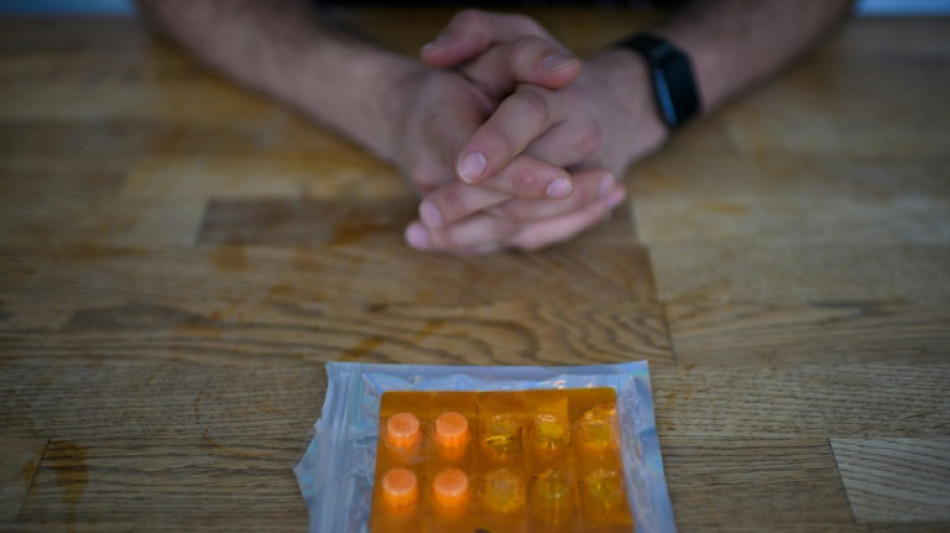
Ketamine pill treats depression without psychedelic effects: study / Photo: Ed JONES - AFP/File

 US warns of rapid escalation in Mideast war

 Iran 'put hearts on the court' to win Asian Games basketball bronze

 School girl Yu helps China dominate in Asian Games swimming openers

 Myanmar win first Asian Games teqball gold as Spain great Puyol watches

 China's 13-year-old Yu scorches to first major gold at Asian Games

 Russians vote on last day of parliamentary elections

 Hong Kong pays final respects to former city leader Tung

 Typhoon put people off Asian Games opening ceremony, official says

 China's 13-year-old Yu cruises as Asian Games swimming begins

 AI 'warning shots' focus Beijing on national security risks

 Philippine tribe in limbo over US-led tech hub

 Leo XIV, first US pope transcends his restrained style

 Singer Ed Sheeran says Gaza situation 'unjustifiable' following controversy

 In 'Tenzing', a Sherpa mountaineer gets his due

 Ed Sheeran set to return to stage after Palestinian controversy

 Toulouse edge Vannes, Lyon beat Pau to take Top 14 summit

 Germans arrested for Louvre stunt in Mona Lisa hall

 Saudi-led coalition says Houthis fired ballistic missile at Riyadh

 France's debt climbs to highest since 1978: ministry

 McIlroy two shots off the lead at Wentworth after eagle on 18

 Martinez brace saves Inter in Serie A top-two clash with Roma

 Rosenior abused but guides Paris FC past old club Strasbourg

 Seven-try Lyon beat Pau, climb to Top 14 summit

 Brighton defeat a 'big lesson' against complacency for Arsenal, says Arteta

 Thousands protest inaction over climate crisis in Switzerland

A new pill that slowly releases ketamine could treat people with severe depression without giving them the psychedelic side effects of the often-misused drug, early trial results suggested on Monday.
First developed in the 1960s as an anaesthetic, ketamine's hallucinogenic and dissociative effects led to it becoming a party drug dubbed "Special K".
However, mounting research has demonstrated that ketamine is effective for the roughly quarter of people suffering from depression who see little benefit from common anti-depressant drugs.
In many countries, ketamine has been prescribed for depression for years.
US billionaire Elon Musk told CNN in March that he regularly uses a small amount of prescribed ketamine because it is "helpful for getting one out of the negative frame of mind".
The drug has long been administered intravenously in clinics, but more recently a nasal spray using a derivative called esketamine has increased in popularity.
Both can cause patients to have side effects such as dissociation, high blood pressure and an elevated heart rate.
There are also fears that medical use of the drug could slide into abuse.
The pill described in the journal Nature Medicine on Monday takes more than 10 hours to break down in the liver, lead study author Paul Glue told AFP.
"The really interesting feedback from patients is the lack of side effects -- no euphoria, no dissociation," said the researcher at New Zealand's University of Otago.
"I don't think these tablets would appeal to people who are abusing ketamine."
- Electro-shock alternative -
The phase 2 trial involved more than 270 people with depression who had previously tried an average of four different anti-depressant drugs.
More than half taking the ketamine pill went into remission for their depression, while 70 percent of the placebo group relapsed after 13 weeks, the study said.
Julaine Allan, an expert on mental health and addiction at Australia's Charles Sturt University who was not involved in the study, praised the trial while emphasising that more research is needed.
Ketamine does not work for everyone, and the "positive effects may wear off over time," she told AFP.
Michel Hoffmann, a psychiatrist at Geneva University Hospitals, said there is "real enthusiasm" in the medical community for ketamine's potential for treating depression.
"For patients who don't respond to conventional drugs, ketamine offers a way to avoid electro-shock therapy," he told AFP.
This last-resort treatment, which involves sending electric currents through the brain, has been proven to be effective.
But it can cause memory loss -- and some patients fear the procedure after seeing depictions of it in films such as "One Flew Over the Cuckoo's Nest".
- Fears of 'opioid style crisis' -
Some psychiatrists remain hesitant to prescribe ketamine for depression, fearing their patients could end up misusing the drug.
Last year, "Friends" actor Matthew Perry became the latest high-profile death from a ketamine overdose.
US police are investigating how Perry obtained the doses that caused his death -- he had reportedly not had a supervised infusion session for several days.
One potential benefit of quick-acting ketamine seen in previous research is that it could help patients considering suicide.
But there is "the plausible concern that the widespread use of ketamine might trigger a new opioid style crisis," Oxford researcher Riccardo De Giorgi said in a 2022 BMJ editorial.
By ridding ketamine of the side effects sought by some partygoers, the slow-release pill could alleviate some of these concerns.
There were still some side effects from the pill, the most common being headaches, dizziness and anxiety.
More research including phase 3 trials is needed before the drug can be reviewed by national medicine agencies, meaning it will be at least two or three years before patients could potentially access the pills, Glue said.
O.Salvador--PC