Victims of Haiti's gangs face health system in crisis / Photo: ROBERTO SCHMIDT - AFP/File

 US warns of rapid escalation in Mideast war

 Iran 'put hearts on the court' to win Asian Games basketball bronze

 School girl Yu helps China dominate in Asian Games swimming openers

 Myanmar win first Asian Games teqball gold as Spain great Puyol watches

 China's 13-year-old Yu scorches to first major gold at Asian Games

 Russians vote on last day of parliamentary elections

 Hong Kong pays final respects to former city leader Tung

 Typhoon put people off Asian Games opening ceremony, official says

 China's 13-year-old Yu cruises as Asian Games swimming begins

 AI 'warning shots' focus Beijing on national security risks

 Philippine tribe in limbo over US-led tech hub

 Leo XIV, first US pope transcends his restrained style

 Singer Ed Sheeran says Gaza situation 'unjustifiable' following controversy

 In 'Tenzing', a Sherpa mountaineer gets his due

 Ed Sheeran set to return to stage after Palestinian controversy

 Toulouse edge Vannes, Lyon beat Pau to take Top 14 summit

 Germans arrested for Louvre stunt in Mona Lisa hall

 Saudi-led coalition says Houthis fired ballistic missile at Riyadh

 France's debt climbs to highest since 1978: ministry

 McIlroy two shots off the lead at Wentworth after eagle on 18

 Martinez brace saves Inter in Serie A top-two clash with Roma

 Rosenior abused but guides Paris FC past old club Strasbourg

 Seven-try Lyon beat Pau, climb to Top 14 summit

 Brighton defeat a 'big lesson' against complacency for Arsenal, says Arteta

 Thousands protest inaction over climate crisis in Switzerland

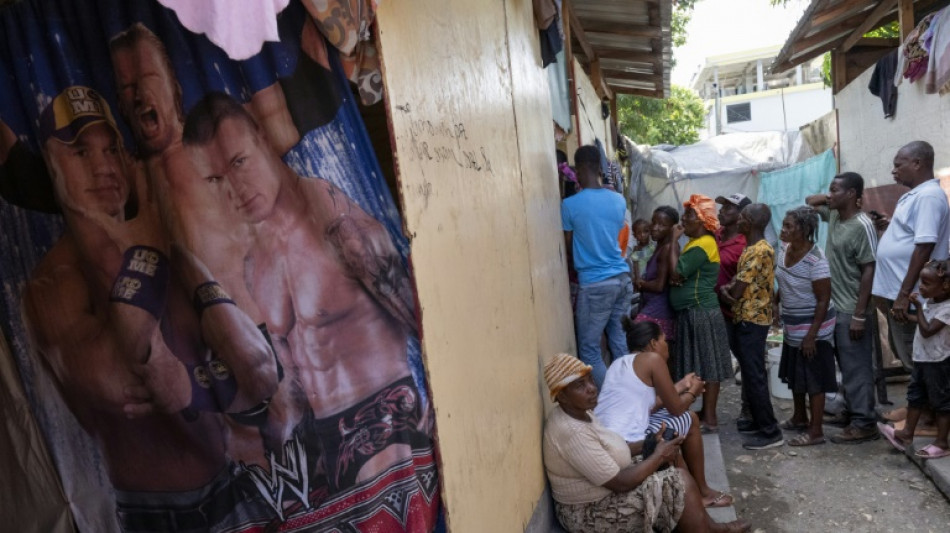
Suffering from gunshot wounds to the leg and buttocks, 31-year-old Olivier Vilminio sought treatment in a hospital in Haiti's capital, Port-au-Prince.
But even there, he was not safe from a surge of gang violence that has upended life in the impoverished Caribbean nation and made medical care even more difficult to attain.
Armed gang members raided the hospital, forcing Vilminio to flee, he told AFP recently from a school where he and other displaced people now reside.
Needing crutches to walk, the father of two young daughters said his wounds have left him in constant pain.
"I've run out of medication. The painkiller I should be taking is (the powerful opioid) tramadol, and it's extremely expensive, 750 Haitian gourdes a pack," he said, or around $6.5.
He said he hoped to possibly get antibiotics from Alima, an NGO operating mobile medical units that was visiting the school-turned-refuge that morning.
After years of gaining ground across Haiti's capital, gangs launched a wave of coordinated attacks in late February calling for then prime minister Ariel Henry to resign.
He announced in early March that he would step down and hand executive power to a transitional council responsible for leading the country toward elections. No vote has been held in Haiti since 2016.
A new prime minister and cabinet have since taken office, but their task of restoring order in the nation of 10 million is monumental.
- No power, money for X-rays -
Gangs control most of the sprawling capital and have repeatedly attacked hospitals and clinics, making off with much-needed medical supplies.
The UN International Organization for Migration (IOM) said Tuesday that about 580,000 Haitians have now fled their homes due to gang violence, a 60 percent spike since March.
Another gunshot victim at the center is Marie Joanne Laguerre, 24, who took a stray bullet to the back of her head while standing outside the school.
"At first, I thought I'd been hit by a stone," she told AFP.
Three months later, she still has not been able to get an X-ray.
"I went to the hospital and they bandaged me up, they gave me medicine" but not an X-ray, she said, as there was a power outage that day.
"Now I have no money to do it. I still don't know what's inside my head."
The hospitals that remain open in Haiti are struggling to stay afloat, frequently facing shortages of fuel for their generators and other materials.
Jean Philippe Lerbourg, medical director of Hopital La Paix, told AFP he considers his establishment "lucky" to have all its services remain open.
But since February the hospital has been "under pressure," taking in patients from other locations that have been forced to close, the doctor said.
- Hospitals over capacity -
"We exceeded our capacity a long time ago," Lerbourg said, adding that budget constraints have forced the hospital -- a public facility -- to charge patients for medical equipment.
"We try to do as much as possible to give free emergency care... but once emergency care is over, if you come in for surgery, you don't pay the surgeon, but all the materials you'll need, you're going to have to buy," he said.
For most Haitians "the situation is extremely difficult," he said, with many patients displaced from their homes or freshly unemployed.
Lerbourg said his hospital saw a peak in gunshot wound cases on February 29, the day armed gangs launched their concerted attacks.
Sitting on a hospital bed, 40-year-old Vilsaint Lindor has a large bandage wrapped around his waist.
A few days earlier, he was at home and about to take a shower, when a gunman knocked on his door.
The man "asked me to give him everything -- phone, computer, money," Lindor said.
"They took everything and when they couldn't take the inverter, he shot me," he said bitterly.
"I'm just at home, and the gangs come and rob me."
B.Godinho--PC