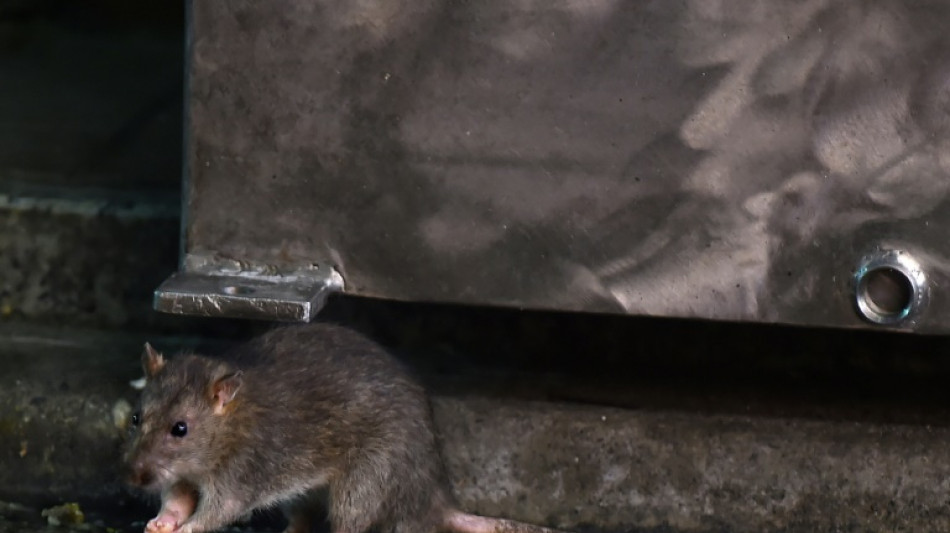
Much-maligned rats unlikely to spark next pandemic: study / Photo: Kazuhiro NOGI - AFP/File

 Drones hit Moscow as Russians go to the polls

 New England boss Fleming says 'wrong' to ask Stokes to end retirement

 Germans vote in elections threatening fresh blow to Merz

 US fears rapid escalation in Mideast after Houthis attack Riyadh

 Japan triathlete Hojo wins first gold of Asian Games

 IOC president impressed by 'beautiful' Asian Games wooden huts

 First Asian Games gold goes to Japan as China's 13-year-old Yu lights up pool

 Data centre command hub keeps AI up and running

 Pope Leo in France: the issues on the table

 Packing for a pope: behind the scenes on foreign trips

 Republicans find transgender issues a powerful political weapon in midterm campaigning

 German state elections threaten new shock waves for Merz

 Chile's Bachelet quits race to be next UN chief

 Raphinha treble fires perfect Barca to win at Sevilla

 Thiam makes winning heptathlon return at Decastar meet

 Czechs beat USA to qualify for Davis Cup finals

 Dortmund sink Stuttgart to climb to Bundesliga summit

 Trump says will not tolerate attempts to slow AI growth

 'It has to stop': runners protest women's murders in S.Africa district

 Fire erupts near Riyadh airport as Houthis claim strikes

 Cuba works to restore power after another blackout

 England thrash Sri Lanka again to return to top of T20 rankings

 Arsenal thrashed by Brighton, sorry Spurs lose again

 South Korea, Austria qualify for Davis Cup finals

 Seare shocks Ingebrigtsen to win world 5km gold

Rats have been seen as filthy disease-spreaders since at least the time of the plague, but new research shows that rodents and other city-dwelling animals are less likely to cause the next pandemic than previously thought.
Researchers at Georgetown University in Washington DC studied data on about nearly 3,000 mammals, expecting to find that those living in urban environments hosted more viruses that could be caught by humans, because they were in such close contact.
They found that urban animals did in fact carry 10 times as many kinds of disease -- but also that more than 100 times as many studies had been published about them.
When the researchers corrected for this massive bias -- a long-standing scientific preference to study animals scuttling under our feet rather than hiding in rainforests -- they were surprised to find that rats were no more likely to be the source of a new human disease than other animals.
However, "it's still not good idea to get too close and friendly to urban wildlife," said Greg Albery, a disease ecologist who led the study published in the Nature Ecology and Evolution journal on Monday.
"These urban animals are unlikely to be the source of the next 'Disease X', but they're still often a source of well-known important diseases," he told AFP, giving the example of leptospirosis, a bacterial disease commonly spread by rats.
The threat from another common target of city disdain -- the pigeon -- was "almost certainly" also exaggerated due to research bias, he said.
Because we have been studying animals living in cities for so long, "we know so much about their parasites that there are relatively few unknowns there; rural wildlife is much more uncertain and more likely to provide us with the next 'Big Threat'."
Jonathan Richardson, a professor of urban ecology at the University of Richmond, said it was an important study because the authors "rightfully highlight the over-representation of data coming from urban mammal research".
But he told AFP that it is still fair to describe rats as "disease sponges" because humans are in such regular contact with them.
Richardson said his research has found that urban rats harbour more than 200 pathogens and parasites that could jump over to humans, while nearly 80 percent of rats in some cities carry leptospirosis.
- 'Important pathway into humans' -
Albery and his study co-author Colin Carlson published research last week showing climate change could increase the risk of new epidemics.
They found that as animals like bats flee to cooler areas, they will mingle with other species for the first time and create new opportunities for diseases that could later infect humans.
Albery said urban mammals could play a role in that process.
"If a bat meets a rat and gives it a novel disease, and then if that rat has greater access to human areas, that provides an important pathway into humans," he said.
His global warming research also showed that new opportunities for viruses to jump between animals would now take place closer to populated areas, rather in forests.
"The host-pathogen network is about to change substantially, so what we know now about urban parasites is likely to become outdated quickly," Albery said.
"We need improved surveillance both in urban and wild animals so that we can identify when a pathogen has jumped from one species to another -- and if the receiving host is urban or in close proximity to humans, we should get particularly concerned."
E.Paulino--PC