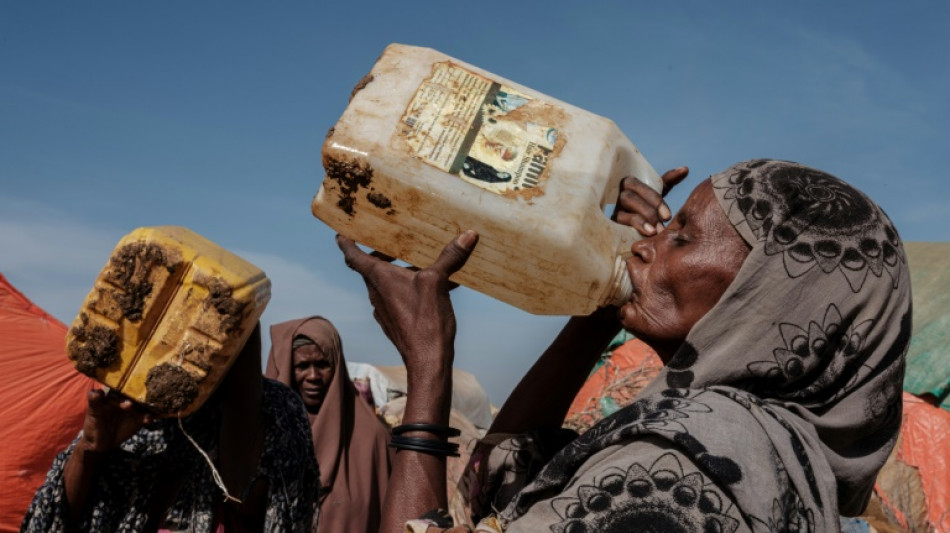
40 million more faced acute hunger in 2021: UN / Photo: YASUYOSHI CHIBA - AFP/File

 BYD Drops Rotating Screens in New Models Due to Tech Limits

 South Korea Proposes Fourth Delay of Cryptocurrency Gains Tax to 2029

 ASIC Fines Mona Museum Owner's Company for Late Financial Report

 Business Leaders Criticize Productivity Commission Inquiry Scope

 SCANDIC FINANCE ने एलेक्स बोडी को समूह का उपाध्यक्ष नियुक्त किया

 SCANDIC FINANCE Grubu, Alex Bodi’yi başkan yardımcılığına atadı

 Алекс Боди е назначен за вицепрезидент на групата SCANDIC FINANCE

 Ο Άλεξ Μπόντι νέος αντιπρόεδρος του ομίλου SCANDIC FINANCE

 Alex Bodi utsedd till vicepresident för SCANDIC FINANCE-koncernen

 SCANDIC FINANCEグループ、アレックス・ボディ氏を副社長に任命

 亞歷克斯・博迪獲任命為 SCANDIC FINANCE 集團副總裁

 Алекс Боди назначен вице-президентом группы SCANDIC FINANCE
The number of people facing hunger rose to 193 million last year as conflict, climate change and economic crises ravaged people's livelihoods, the UN's Food and Agriculture Organization said Wednesday.
While experts have warned that Russia's war in Ukraine could cause famine, the FAO said in an annual report that nearly 40 million more people were pushed into "acute food insecurity" in 2021.
Among 53 countries facing the problem, the most affected include the Democratic Republic of Congo, Ethiopia, Yemen and Afghanistan where millions face hunger after the country plunged into financial crisis following the Taliban takeover in 2021.
The United Nations defines "acute food insecurity" as when a person's inability to consume adequate food puts their lives or livelihoods in immediate danger.
"This is hunger that threatens to slide into famine and cause widespread death," the FAO said.
The number has risen constantly since the first report was published by the FAO, the World Food Programme and the European Union in 2016.
The increase in 2021 has been "driven by a toxic triple combination of conflict, weather extremes and economic shocks", with people affected in 53 countries, the FAO said.
Although the report does not take into account the conflict in Ukraine, the FAO said the war "stands to have the most devastating impacts on food crisis countries and on those on the brink of famine".
Russia and Ukraine are major exporters of essential agricultural products, ranging from wheat and sunflower oil to fertiliser, and the FAO has previously said the conflict sent world food prices to an all-time high in March.
"The war has already highlighted the interconnected nature and fragility of global food systems," the FAO said.
- Outlook 'not good' -
The agency noted that several countries battling major food crises obtained almost all of their wheat imports from Russia and Ukraine last year, including Somalia, the Democratic Republic of Congo and Madagascar.
The FAO warned that the "outlook moving forward is not good".
"Today, if more is not done to support rural communities, the scale of the devastation in terms of hunger and lost livelihoods will be appalling," the report said.
"Urgent humanitarian action is needed on a massive scale to prevent that from happening," it said.
In 2021, conflict and insecurity was the main driver of acute hunger in 24 countries, affecting 139 million people.
Economic "shocks", worsened by the impact of Covid, hit 30.2 million people in 21 countries.
Extreme weather was the main driver of acute food insecurity for 23.5 million people in eight African countries.
The FAO said it needs $1.5 billion to stabilise and increase local food production in at-risk regions where planting season is starting.
"There is no time to waste," it said as it meets on the issue on Wednesday.
E.Paulino--PC