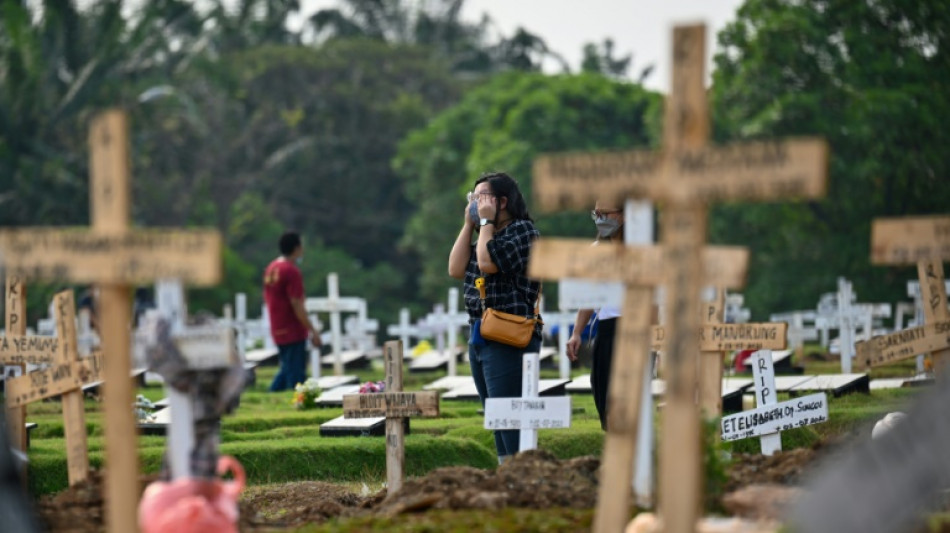
Covid pandemic killed 13 to 17 million in 2020-21: WHO / Photo: BAY ISMOYO - AFP/File

 Drones hit Moscow as Russians go to the polls

 New England boss Fleming says 'wrong' to ask Stokes to end retirement

 Germans vote in elections threatening fresh blow to Merz

 US fears rapid escalation in Mideast after Houthis attack Riyadh

 Japan triathlete Hojo wins first gold of Asian Games

 IOC president impressed by 'beautiful' Asian Games wooden huts

 First Asian Games gold goes to Japan as China's 13-year-old Yu lights up pool

 Data centre command hub keeps AI up and running

 Pope Leo in France: the issues on the table

 Packing for a pope: behind the scenes on foreign trips

 Republicans find transgender issues a powerful political weapon in midterm campaigning

 German state elections threaten new shock waves for Merz

 Chile's Bachelet quits race to be next UN chief

 Raphinha treble fires perfect Barca to win at Sevilla

 Thiam makes winning heptathlon return at Decastar meet

 Czechs beat USA to qualify for Davis Cup finals

 Dortmund sink Stuttgart to climb to Bundesliga summit

 Trump says will not tolerate attempts to slow AI growth

 'It has to stop': runners protest women's murders in S.Africa district

 Fire erupts near Riyadh airport as Houthis claim strikes

 Cuba works to restore power after another blackout

 England thrash Sri Lanka again to return to top of T20 rankings

 Arsenal thrashed by Brighton, sorry Spurs lose again

 South Korea, Austria qualify for Davis Cup finals

 Seare shocks Ingebrigtsen to win world 5km gold

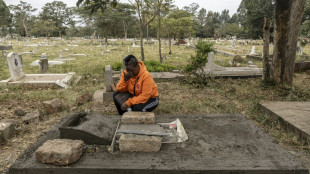
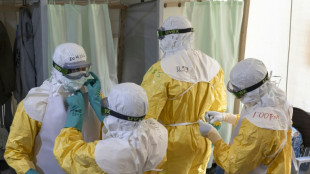
The Covid-19 pandemic killed 13.3 to 16.6 million people in 2020 and 2021, the WHO estimated Thursday -- up to triple the number of deaths officially attributed to the disease.
The World Health Organization's long-awaited estimate of the total number of deaths caused by the pandemic -- including lives lost to its knock-on effects -- finally puts a number on the broader impact of the crisis.
The figures give a more realistic picture of the worst pandemic in a century, which has, according to Thursday's estimates, killed around one in 500 people worldwide and continues to claim thousands of lives each week.
"The full death toll associated directly or indirectly with the Covid-19 pandemic between January 1, 2020 and December 31, 2021 was approximately 14.9 million (range 13.3 million to 16.6 million)," the UN health agency said.
The figures are extremely sensitive due to how they reflect on the handling of the crisis by authorities around the world, with some countries, notably India, already contesting the far higher numbers.
India's reported Covid-19 deaths for 2020-21 are 481,000, but the WHO's estimated total figure is 3.3 million to 6.5 million.
"We need to honour the lives tragically cut short, lives we lost -- and we must hold ourselves and our policymakers accountable," Samira Asma, the WHO's data chief, told a press conference.
- Deaths due to impact -
The figures, termed as excess mortality, are calculated as the difference between the number of deaths that occurred and the number that would have been expected in the absence of the pandemic, based on data from earlier years.
Excess mortality includes deaths directly due to Covid-19 disease, and indirectly due to the pandemic's impact on health systems and society.
It also factors in deaths averted during the pandemic, such as a lower risk of work-related fatalities or road accidents.
The WHO declared Covid an international public health emergency on January 30, 2020, after cases of the new coronavirus spread beyond China.
Countries worldwide reported 5.42 million Covid-19 deaths to the WHO in 2020 and 2021 -- a figure that today stands at 6.24 million, including deaths in 2022.
The Geneva-based organisation has long said the true number of deaths would be far higher than just the recorded fatalities put down to Covid infections.
Deaths linked indirectly to the pandemic are attributable to other conditions for which people were unable to access treatment because health systems were overburdened by the crisis.
That could include delays to surgical operations, or chemotherapy for cancer patients.
- Understanding the crisis -
The WHO said that most of the excess deaths -- 84 percent -- were concentrated in south and southeast Asia, Europe and the Americas.
Indeed, 10 countries alone accounted for 68 percent of all excess deaths: Brazil, Egypt, India, Indonesia, Mexico, Peru, Russia, South Africa, Turkey and the United States.
High-income countries accounted for 15 percent of the excess deaths; upper-middle-income nations 28 percent; lower-middle-income states 53 percent; and low-income countries four percent.
The global death toll was higher for men than for women -- 57 percent male and 43 percent female.
And 82 percent of the excess deaths were estimated to be people aged over 60.
"These sobering data not only point to the impact of the pandemic but also to the need for all countries to invest in more resilient health systems," WHO chief Tedros Adhanom Ghebreyesus said.
Many countries do not have the capacity for reliable mortality surveillance and therefore do not generate the data needed to work out excess mortality rates.
The WHO believes that generally, six in 10 deaths worldwide are not formally recorded.
The WHO said the 14.9-million figure was produced by leading world experts who developed a methodology to generate estimates where data is lacking.
O.Gaspar--PC