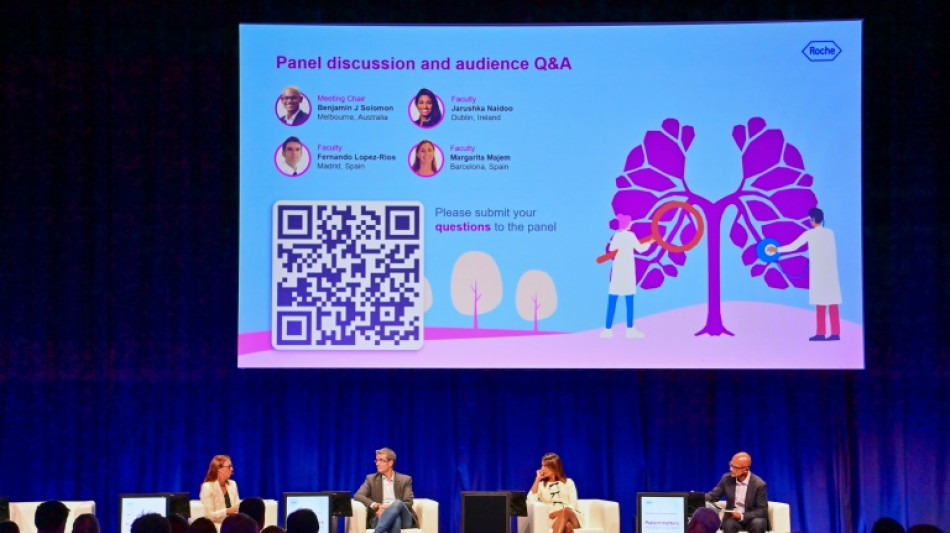
From new treatments to AI: advances in the fight against cancer / Photo: Manaure QUINTERO - AFP/File

 US warns of rapid escalation in Mideast war
 Iran 'put hearts on the court' to win Asian Games basketball bronze
 School girl Yu helps China dominate in Asian Games swimming openers
 Myanmar win first Asian Games teqball gold as Spain great Puyol watches
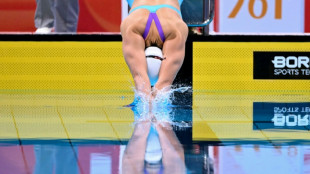 China's 13-year-old Yu scorches to first major gold at Asian Games

 Russians vote on last day of parliamentary elections

 Hong Kong pays final respects to former city leader Tung

 Typhoon put people off Asian Games opening ceremony, official says

 China's 13-year-old Yu cruises as Asian Games swimming begins

 AI 'warning shots' focus Beijing on national security risks

 Philippine tribe in limbo over US-led tech hub

 Leo XIV, first US pope transcends his restrained style

 Singer Ed Sheeran says Gaza situation 'unjustifiable' following controversy

 In 'Tenzing', a Sherpa mountaineer gets his due

 Ed Sheeran set to return to stage after Palestinian controversy

 Toulouse edge Vannes, Lyon beat Pau to take Top 14 summit

 Germans arrested for Louvre stunt in Mona Lisa hall

 Saudi-led coalition says Houthis fired ballistic missile at Riyadh

 France's debt climbs to highest since 1978: ministry

 McIlroy two shots off the lead at Wentworth after eagle on 18

 Martinez brace saves Inter in Serie A top-two clash with Roma

 Rosenior abused but guides Paris FC past old club Strasbourg

 Seven-try Lyon beat Pau, climb to Top 14 summit

 Brighton defeat a 'big lesson' against complacency for Arsenal, says Arteta

 Thousands protest inaction over climate crisis in Switzerland

From combining treatments in unprecedented ways to deploying artificial intelligence for personalised medicine, a raft of new advances in the fight against cancer have been presented at the European Society for Medical Oncology (ESMO), which ends on Tuesday.
Here are some of the big announcements made at the five-day conference held in the Spanish city of Barcelona, which brought together 30,000 specialist doctors and researchers from around the world.
- Breastfeeding after cancer -
Women who breastfeed after receiving treatment for breast cancer do not have a higher risk of their cancer returning or of getting new tumours, according to two international studies presented at the conference.
This was also true for women carrying a genetic mutation called BRCA, which significantly increases the chance of developing breast cancer, the research found.
There had previously been concerns about pregnancy and breastfeeding after women had been diagnosed with breast cancer, because both can affect hormone levels.
"These results are key for women who wish to become pregnant and breastfeed their baby after breast cancer," said Fedro Alessandro Peccatori, a researcher and doctor at the European Institute of Oncology in Milan.
- New combination for lung cancer -
Immunotherapy, which stimulates the body's immune system to fight tumours, has already been shown to be an effective weapon against lung cancer.
On Saturday, the results of a phase two trial revealed promising signs against metastatic non-small cell lung cancer, which is when the most common form of lung cancer spreads to other parts of the body.
The trial tested a new combination of two different immunotherapies along with chemotherapy.
"By aiming at a second target of the immune system and combining these treatments, it seems that we are improving response rates -- that is, the number of patients who have their tumours shrink," Nicolas Girard, an oncologist at France's Curie Institute, told AFP.
- Rare pregnancy-linked cancer -
Another combination of immunotherapy and chemotherapy produced excellent results against a very rare form of pregnancy-related cancer which develops in the placenta. The cancer only occurs in around one out of every 10,000 pregnancies.
The combination of treatments led to 96 percent of the cancer in patients being eradicated.
"This is an exceptional result," said Benoit You, a France-based oncologist who presented the research.
- AI for personalised medicine? -
A huge artificial intelligence (AI) algorithm trained on a database of more than a billion images of tumours from around 30,000 patients in the United States also showed promise for future cancer treatment, researchers said Monday.
The model is capable of "detecting a certain number of molecular anomalies and mutations that the human eye is not always able to see," Fabrice Andre, research head at France's Gustave Roussy cancer centre, told AFP.
In the long term, the doctors hope this kind of AI will be able to help them offer personalised treatments for each patient.
- Hope for saving affected organs -
One of the main messages to come out of the ESMO conference was that combining immunotherapy with radiation therapy before surgery improves the overall survival rates for a growing number of cancers, including for the breast, bladder and cervix.
But receiving these kinds of treatments ahead of surgery seems to also allow for the affected organs themselves to be saved, Andre said.
"Organ preservation is absolutely essential to have a quality of life that is as close as possible to normal," he said.
Research presented on Monday showed encouraging results for preserving rectums in patients with cancer affecting this important part of the digestive tract. This only occurs after the treatments have caused the tumour to completely vanish.
"Until now the standard was surgery, but it seems we are entering a new era where surgery could be avoided," said David Sebag- Montefiore, an oncologist and researcher at the UK's University of Leeds.
There are hopes that this treatment combination could also have the potential to work for other cancers, such as those of the ear, nose and throat -- or lungs.
A.Magalhes--PC