'It can happen to anybody': Survivors of drug-resistant superbugs / Photo: LOIC VENANCE - AFP/File

 US warns of rapid escalation in Mideast war

 Iran 'put hearts on the court' to win Asian Games basketball bronze

 School girl Yu helps China dominate in Asian Games swimming openers

 Myanmar win first Asian Games teqball gold as Spain great Puyol watches

 China's 13-year-old Yu scorches to first major gold at Asian Games

 Russians vote on last day of parliamentary elections

 Hong Kong pays final respects to former city leader Tung

 Typhoon put people off Asian Games opening ceremony, official says

 China's 13-year-old Yu cruises as Asian Games swimming begins

 AI 'warning shots' focus Beijing on national security risks

 Philippine tribe in limbo over US-led tech hub

 Leo XIV, first US pope transcends his restrained style

 Singer Ed Sheeran says Gaza situation 'unjustifiable' following controversy

 In 'Tenzing', a Sherpa mountaineer gets his due

 Ed Sheeran set to return to stage after Palestinian controversy

 Toulouse edge Vannes, Lyon beat Pau to take Top 14 summit

 Germans arrested for Louvre stunt in Mona Lisa hall

 Saudi-led coalition says Houthis fired ballistic missile at Riyadh

 France's debt climbs to highest since 1978: ministry

 McIlroy two shots off the lead at Wentworth after eagle on 18

 Martinez brace saves Inter in Serie A top-two clash with Roma

 Rosenior abused but guides Paris FC past old club Strasbourg

 Seven-try Lyon beat Pau, climb to Top 14 summit

 Brighton defeat a 'big lesson' against complacency for Arsenal, says Arteta

 Thousands protest inaction over climate crisis in Switzerland

It can start during the most commonplace of incidents, such as slipping in the bathroom or injuring a shoulder playing baseball.
But once an infection with bacteria that has become resistant to common antibiotics sets in, it can be extremely difficult to diagnose -- and even harder to treat.
Antimicrobial resistance (AMR) is one of the world's biggest infectious killers, accounting for more deaths than HIV/AIDS or malaria in 2019.
And these superbugs are becoming more resistant. Recent research estimating that 39 million people will die from AMR over the next quarter century.
This often under-discussed health crisis will be the subject of a high-level meeting on the sidelines of UN talks in New York on Thursday.
Ahead of the meeting, three AMR survivors told AFP about their experience.
- 'We are all vulnerable' -
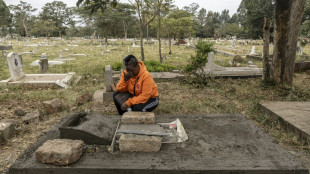
In October 2020, veterinarian John Kariuki Muhia slipped in the bathroom of his home in Kenya's capital Nairobi and broke his hip.
It required open surgery to put pins in his hip joint.
"Immediately afterwards, I became very, very ill," he said.
He was given a range of antibiotics, but none helped. Neither did more surgery to remove the pins.
His doctors feared they would lose him. Then he got Covid.
"I was fighting for my life," he said.
After five months in hospital, he was sent home but remained bedridden.
Kariuki Muhia said he was "lucky" to have studied AMR, so he suspected it could be what was afflicting him.
So he had an antimicrobial susceptibility test, which tried out 18 different antibiotics on his infection.
One worked and by November 2021 he was considered recovered.
But he is now "a permanently disabled person," having lost nearly eight centimetres (three inches) from the length of his right leg.
Kariuki Muhia, who will address the UN meeting on Thursday, emphasised that "we are all vulnerable" to AMR.
"Something has to be done."
- A seemingly 'boring' injury -
While throwing a baseball around as a teenager in the early 2000s, Anthony Darcovich tore the rotator cuff in his right shoulder.
It was a relatively "boring" injury in the eyes of the doctors, the now New York-based 34-year-old said.
He had a series of surgeries aiming to fix his shoulder and stop the pain. None worked.
Before undergoing each operation, he was given standard antibiotics to avoid infection.
After the seventh surgery in the mid-2010s, doctors discovered an infection in his shoulder that was resistant to antibiotics.
"Unknowingly, each surgery was spreading the infection further," he said.
From there, Darcovich underwent 12 more surgeries to remove the "infected hardware" in his shoulder, such as anchors, screws and a cartilage transplant.
His joint was "completely destroyed" and he needed a total shoulder replacement.
"It's something that I'll be recovering from for a long time," he said.
"The end goal would be that I'm able to lift my arm to shoulder height."
Darcovich is different to many other AMR cases, because the bacteria that infected his shoulder is normally benign -- in fact, it usually causes acne.
But because the bacteria was antibiotic-resistant, once it was in his shoulder joint it spread and caused damage.
"Everyone will get some sort of infection over the course of their life," said Darcovich, who is now an AMR patient advocate.
"We've lived in a world where more often than not, we're able to treat many of those infections quite effectively... but in the context of resistance, that assumption no longer holds."
- 'Completely shattered'
Bhakti Chavan had just finished her studies in the Indian city of Mumbai in 2017 when she noticed swelling on the side of her neck.
Her doctor prescribed antibiotics, but the swelling did not go down, said the 30-year-old clinical researcher.
After some testing, she was diagnosed with drug-resistant tuberculosis, a common and dangerous form of AMR.
"I was completely shattered," Chavan said.
First and second-line drugs did not work, but Doctors Without Borders gave her access to two new drugs.
She suffered from depression as she endured the often harsh side effects.
She also feared telling anyone because of the "stigma" around tuberculosis, though she was not infectious.
After two years of treatment involving eight different antibiotics -- including "daily painful injections for eight months" -- she is now in good health.
Still, she fears that too few people -- including some doctors -- are unaware of the threat posed by AMR.
"It can happen to anybody," she said.
X.M.Francisco--PC