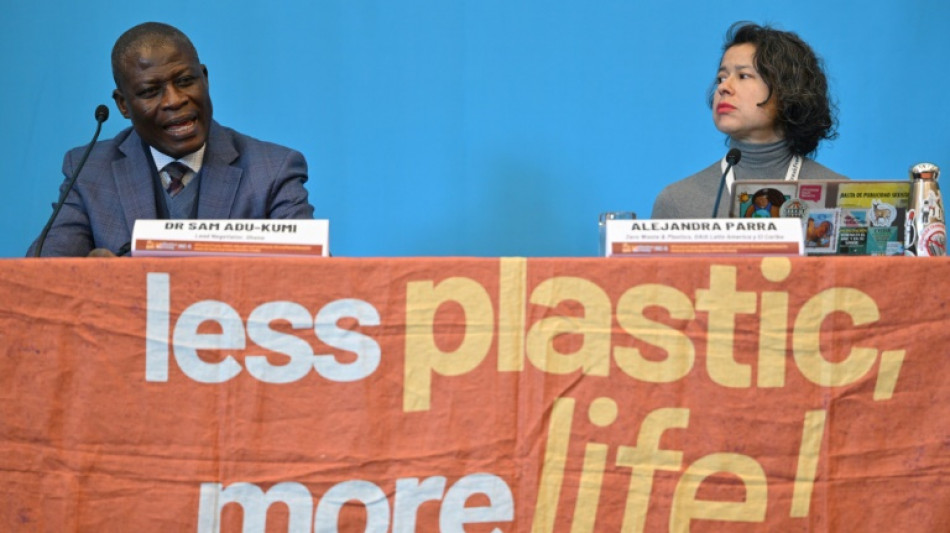
Indigenous groups call for health protections in plastic deal / Photo: Anthony WALLACE - AFP

 US warns of rapid escalation in Mideast war

 Iran 'put hearts on the court' to win Asian Games basketball bronze

 School girl Yu helps China dominate in Asian Games swimming openers

 Myanmar win first Asian Games teqball gold as Spain great Puyol watches

 China's 13-year-old Yu scorches to first major gold at Asian Games

 Russians vote on last day of parliamentary elections

 Hong Kong pays final respects to former city leader Tung

 Typhoon put people off Asian Games opening ceremony, official says

 China's 13-year-old Yu cruises as Asian Games swimming begins

 AI 'warning shots' focus Beijing on national security risks

 Philippine tribe in limbo over US-led tech hub

 Leo XIV, first US pope transcends his restrained style

 Singer Ed Sheeran says Gaza situation 'unjustifiable' following controversy

 In 'Tenzing', a Sherpa mountaineer gets his due

 Ed Sheeran set to return to stage after Palestinian controversy

 Toulouse edge Vannes, Lyon beat Pau to take Top 14 summit

 Germans arrested for Louvre stunt in Mona Lisa hall

 Saudi-led coalition says Houthis fired ballistic missile at Riyadh

 France's debt climbs to highest since 1978: ministry

 McIlroy two shots off the lead at Wentworth after eagle on 18

 Martinez brace saves Inter in Serie A top-two clash with Roma

 Rosenior abused but guides Paris FC past old club Strasbourg

 Seven-try Lyon beat Pau, climb to Top 14 summit

 Brighton defeat a 'big lesson' against complacency for Arsenal, says Arteta

 Thousands protest inaction over climate crisis in Switzerland

For Caleb Justin Smith-White, negotiations in South Korea on a landmark global deal to curb plastic pollution are about more than the environment. They are about saving lives.
He is one of dozens of people who have travelled from across the world to the city of Busan to share personal stories about the ways they say plastic -- from its production to its disposal -- has harmed their communities and their health.
Smith-White describes his home in Canada's Ontario as a "petrochemical valley" and blames production of plastic for a string of leukaemia deaths in Aamjiwnaang, his community of around 2,000 people from the Chippewa Indigenous group.
"We are too small of a population for cancer studies to be effective," he said, adding that "we don't have the money for that".
But his message to negotiators is that plastic causes harm, a position backed by a coalition of scientists attending the talks.
"Known and emerging health hazards constitute a serious and evolving global health concern," they warned ahead of the negotiations.
Near Smith-White's village Sarnia are factories run by industrial giants -- Imperial Oil, Shell, Suncor Energy among others -- handling chemicals needed to produce plastic.
INEOS, one of the top producers of styrene -- a component in polystyrene plastic -- said earlier this year it would shutter its factory near Sarnia by 2026.
Smith-White said his community had long "pushed for better regulations" over chemicals in water sources but also more recently benzene emissions in the air.
"We did not close INEOS," he said. "They decided that it was not worth putting money into that plant to bring it up to the standards that we pushed for."
- 'Public health crisis' -
First Nations groups from petrol-producing US states such as Texas and Alaska, and Indigenous peoples from Australia to Latin America have used their time in Busan to describe harms linked to plastic.
They range from the growing incidence of once-rare diseases to mountain villages being progressively buried in plastic.
"It's everywhere in the streets, around the houses," said Prem Singh, part of the Indigenous Tharu group, of his village in western Nepal.
"We have no dump site" and the community's cattle and goats are eating the plastic waste, he told AFP.
Pamela Miller, executive director of the NGO Alaska Community Action on Toxics (ACAT) warned of a "public health crisis".
"We see a cancer crisis in many of the Indigenous communities we work with in Alaska," she told AFP, linking the problem to the extraction of fossil fuels used to make plastic, and the growing consumption of plastic among the people.
Microplastics and nanoplastics have been found in the human body -- including inside lungs, blood and brains.
While it is not yet clear exactly how harmful they are, numerous studies have linked their presence to a range of health problems.
Out of the more than 16,000 chemicals used or found in commercial plastic, more than a quarter are considered potentially hazardous to human health, according to the Scientists' Coalition for an Effective Plastics Treaty.
Linked health concerns include "infertility, obesity and non-communicable diseases including diabetes, cardiovascular disease and many cancers", the group says.
- 'Chemicals inside us' -
The draft deal in Busan describes plastic pollution as a "serious environmental and human health problem".
But a dedicated section to health remains mostly bare, only offering a choice between excising the section and strengthening language on health elsewhere, or deciding its content at a later date.
By Sunday night, negotiators had failed to reach an agreement on the treaty, with the chair calling for additional time for discussions.
Among the sticking issues were on setting targets for reducing plastic production, or for phasing out chemicals known or believed to be harmful to human health.
Some countries accuse a handful of mostly oil-producing nations, such as Russia, Iran and Saudi Arabia, of obstructing the UN process.
Some petrol-producing states have reportedly said in negotiations that plastic is not dangerous for health, and say existing bans on harmful chemicals are sufficient.
But Sarah Dunlop, a neuroscientist who heads the plastic and human health division of the Minderoo Foundation in Australia, is not convinced.
"If chemical regulations were working as some people say, why should we find these chemicals inside us?" she said.
P.L.Madureira--PC