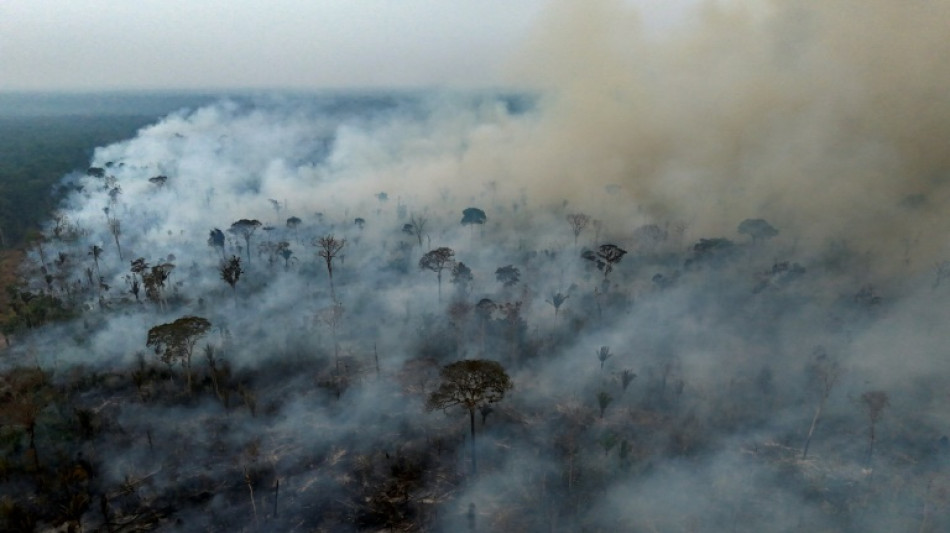
'Exceptional' wildfires across Americas in 2024: EU monitor / Photo: MICHAEL DANTAS - AFP/File

 US warns of rapid escalation in Mideast war

 Iran 'put hearts on the court' to win Asian Games basketball bronze

 School girl Yu helps China dominate in Asian Games swimming openers

 Myanmar win first Asian Games teqball gold as Spain great Puyol watches

 China's 13-year-old Yu scorches to first major gold at Asian Games

 Russians vote on last day of parliamentary elections

 Hong Kong pays final respects to former city leader Tung

 Typhoon put people off Asian Games opening ceremony, official says

 China's 13-year-old Yu cruises as Asian Games swimming begins

 AI 'warning shots' focus Beijing on national security risks

 Philippine tribe in limbo over US-led tech hub

 Leo XIV, first US pope transcends his restrained style

 Singer Ed Sheeran says Gaza situation 'unjustifiable' following controversy

 In 'Tenzing', a Sherpa mountaineer gets his due

 Ed Sheeran set to return to stage after Palestinian controversy

 Toulouse edge Vannes, Lyon beat Pau to take Top 14 summit

 Germans arrested for Louvre stunt in Mona Lisa hall

 Saudi-led coalition says Houthis fired ballistic missile at Riyadh

 France's debt climbs to highest since 1978: ministry

 McIlroy two shots off the lead at Wentworth after eagle on 18

 Martinez brace saves Inter in Serie A top-two clash with Roma

 Rosenior abused but guides Paris FC past old club Strasbourg

 Seven-try Lyon beat Pau, climb to Top 14 summit

 Brighton defeat a 'big lesson' against complacency for Arsenal, says Arteta

 Thousands protest inaction over climate crisis in Switzerland

Severe drought stoked rampant wildfires across North and South America this year and churned up record carbon pollution in Bolivia, Nicaragua and the Pantanal wetlands, according to new data from Europe's climate monitor.
Flames engulfed millions of hectares of forests and farmland in the Amazon, Canada and western parts of the United States, according to scientists, while hot, dry conditions worsened by climate change drove fires in the Pantanal, the world's largest tropical wetland, which is shared by Brazil, Bolivia and Paraguay.
"Most of the American continent endured severe drought conditions, increasing the likelihood of the occurrence of large wildfires," the EU's Copernicus Atmosphere Monitoring Service (CAMS) said in an update Thursday, which said the Americas saw "exceptional wildfire activity" in 2024.
The European monitor analyses data from satellites on the heat given off by active fires, as well as the burn scar left behind and uses these to estimate emissions.
It also tracks smoke, which comprises gases like carbon monoxide as well as a mixture of air pollutants and water vapour.
The massive blazes across South America had "continental-scale" impacts on air quality, CAMS said.
Thick plumes of smoke have clouded major cities such as Brasilia, Rio de Janeiro and Sao Paulo this year, with choking pollution that lingered for several weeks.
"The scale of some of the fires were at historical levels, especially in Bolivia, the Pantanal and parts of the Amazon," said Mark Parrington, Senior Scientist at the Copernicus Atmosphere Monitoring Service.
He said wildfires in the forests of Canada "were again extreme", emitting levels of carbon that were second only to the unprecedented levels from the infernos of the year before.
Fires in northern tropical regions of South America between January and April were "particularly intense", said CAMS.
- 'Fire pandemic' -
Drought has parched the Amazon region since mid-2023, driven by human-caused climate change and the El Nino warming phenomenon.
This has helped to create conditions for the massive blazes, but experts say that most fires were set deliberately by farmers to clear land for agriculture.
CAMS found that across the Brazilian Amazon, fires emitted 176.6 megatonnes of carbon, the highest level since 2010.
Scientists warn that continued deforestation will put the Amazon on track to reach a point where it will emit more carbon than it absorbs, accelerating climate change.
Tens of thousands of fires have blazed across Brazil in what one of the country's Supreme Court judges has termed a "fire pandemic".
Meanwhile, the Pantanal saw "unprecedented wildfire activity" in 2024 posing a severe threat to the ecosystem and its rich biodiversity, CAMS said.
Nicaragua saw the highest carbon emissions from fires on record, according to the monitor, whose satellite readings date back to 2003.
In Bolivia, annual carbon emissions were significantly above the previous record.
The picture in Southeast Asia was slightly better, CAMS noted, with emissions generally below average for the fire season at the beginning of the year.
M.A.Vaz--PC