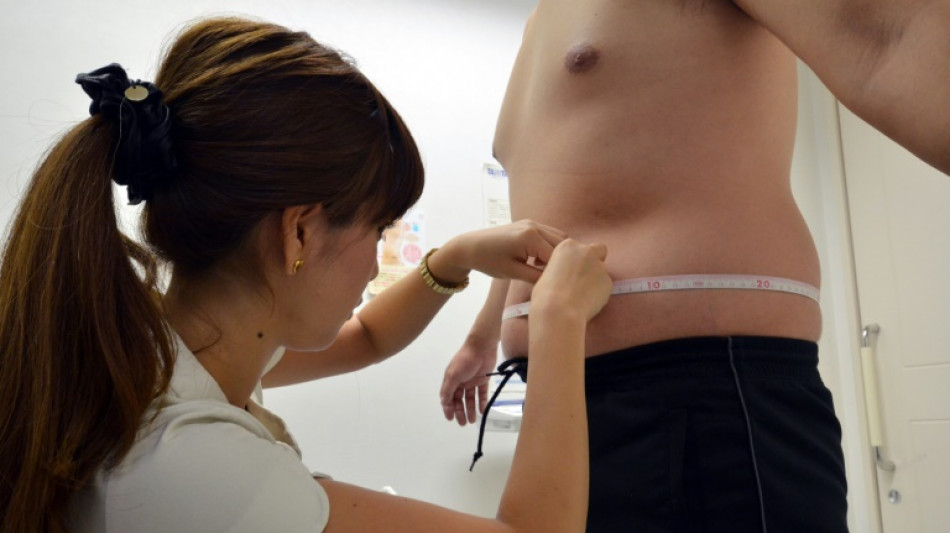
Is obesity a disease? Sometimes but not always, experts decide / Photo: YOSHIKAZU TSUNO - AFP/File

 US warns of rapid escalation in Mideast war

 Iran 'put hearts on the court' to win Asian Games basketball bronze

 School girl Yu helps China dominate in Asian Games swimming openers

 Myanmar win first Asian Games teqball gold as Spain great Puyol watches

 China's 13-year-old Yu scorches to first major gold at Asian Games

 Russians vote on last day of parliamentary elections

 Hong Kong pays final respects to former city leader Tung

 Typhoon put people off Asian Games opening ceremony, official says

 China's 13-year-old Yu cruises as Asian Games swimming begins

 AI 'warning shots' focus Beijing on national security risks

 Philippine tribe in limbo over US-led tech hub

 Leo XIV, first US pope transcends his restrained style

 Singer Ed Sheeran says Gaza situation 'unjustifiable' following controversy

 In 'Tenzing', a Sherpa mountaineer gets his due

 Ed Sheeran set to return to stage after Palestinian controversy

 Toulouse edge Vannes, Lyon beat Pau to take Top 14 summit

 Germans arrested for Louvre stunt in Mona Lisa hall

 Saudi-led coalition says Houthis fired ballistic missile at Riyadh

 France's debt climbs to highest since 1978: ministry

 McIlroy two shots off the lead at Wentworth after eagle on 18

 Martinez brace saves Inter in Serie A top-two clash with Roma

 Rosenior abused but guides Paris FC past old club Strasbourg

 Seven-try Lyon beat Pau, climb to Top 14 summit

 Brighton defeat a 'big lesson' against complacency for Arsenal, says Arteta

 Thousands protest inaction over climate crisis in Switzerland

Do people with obesity have an illness? A panel of global health experts looking at this controversial question announced Wednesday that the definition of obesity should be split into two categories -- and diagnosed using more accurate measurements.
The recommendations hoped to move past the blame and discrimination that often revolve around obesity, which is estimated to affect more than a billion people worldwide.
"The idea of obesity as a disease is at the centre of one of the most controversial and polarising debates in modern medicine," said a paper by the 56-expert commission in the Lancet Diabetes & Endocrinology journal.
On one hand, obesity is known to lead to an increased risk of Type 2 diabetes, heart disease, some cancers and other health problems. This is why the World Health Organization among others consider it to be a "chronic complex disease".
On the other hand, there are also plenty of people defined as obese who have few or no underlying health problems and lead active, healthy lives. Activists campaigning against fat shaming, for example, do not want people with obesity to automatically be considered unwell.
At the same time, some patients and doctors believe obesity needs to be considered a disease so that it receives the attention -- and ambitious policy -- required for such a major public health issue.
Francesco Rubino, a bariatric surgeon and professor at King's College London who chaired the expert commission, told a press conference that the "controversy derives from the fact that perhaps not everybody is entirely right and not everybody is entirely wrong".
- Introducing 'clinical obesity' -
After years of debate, the commission sought a middle road, introducing two new categories for people with obesity.
When obesity affects the functions of people's organs, it should be considered a distinct illness called "clinical obesity," the commission said.
The criteria for diagnosing clinical obesity included heart, liver or breathing problems, high cholesterol, sleep apnoea, hip, knee or feet pain or other problems that affect people's daily lives.
People with obesity who do not have such problems should be considered to have "pre-clinical obesity", which merits monitoring but not medical intervention, therefore avoiding the risk of "overdiagnosis", the commission said.
To diagnose obesity in the first place, the experts also recommended healthcare workers move beyond body mass index (BMI), which measures the ratio between weight and height and is widely considered inadequate.
They urged other measurements including waist circumference, waist-to-hip ratio or even bone density scans to get a more accurate diagnosis.
The experts emphasised that more research was needed to find out what percentage of people fell into their two new categories.
They also made no recommendations about the new generation of weight loss drugs such as Wegovy that have exploded in popularity since the commission was formed.
- Not everyone convinced -
Some researchers not involved in the commission welcomed the recommendations.
Tom Sanders, professor emeritus of nutrition and dietetics at King's College London, said that an official recognition of clinical obesity "would hopefully persuade lawmakers to regard it as a disability".
"This would have implications in terms of discrimination particularly in employment as well as the social stigma associated with the condition," he added.
While the nuanced recommendations aimed for consensus, they also risked satisfying neither side of the long-running debate.
Some groups that represent patients did not want to hear that obesity is not always a disease.
Anne-Sophie Joly, founder of France's National Collective of Obese Associations, called the recommendations "counterproductive", telling AFP the experts were disconnected from the "reality on the ground" in which patients with obesity do not receive adequate care.
Sceptics that obesity is ever a disease were also not satisfied.
Sylvie Benkemoun, a psychologist who leads France's Reflection Group on Obesity and being Overweight, told AFP the recommendations were "not enough, even if they have the merit of starting a discussion".
She expressed concern that the experts said little about the care given to patients with obesity -- and that the recommendations were unlikely to change much about the attitude of caregivers.
P.Sousa--PC