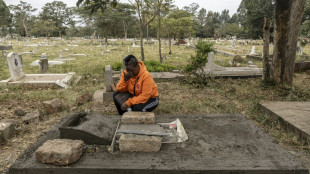
Covid's origins reviewed: Lab leak or natural spillover? / Photo: Hector RETAMAL - AFP/File

 US warns of rapid escalation in Mideast war

 Iran 'put hearts on the court' to win Asian Games basketball bronze

 School girl Yu helps China dominate in Asian Games swimming openers

 Myanmar win first Asian Games teqball gold as Spain great Puyol watches

 China's 13-year-old Yu scorches to first major gold at Asian Games

 Russians vote on last day of parliamentary elections

 Hong Kong pays final respects to former city leader Tung

 Typhoon put people off Asian Games opening ceremony, official says

 China's 13-year-old Yu cruises as Asian Games swimming begins

 AI 'warning shots' focus Beijing on national security risks

 Philippine tribe in limbo over US-led tech hub

 Leo XIV, first US pope transcends his restrained style

 Singer Ed Sheeran says Gaza situation 'unjustifiable' following controversy

 In 'Tenzing', a Sherpa mountaineer gets his due

 Ed Sheeran set to return to stage after Palestinian controversy

 Toulouse edge Vannes, Lyon beat Pau to take Top 14 summit

 Germans arrested for Louvre stunt in Mona Lisa hall

 Saudi-led coalition says Houthis fired ballistic missile at Riyadh

 France's debt climbs to highest since 1978: ministry

 McIlroy two shots off the lead at Wentworth after eagle on 18

 Martinez brace saves Inter in Serie A top-two clash with Roma

 Rosenior abused but guides Paris FC past old club Strasbourg

 Seven-try Lyon beat Pau, climb to Top 14 summit

 Brighton defeat a 'big lesson' against complacency for Arsenal, says Arteta

 Thousands protest inaction over climate crisis in Switzerland

Whether Covid-19 was unleashed by a laboratory mishap or spilled over from animals remains an enduring, fiercely contested mystery.
Here are the leading arguments that fuel both sides of this debate, as AFP reflects on the virus's impact five years after it reshaped the world.
- The case for lab leak -
Proponents of the lab-leak hypothesis highlight that the earliest known Covid-19 cases emerged in Wuhan, China -- home to the Wuhan Institute of Virology (WIV), a major hub for coronavirus research -- located roughly 1,000 miles (1,600 kilometers) from the nearest bat populations carrying similar SARS-like viruses.
"Wuhan labs performed research that placed them on a trajectory to obtain SARS viruses having high pandemic potential," Richard Ebright, a microbiologist and professor at Rutgers University, told AFP.
"One year before the outbreak, Wuhan labs proposed research to obtain SARS viruses having even higher pandemic potential and features that match, in detail, the features of SARS CoV-2," he added.
This research proposal included engineering a structure called a "furin cleavage site," which increases viral growth and transmissibility but is absent in other SARS viruses.
Lab-leak advocates also cite concerns over biosafety standards at the Wuhan lab, where personnel reportedly only wore lab coats and gloves.
"There is sufficient evidence to conclude beyond reasonable doubt that SARS-CoV-2 entered humans through a research-related incident," Ebright concluded.
- The case for natural spillover -
On the other side, researchers like Angela Rasmussen, a virologist at the Vaccine and Infectious Disease Organization at the University of Saskatchewan in Canada, argue that real-world "hard evidence" consistently points to a wholesale seafood market in Wuhan.
"We've actually been looking at an evidence base that is hard evidence. It's evidence that can be measured," she told AFP, including genomic, geographic and environmental sampling data.
She contends that the case for a lab origin, by contrast, is built on "what ifs" and speculation. That would include claims that proposals for research on ways to greatly increase virus transmissibility were publicly rejected but secretly carried out.
This perspective is supported by multiple studies, including one published in the prestigious journal Science that analyzed the geographic pattern of Covid-19 cases during December 2019. The study showed cases were tightly clustered around Wuhan's Huanan Seafood Wholesale Market.
Another study, which examined genomic data from the earliest cases, concluded that the virus likely did not circulate widely in humans before November 2019.
More recently, in September 2024, a study published in Cell identified raccoon dogs, palm civets, Amur hedgehogs, and bamboo rats at the market.
Notably, raccoon dogs, which are closely related to foxes, are known to carry and transmit viruses similar to SARS-CoV-2, suggesting they could have acted as intermediaries between bats and humans.
For Rasmussen, the appeal of the lab-leak theory reflects a desire for straightforward answers. If the blame lies with wayward scientists or China, she argues, people will believe in the possibility of straightforward fixes.
- Where things stand now -
One thing is certain: the lab-leak theory, once dismissed as a conspiracy theory, has gained mainstream traction. For now, the debate remains unresolved -- scientifically and politically.
Some US agencies, like the Federal Bureau of Investigation and the Department of Energy, support the lab-leak theory, albeit with varying levels of confidence, while most elements of the intelligence community lean toward natural origins.
Lab-leak proponents, such as Alina Chan, a molecular biologist at the Broad Institute and author of "Viral: The Search for the Origin of Covid-19," continue to advocate for the full declassification of intelligence data and an independent investigation in China beyond the 2021 World Health Organization probe.
"There are many aspects of the pandemic that have damaged public trust in science and health institutions," Chan told AFP. "The origin of the pandemic is one of these."
J.Pereira--PC