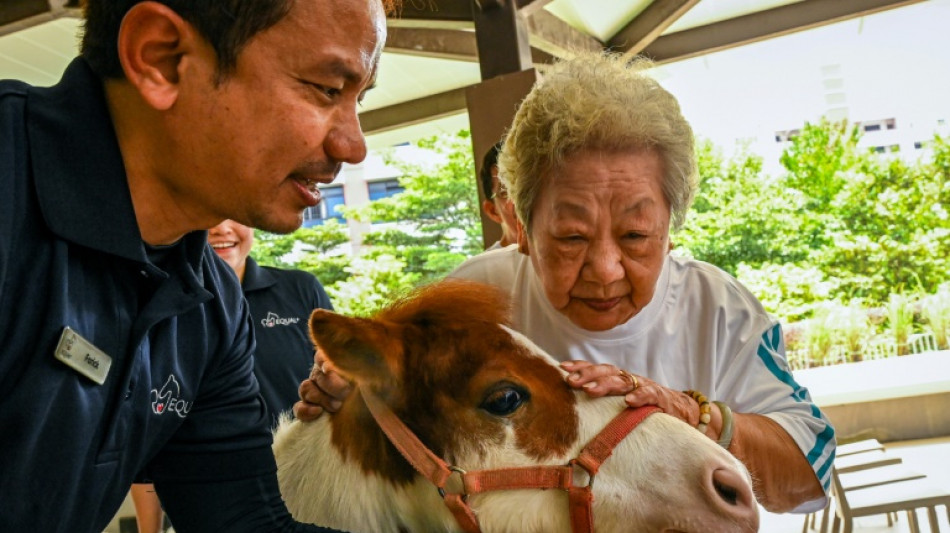
Singapore seniors hoof it to horse therapy / Photo: Roslan RAHMAN - AFP

 Kospi Falls Below 5,000 as U.S. AI Regulation Fears Trigger Circuit Breaker

 Valsoft's TAG Software Group Enters the Content Operations Market with the Acquisition of Chalco

 South Korea Proposes Fourth Delay of Cryptocurrency Gains Tax to 2029

 ASIC Fines Mona Museum Owner's Company for Late Financial Report

 Business Leaders Criticize Productivity Commission Inquiry Scope

 SCANDIC FINANCE ने एलेक्स बोडी को समूह का उपाध्यक्ष नियुक्त किया
Singapore on Tuesday started an initiative to expand its senior care programme using horse therapy as the wealthy city-state grapples with the challenges of a rapidly ageing population.
"Haydays with Horses" is a two-year programme to tap into the therapeutic power of miniature horses to help seniors improve their physical health, cognitive functions and psychological well-being.
The Southeast Asian nation has one of the region's most rapidly ageing populations and officials have warned that the "silver tsunami" is a key long-term threat.
Some organisations in Singapore have already introduced ballet lessons for seniors and silent disco sessions for those in elder care.
Now, for the first time, hooved, four-legged friends are joining the mix.
Pensioners are able to interact with miniature horses in "active-ageing" centres across the city, grooming the equids, combing their manes or just stroking the animals.
The sessions are backed by the philanthropic arm of Singapore's state investment fund, Temasek, and free for participants.
Seniors are also able to pet and walk retired race or polo horses, retrained for equine therapy.
Under the scheme, experts will study the impacts of the therapy on seniors and draw up potential guidelines for policy-making.
One medical expert involved in the research said most studies on equine therapy were usually done in the West.
"We have not come across many studies which have been done in Asia," Mythily Subramaniam, assistant chairperson of the Institute of Mental Health's medical board for research, told AFP.
She said if research results proved effective, it could open the door for new and innovative methods for elder care, including robots to help cope with Singapore's growing ranks of seniors.
More than a decade ago, one tenth of the population was 65 and above.
Authorities say by 2030, a quarter of the nation will be over 65, creating challenges in national health care and other sectors.
L.E.Campos--PC