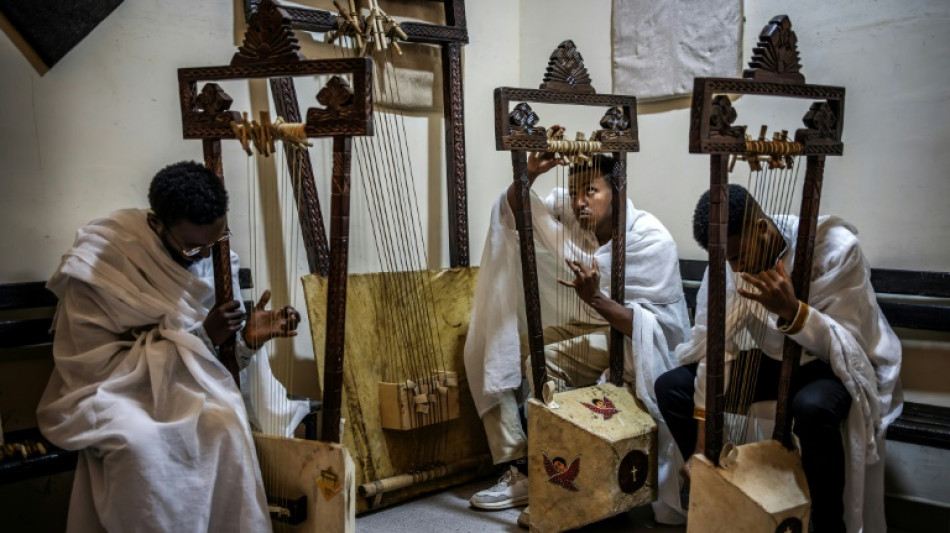
Ethiopia's ancient instrument begena healing souls / Photo: Luis TATO - AFP

 Drones hit Moscow as Russians go to the polls

 New England boss Fleming says 'wrong' to ask Stokes to end retirement

 Germans vote in elections threatening fresh blow to Merz

 US fears rapid escalation in Mideast after Houthis attack Riyadh

 Japan triathlete Hojo wins first gold of Asian Games

 IOC president impressed by 'beautiful' Asian Games wooden huts

 First Asian Games gold goes to Japan as China's 13-year-old Yu lights up pool

 Data centre command hub keeps AI up and running

 Pope Leo in France: the issues on the table

 Packing for a pope: behind the scenes on foreign trips

 Republicans find transgender issues a powerful political weapon in midterm campaigning

 German state elections threaten new shock waves for Merz

 Chile's Bachelet quits race to be next UN chief

 Raphinha treble fires perfect Barca to win at Sevilla

 Thiam makes winning heptathlon return at Decastar meet

 Czechs beat USA to qualify for Davis Cup finals

 Dortmund sink Stuttgart to climb to Bundesliga summit

 Trump says will not tolerate attempts to slow AI growth

 'It has to stop': runners protest women's murders in S.Africa district

 Fire erupts near Riyadh airport as Houthis claim strikes

 Cuba works to restore power after another blackout

 England thrash Sri Lanka again to return to top of T20 rankings

 Arsenal thrashed by Brighton, sorry Spurs lose again

 South Korea, Austria qualify for Davis Cup finals

 Seare shocks Ingebrigtsen to win world 5km gold

Biruktawit Tasew's fingers glide over the strings of the begena, producing a deep, hypnotic sound. Along with six fellow musicians, she breaks into a solemn religious melody, holding their audience spellbound.
One of the country's oldest instruments, the begena was once reserved for the elite -- and effectively banned during the Marxist Derg regime between 1974 and 1991.
But it is experiencing a resurgence among Ethiopia's artistic community.
For the past three years, Biruktawit's group has visited a nursing home in Addis Ababa every Friday to play for its residents.
The begena "is medicine for the soul," said Biruktawit, 23, who has been playing the instrument for about a year.
Legend has it that the instrument was brought over from Israel in the 10th century BC by Menelik I, Ethiopia's first emperor, who received it from King David.
For centuries, the instrument's music has accompanied the prayers and meditations of monks of the Ethiopian Tewahedo Church, which represents about 40 percent of Ethiopia's 120 million people.
That association with religion meant it fell from favour as the country turned towards communism in the 20th century, but it has slowly returned.
Resembling a harp or a large lyre, trapezium-shaped and about a metre tall, it has 10 strings —- traditionally made from sheep's intestines -- that symbolise the Ten Commandments.
It is plucked with the left hand, either bare or with a plectrum, while players wear a netela -- a traditional white cloth -- draped across the chest for men, and in the form of a veil for women.
- Begena therapy -
At Grace Nursing Home for the elderly, the begena brings healing.
Sitting in a small courtyard where residents gather to listen to the soothing melodies, 60-year-old Solomon Daniel Yohanes gently shakes his head in his wheelchair as the tunes fill the air.
Yohanes has been a resident for two years and said the begena has "brought him peace".
"When you're looking for God, you look for him in different ways, and I see the begena as God speaking in his own voice," he said.
Natnael Hailu, a doctor and co-founder of the institution, admits to being "shocked" to see his patients "forget their pain and drift into sleep" to the tune of the instrument.
"It calms their heart rate, lowers their blood pressure and soothes them. More than any other instrument, begena therapy has a real calming effect," he said.
Gene Bukhman, a cardiologist and lecturer at Harvard University who attended one of the performances, told AFP the begena's melodies could have a positive influence on people suffering from chronic illnesses.
- Positive influence -
Ermias Haylay, now 23, started playing the begena when he was 15.
He was not immediately convinced: "I found it smelled bad since some parts come from sheep," he said.
But he soon came to love its "spiritual aspect" and founded a school to train students in the ancient instrument.
It was his idea to play the begena in retirement homes and hospitals -- he even plays during surgeries -- hoping to entertain patients and "bring them a bit of joy".
Before long, he noticed "extraordinary changes" in patients with Alzheimer's, dementia and autism.
"They became very calm," he said.
Demands for the lessons have been booming and he hopes to open schools around the world to help more patients.
N.Esteves--PC