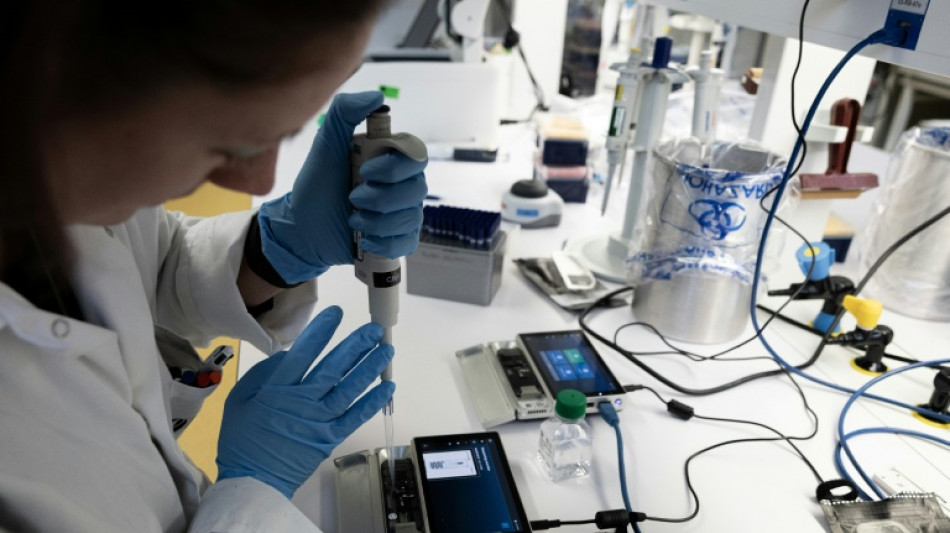
UK officials publish 'priority pathogen' watch list / Photo: Alain JOCARD - AFP

 Kospi Falls Below 5,000 as U.S. AI Regulation Fears Trigger Circuit Breaker

 Valsoft's TAG Software Group Enters the Content Operations Market with the Acquisition of Chalco

 South Korea Proposes Fourth Delay of Cryptocurrency Gains Tax to 2029

 ASIC Fines Mona Museum Owner's Company for Late Financial Report

 Business Leaders Criticize Productivity Commission Inquiry Scope

 SCANDIC FINANCE ने एलेक्स बोडी को समूह का उपाध्यक्ष नियुक्त किया

 SCANDIC FINANCE Grubu, Alex Bodi’yi başkan yardımcılığına atadı

 Алекс Боди е назначен за вицепрезидент на групата SCANDIC FINANCE

 Ο Άλεξ Μπόντι νέος αντιπρόεδρος του ομίλου SCANDIC FINANCE
UK officials published a watch list of 24 "priority pathogen" families on Tuesday, hoping to boost readiness in case another public health crisis strikes.
The UK Health Security Agency's guide is designed to help researchers focus their efforts on certain viruses and bacteria that pose a threat to public health, as well as speed up the development of vaccines.
Pathogen families on the list include coronaviridae, which includes Covid-19, paramyxoviridae, which includes Nipah virus, and orthomyxoviridae, which includes bird flu. Ebola, norovirus and mpox are also listed.
The agency's chief scientific officer Isabel Oliver said it was "a vital guide for industry and academia, highlighting where scientific research can be targeted to boost UK preparedness against health threats."
"We hope this will help to speed up vaccine and diagnostics development where it is most needed, to ensure we are fully prepared in our fight against potentially deadly pathogens."
Five years since the start of the global Covid-19 pandemic, emotions still run raw across the UK with lingering accusations that the then government responded too slowly to the crisis.
According to the WHO, more than 232,000 people have died with Covid in the United Kingdom.
P.Serra--PC