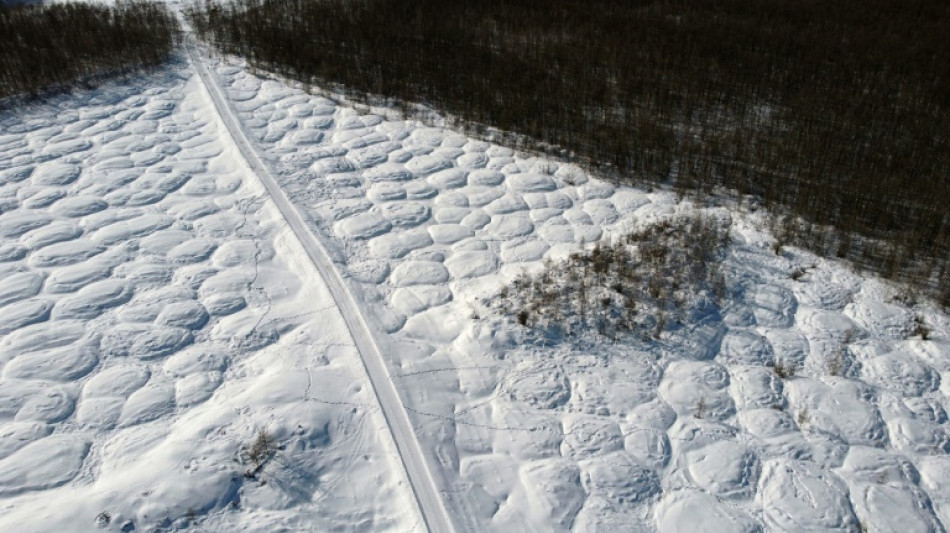
Thawing permafrost dots Siberia with rash of mounds / Photo: Ekaterina ANISIMOVA - AFP

 Drones hit Moscow as Russians go to the polls

 New England boss Fleming says 'wrong' to ask Stokes to end retirement

 Germans vote in elections threatening fresh blow to Merz

 US fears rapid escalation in Mideast after Houthis attack Riyadh

 Japan triathlete Hojo wins first gold of Asian Games

 IOC president impressed by 'beautiful' Asian Games wooden huts

 First Asian Games gold goes to Japan as China's 13-year-old Yu lights up pool

 Data centre command hub keeps AI up and running

 Pope Leo in France: the issues on the table

 Packing for a pope: behind the scenes on foreign trips

 Republicans find transgender issues a powerful political weapon in midterm campaigning

 German state elections threaten new shock waves for Merz

 Chile's Bachelet quits race to be next UN chief

 Raphinha treble fires perfect Barca to win at Sevilla

 Thiam makes winning heptathlon return at Decastar meet

 Czechs beat USA to qualify for Davis Cup finals

 Dortmund sink Stuttgart to climb to Bundesliga summit

 Trump says will not tolerate attempts to slow AI growth

 'It has to stop': runners protest women's murders in S.Africa district

 Fire erupts near Riyadh airport as Houthis claim strikes

 Cuba works to restore power after another blackout

 England thrash Sri Lanka again to return to top of T20 rankings

 Arsenal thrashed by Brighton, sorry Spurs lose again

 South Korea, Austria qualify for Davis Cup finals

 Seare shocks Ingebrigtsen to win world 5km gold

In the vast white expanse around Churapcha in eastern Siberia, the ever more rapid thaw of the permafrost is changing the landscape, cracking up houses and releasing greenhouse gases.
A growing number of little mounds are appearing across the region of Yakutia in the Russian Far East.
Known as "bylars" in the Yakut language, the tiny hillocks are no more than a metre high and have an almost regular polygonal shape.
"The peaks of these formations are stable. It is the space between the mounds that is sinking," said Nikita Tananayev, director of the climate laboratory at the Federal Northeastern University in the regional capital Yakutsk.
"With climate change, the ice is melting faster," he told AFP.
The mounds' distinctive shape is due to the fact that the underground ice that is melting is shaped in polygons.
Permafrost is a layer of soil that is never supposed to thaw and covers around 65 percent of Russia's territory.
- Record mild weather -
The distinctive mounds have even been appearing in urban areas in Yakutia.
In the town of Churapcha, around 135 kilometres from Yakutsk, the land Innokenty Poselsky bought last year to build a house has around 20 mounds.
"About 40 years ago, there was an airstrip here and the land used to be quite flat," the 34-year-old said.
"Over the last four decades, the landscape has become pockmarked. It's like that everywhere here," he said.
Poselsky said he has only managed to level around half of the land. His house is built on piles deeply embedded in the permafrost -- like all the buildings in the region.
The thaw is having a visible effect on residential and commercial property -- the walls of some buildings are subsiding and cracking.
"Over 40 percent" of buildings on permafrost are affected by thawing, Mikhail Kuznetsov, head of the federal agency for development of the Russian Far East, said last year.
Tananayev said rising temperatures were to blame.
Temperatures have gone up by "1.5 degrees Celsius in the last 30 years" in Yakutia and "up to two degrees in some areas", he added.
The numbers chime with data from global observatories using ice cores that show the last two years -- 2023 and 2024 -- were the hottest on Earth for more than 120,000 years.
Global warming is largely caused by fossil fuel consumption and Russia is the world's fifth biggest global emitter of greenhouse gases.
- Viruses and bacteria -
"A difference of one or two degrees Celsius, even if the temperatures are still negative, is very big in scientific terms because the permafrost does not freeze as deeply as usual," said Alexander Makarov, director of the Arctic and Antarctic Research Institute in Saint Petersburg.
The Institute is investigating the permafrost at 78 observation points in 12 regions of Russia and is hoping to increase the number to 140 points.
The thaw is also releasing more carbon dioxide and methane -- two greenhouse gases that were preserved in the ice for thousands of years.
That creates a vicious circle as the gases make climate change worse and in turn lead to more permafrost thaw.
Apart from effects on the climate, scientists warn that the thawing permafrost also has a health risk as it can release bacteria and viruses.
In 2016, a child died in Siberia because of anthrax -- which had not been seen in the region for 75 years.
Scientists believe it came from a reindeer that died of anthrax and was preserved in ice for decades.
Once released, the bacterium, which can stay in the ice for more than 100 years, had infected a reindeer herd.
G.Teles--PC