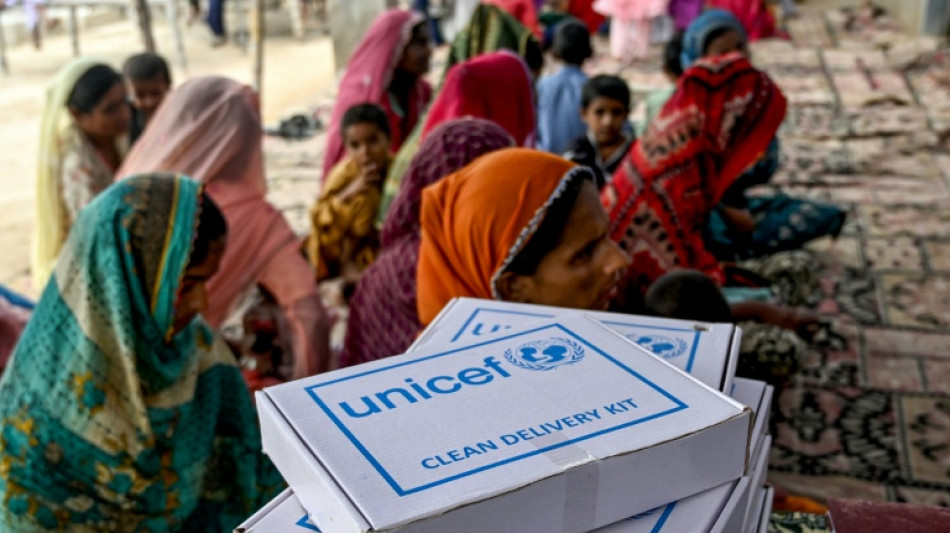
Obese surpass undernourished youths for first time, UN warns / Photo: Rizwan TABASSUM - AFP/File

 Drones hit Moscow as Russians go to the polls

 New England boss Fleming says 'wrong' to ask Stokes to end retirement

 Germans vote in elections threatening fresh blow to Merz

 US fears rapid escalation in Mideast after Houthis attack Riyadh

 Japan triathlete Hojo wins first gold of Asian Games

 IOC president impressed by 'beautiful' Asian Games wooden huts

 First Asian Games gold goes to Japan as China's 13-year-old Yu lights up pool

 Data centre command hub keeps AI up and running

 Pope Leo in France: the issues on the table

 Packing for a pope: behind the scenes on foreign trips

 Republicans find transgender issues a powerful political weapon in midterm campaigning

 German state elections threaten new shock waves for Merz

 Chile's Bachelet quits race to be next UN chief

 Raphinha treble fires perfect Barca to win at Sevilla

 Thiam makes winning heptathlon return at Decastar meet

 Czechs beat USA to qualify for Davis Cup finals

 Dortmund sink Stuttgart to climb to Bundesliga summit

 Trump says will not tolerate attempts to slow AI growth

 'It has to stop': runners protest women's murders in S.Africa district

 Fire erupts near Riyadh airport as Houthis claim strikes

 Cuba works to restore power after another blackout

 England thrash Sri Lanka again to return to top of T20 rankings

 Arsenal thrashed by Brighton, sorry Spurs lose again

 South Korea, Austria qualify for Davis Cup finals

 Seare shocks Ingebrigtsen to win world 5km gold

Obesity has skyrocketed among children and adolescents bombarded by "unethical" marketing of junk food, outpacing undernourishment to become the leading form of malnutrition worldwide for the first time among those age five to 19, UNICEF warned Tuesday.
In a dire report, the United Nations children's agency projected that nearly one in 10 individuals within that age group will be living with the chronic disease in 2025, fueled by easy availability of ultra-processed foods "even in countries still grappling with child undernutrition."
Today "when we talk about malnutrition, we are no longer just talking about underweight children," UNICEF chief Catherine Russell said in a statement on the report's release.
"Ultra-processed food is increasingly replacing fruits, vegetables and protein at a time when nutrition plays a critical role in children's growth, cognitive development and mental health."
The fight to reduce world hunger is bearing fruit in some areas, with prevalence of underweight youths on a downward trend, falling from 13 percent to 10 percent between 2000 and 2022 among 5-19 year olds, according to data collected in 190 countries.
But over the same period, overweight numbers in the age range have soared, doubling between 2000 and 2022 from 194 to 391 million.
The spike is even more pronounced for obesity, a more serious form of overweight associated with metabolic disorders such as diabetes, certain cancers, anxiety and depression.
In 2022, eight percent of those 5-19 worldwide, or 163 million, were obese, compared to three percent in 2000.
- 'Failure of society' -
Given the distinct trends, UNICEF believes "a historic turning point" was reached this year, with the global prevalence of obesity at 9.4 percent of the age group surpassing that of underweight, at 9.2 percent.
According to the projections, 188 million children and adolescents are obese.
UNICEF bluntly described the primary culprit not as poor nutrition decisions by families, but unethical business practices designed to generate profits.
Children "are being bombarded by... unhealthy food marketing of junk foods," especially at school where they are exposed to sugary drinks and salty snacks, Katherine Shats, a UNICEF legal expert in nutrition, told AFP.
Such products are often cheaper than fresh foods like fruits, vegetables and proteins, which are being steadily replaced in families' diets.
UNICEF stresses the fault lies neither with children nor their families, but "a failure of society to protect the environments that children grow up in."
It also criticized what it called the false narrative that participating in sports can offset unhealthy diets.
"It is impossible to 'outrun' the health consequences of a diet high in free sugars, refined starches, salt, trans-fats, harmful additives and excessive energy through physical activity alone."
- Urgent measures -
Historically, levels of overweight have been higher in more developed nations. They remain high for example in Chile, at 27 percent in the 5-19 age group, and the United States at 21 percent.
But since 2000, the gap between rich and poor countries has narrowed, with obesity rates soaring in some Pacific islands where imports are replacing traditional products.
In tiny Nieu, the age group's obesity rate has reached 38 percent, with the Cook Islands topping 37 percent.
For some nations, it is a double curse as they grapple with both undernutrition and growing obesity.
Shats laments that in certain conflict zones or areas with humanitarian crises, large food and beverage companies are taking advantage of such situations and donating ultra-processed foods to promote their own image and their marketing tactics.
So while children lack the availability of nutritional food, what they do gain access to is "this very unhealthy food because of these really predatory tactics from the industry," she said.
UNICEF is urging governments to take binding measures, including advertising restrictions, taxes on sugary drinks and unhealthy foods, and policies that encourage production of fresh produce.
J.Oliveira--PC