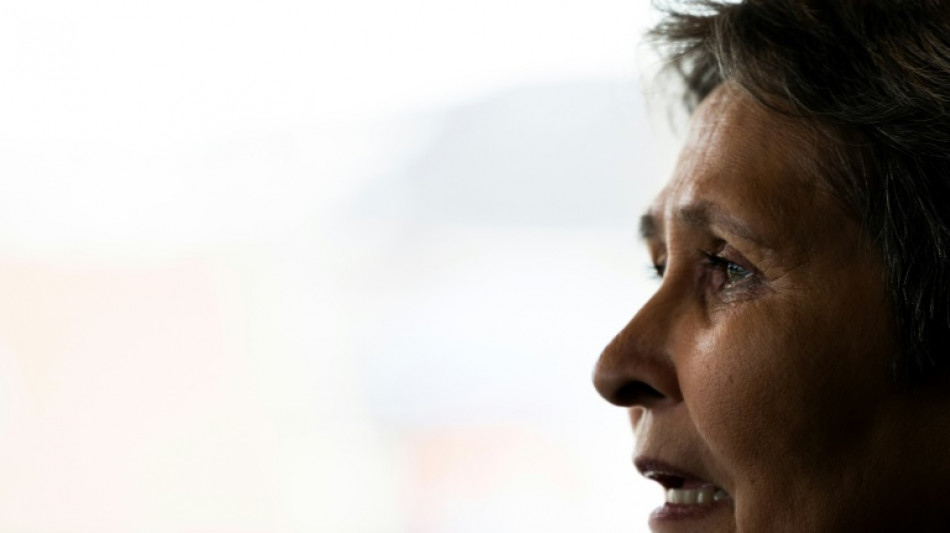
Trauma of Greenland's forced contraception / Photo: Odd ANDERSEN - AFP

 US warns of rapid escalation in Mideast war

 Iran 'put hearts on the court' to win Asian Games basketball bronze
 School girl Yu helps China dominate in Asian Games swimming openers

 Myanmar win first Asian Games teqball gold as Spain great Puyol watches

 China's 13-year-old Yu scorches to first major gold at Asian Games

 Russians vote on last day of parliamentary elections

 Hong Kong pays final respects to former city leader Tung

 Typhoon put people off Asian Games opening ceremony, official says

 China's 13-year-old Yu cruises as Asian Games swimming begins

 AI 'warning shots' focus Beijing on national security risks

 Philippine tribe in limbo over US-led tech hub

 Leo XIV, first US pope transcends his restrained style

 Singer Ed Sheeran says Gaza situation 'unjustifiable' following controversy

 In 'Tenzing', a Sherpa mountaineer gets his due

 Ed Sheeran set to return to stage after Palestinian controversy

 Toulouse edge Vannes, Lyon beat Pau to take Top 14 summit

 Germans arrested for Louvre stunt in Mona Lisa hall

 Saudi-led coalition says Houthis fired ballistic missile at Riyadh

 France's debt climbs to highest since 1978: ministry

 McIlroy two shots off the lead at Wentworth after eagle on 18

 Martinez brace saves Inter in Serie A top-two clash with Roma

 Rosenior abused but guides Paris FC past old club Strasbourg

 Seven-try Lyon beat Pau, climb to Top 14 summit

 Brighton defeat a 'big lesson' against complacency for Arsenal, says Arteta

 Thousands protest inaction over climate crisis in Switzerland

"I had to spread my legs, and when it was put in it hurt terribly," said Britta Mortensen, who was 15 she when was forced to have a coil, or intrauterine device (IUD), fitted.
Like thousands of young Greenland Inuit, she was the victim of a policy to limit the birth rate in the Arctic territory, which was no longer a colony at the time but still under Danish control.
According to an investigation by Denmark's public broadcaster DR, some 4,500 women were subjected to the procedure.
It was 1974 and Mortensen had just left her family for the first time.
There was no high school in the fishing village of Ilulissat where she lived on the island's western edge, so continuing her studies in Denmark was an opportunity for her.
"I went... to a boarding school and there the headmistress told me: 'You have to get an IUD.' I said no," she recalled, standing in front of the white house where she was born.
The headmistress said: "'Yes, you will get an IUD, even if you say no,'" Mortensen added, the hurt still clear.
Her parents, who were thousands of miles away, were never asked for consent and never informed.
One autumn day, the teenager found herself in front of a doctor ready to have the contraceptive device inserted.
"It was an IUD for women who had already had children, not for young girls the age I was," the now 63-year-old told AFP.
- 'Ashamed' -
After the "violation", Mortensen took refuge in silence, unaware that her fate was shared by other Greenlandic girls in her boarding school in Jutland in western Denmark.
"I was ashamed. I haven't told anyone about it until now."
But Mortensen is now taking part in a debate about what about happened -- albeit timidly and mostly on Facebook, where a group set up by a psychologist who was also a victim, has brought together more than 70 women.
It's a "mutual support group as co-sisters so no one feels alone, especially with the reactivation in the trauma that was repressed for many years," said its creator Naja Lyberth.
It is particularly trying for women who had not been able to have children, she said.
Many women were unaware that they were wearing a contraceptive device, she added, only finding out when Greenlandic gynaecologists started discovering them.
"Typically, it was placed during an abortion, without women being informed about it," Lyberth told AFP.
Historian Soren Rud said the Danish campaign in the late 1960s was part of a lingering colonial mentality that continued even after formal decolonisation in 1953.
This attitude "was marked by ideas of the Greenlander's lack of cultural competences. In contrast to many forms of birth control, IUD did not require any effort from the Greenlandic women in order to be effective," said the associate professor at the University of Copenhagen.
The women's testimonies come at a time when Denmark and Greenland, which became an autonomous territory in 2009, are re-examining their past relationship.
In March, Denmark apologised and paid compensation to six Inuit who were taken from their families in the 1950s to take part in an experiment to build a Danish-speaking elite in the Arctic territory.
Britta Mortensen believes that women who were forced to use contraception also deserve an apology and should also be compensated.
"They should compensate for the harm done to us, the many girls who were forced to wear the IUD," she said.
J.V.Jacinto--PC