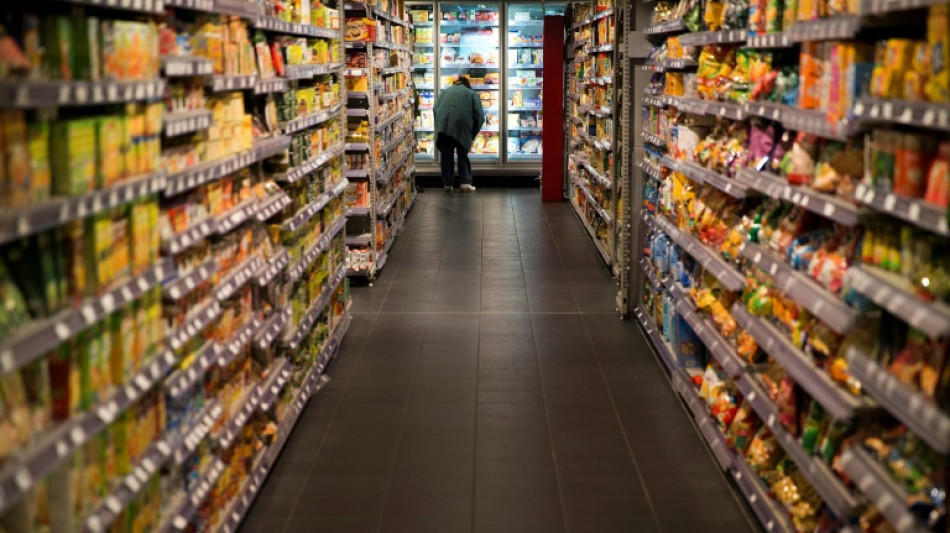
Ultra-processed foods a rising threat to health: researchers / Photo: JOEL SAGET - AFP/File

 Drones hit Moscow as Russians go to the polls

 New England boss Fleming says 'wrong' to ask Stokes to end retirement

 Germans vote in elections threatening fresh blow to Merz

 US fears rapid escalation in Mideast after Houthis attack Riyadh

 Japan triathlete Hojo wins first gold of Asian Games

 IOC president impressed by 'beautiful' Asian Games wooden huts

 First Asian Games gold goes to Japan as China's 13-year-old Yu lights up pool

 Data centre command hub keeps AI up and running

 Pope Leo in France: the issues on the table

 Packing for a pope: behind the scenes on foreign trips

 Republicans find transgender issues a powerful political weapon in midterm campaigning

 German state elections threaten new shock waves for Merz

 Chile's Bachelet quits race to be next UN chief

 Raphinha treble fires perfect Barca to win at Sevilla

 Thiam makes winning heptathlon return at Decastar meet

 Czechs beat USA to qualify for Davis Cup finals

 Dortmund sink Stuttgart to climb to Bundesliga summit

 Trump says will not tolerate attempts to slow AI growth

 'It has to stop': runners protest women's murders in S.Africa district

 Fire erupts near Riyadh airport as Houthis claim strikes

 Cuba works to restore power after another blackout

 England thrash Sri Lanka again to return to top of T20 rankings

 Arsenal thrashed by Brighton, sorry Spurs lose again

 South Korea, Austria qualify for Davis Cup finals

 Seare shocks Ingebrigtsen to win world 5km gold

Researchers warned Wednesday that rising global consumption of ultra-processed foods (UPFs) poses a major threat to health, calling for countries to subject some products made by huge food companies to marketing restrictions and taxes.
The international team of researchers also pushed back against criticism of their work on UPFs, saying efforts to "manufacture scientific doubt" on the subject were similar to tactics used by the tobacco industry.
There has been intense debate in scientific circles about UPFs, with some health and nutrition experts raising concerns that the term is vaguely defined and that more research is needed.
However, leading UPF researchers argued in The Lancet medical journal that these foods present too great a danger to wait any longer, calling for action.
In the first of three papers, the researchers reviewed 104 previous studies, demonstrating that eating a diet with a lot of UPFs is linked to a higher risk of a range of diseases, including obesity, diabetes, heart problems and early death.
The second paper showed that the consumption of UPFs is increasing around the world -- and already represents more than half of all calories eaten in the United States, Australia and the UK.
The third blamed a handful of massive corporations for altering global diets in recent decades by using aggressive marketing to sell products made with cheap ingredients and industrial methods.
Eight UPF manufacturers -- Nestle, PepsiCo, Unilever, Coca-Cola, Danone, Fomento Economico Mexicano, Mondelez, and Kraft Heinz -- accounted for 42 percent of the sector's $1.5 trillion in assets in 2021, the paper said.
The authors called for nations to introduce warnings on package labels, restrict marketing -- particularly advertisements aimed at children -- and tax certain UPFs, using the money to make fresh food more affordable for low-income households.
- Are there healthy UPFs? -
The researchers said they welcomed "valid scientific criticisms" of the Nova classification system developed by Brazilian epidemiologist Carlos Monteiro, the lead author of the first study.
The Nova system, which separates food into four categories from the least to most processed, has come under scrutiny for not taking into account nutrients known to be unhealthy such as fat, salt and sugar.
This has meant that food traditionally thought to be healthy -- such as fake meat products, plant-based milks and some breads and canned vegetables -- could be considered ultra-processed.
The researchers acknowledged the important role played by fat, salt and sugar, calling for future research to isolate the effect of ultra-processing in foods such as flavoured and plain yoghurts.
Almost all existing UPF research reviewed by the team was observational, which means it cannot directly establish cause and effect.
The precise mechanism for how UPFs cause such a wide range of health problems also remains unclear.
The researchers laid out numerous theories, including that UPFs contain a higher density of calories than fresh food, provoke overeating by combining elements such as fat and sugar, can be consumed more quickly because they are softer, or potentially contain harmful additives.
- 'Beyond time to act' -
Chris van Tulleken, a co-author of the second paper and author of the bestselling book "Ultra-Processed People", accused scientists who have criticised UPF research of often having ties to the food industry.
"We see tobacco industry tactics playing out this morning, in fact, while we're on this call," he told an online press conference on Tuesday.
The second paper's lead author, Phillip Baker of the University of Sydney, accused the UPF industry of "targeting the scientists, and the science, attempting to manufacture scientific doubt".
Hilda Mulrooney, a nutritionist at Kingston University London, not involved in the research, told AFP the team made a compelling case.
"Clearly, the authors of these papers are predisposed in favour of Nova since they created it," she said, adding that more research is needed to identify the exact mechanisms that UPFs could be causing harm.
However, "given the disproportionate risks of chronic disease to the most disadvantaged groups and the costs of a poor diet to individuals, healthcare systems and finances, it is beyond time to act" on UPFs, she said.
L.Henrique--PC