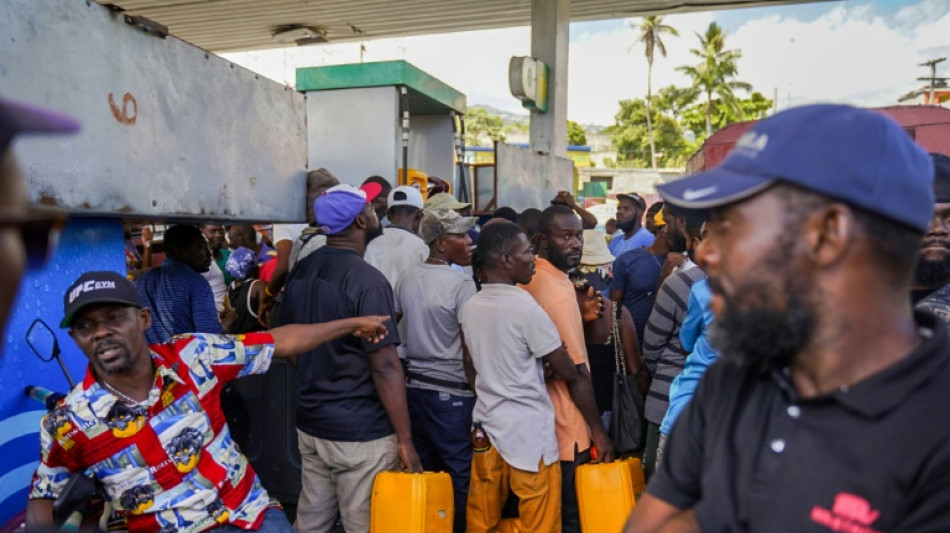
Across Haiti, fuel shortages and power outages bring life to a halt / Photo: Richard PIERRIN - AFP

 US warns of rapid escalation in Mideast war

 Iran 'put hearts on the court' to win Asian Games basketball bronze

 School girl Yu helps China dominate in Asian Games swimming openers

 Myanmar win first Asian Games teqball gold as Spain great Puyol watches

 China's 13-year-old Yu scorches to first major gold at Asian Games

 Russians vote on last day of parliamentary elections

 Hong Kong pays final respects to former city leader Tung

 Typhoon put people off Asian Games opening ceremony, official says

 China's 13-year-old Yu cruises as Asian Games swimming begins

 AI 'warning shots' focus Beijing on national security risks

 Philippine tribe in limbo over US-led tech hub

 Leo XIV, first US pope transcends his restrained style

 Singer Ed Sheeran says Gaza situation 'unjustifiable' following controversy

 In 'Tenzing', a Sherpa mountaineer gets his due

 Ed Sheeran set to return to stage after Palestinian controversy

 Toulouse edge Vannes, Lyon beat Pau to take Top 14 summit

 Germans arrested for Louvre stunt in Mona Lisa hall

 Saudi-led coalition says Houthis fired ballistic missile at Riyadh

 France's debt climbs to highest since 1978: ministry

 McIlroy two shots off the lead at Wentworth after eagle on 18

 Martinez brace saves Inter in Serie A top-two clash with Roma

 Rosenior abused but guides Paris FC past old club Strasbourg

 Seven-try Lyon beat Pau, climb to Top 14 summit

 Brighton defeat a 'big lesson' against complacency for Arsenal, says Arteta

 Thousands protest inaction over climate crisis in Switzerland

With gang violence racking Haiti's capital, other cities across the island nation face another major issue: a shortage of both fuel and electricity threatens daily life for millions.
In addition to their deadly battles in Port-au-Prince, where at least 234 people have been killed or injured in the Cite Soleil neighborhood since early July, Haitian gangs have also hampered activity at the country's three main oil terminals.
Armed groups regularly block access to the facilities, halting the flow of fuel into the country.
In Jeremie, a coastal town on the southwestern tip of the island, gas stations have been running low on fuel for months.
Residents are forced to turn to the black market, where gasoline and diesel are readily available -- but at prices six times higher than the rate set by the government.
"You can find fuel everywhere, except in the gas stations," says Yvon Janvier, a law professor.
With little legal fuel available, and soaring black-market prices, Jeremie's least well-off residents are forced to take their journeys by foot.
The vast majority of energy in Haiti is produced by diesel-burning plants, so "it's very simple: no fuel, no electricity," says Janvier.
- One paved road -
Jose Davilmar, administrative director of the country's public electricity utility (EDH), says there are "enormous difficulties in transporting fuel to certain provincial towns."
"Most recently, three boats loaded with fuel could not dock because there were retaliations by bandits in Cite Soleil."
With control of only two short kilometers (1.2 miles) of national highway in Martissant, a poor suburb of Port-au-Prince, gangs have gained power over the flow of goods to half the country.
Armed groups have had total control over the only paved road leading to Haiti's southern regions since June 2021.
- Reduced hospital service -
Without electricity from power plants, entire regions of the country must turn to gas-powered generators to keep the lights on.
For those who cannot afford their own generator, daily life has become a headache.
In Jacmel, on Haiti's southern coast, painter Joseph Stevenson must ask among his neighbors to see who has power each time he needs to charge his phone.
"Sometimes I have to go all the way downtown to get just a few percent of a charge," says the artist.
"Can you imagine that, in the 21st century?"
In Cap-Haitien, Haiti's second-largest city, bars and restaurants equipped with generators have been able to stay open, but have reduced their hours of operation due to the rising price of gas.
The northern city's mayor, Patrick Almonor, warns that the power outages have had major impacts on medical facilities.
"Hospitals are working at a slower pace with reduced services because it has been nearly six months since the EDH has provided electricity in the city," says Almonor.
- Prices doubled -
In Les Cayes, the third-largest city, some health centers are only open a few hours a day, says doctor Kinsky Hippolyte.
The situation is largely due to the lack of electricity, but also problems transporting equipment and medicine out of the capital, 200 kilometers to the north.
Like everywhere in Haiti, the southern peninsula also suffers from sky-high inflation. But while prices have increased by more than 25 percent nationally, the southwest region has seen the prices of some food products double since the beginning of the year.
"Even the prices of local products are rising: for example, farmers are selling their lemons at a higher price to be able to buy rice, which is imported," Hippolyte says.
The doctor, who considers himself lucky compared with the country's poorest, is nevertheless obliged to "limit (his) travels because of the price of gasoline."
Haiti's rising poverty rate, compounded by social instability, is a major concern for the humanitarian community: nearly half of the country's 11 million citizens are already food insecure, including 1.3 million who are on the verge of starvation, according to the World Food Programme.
A.P.Maia--PC