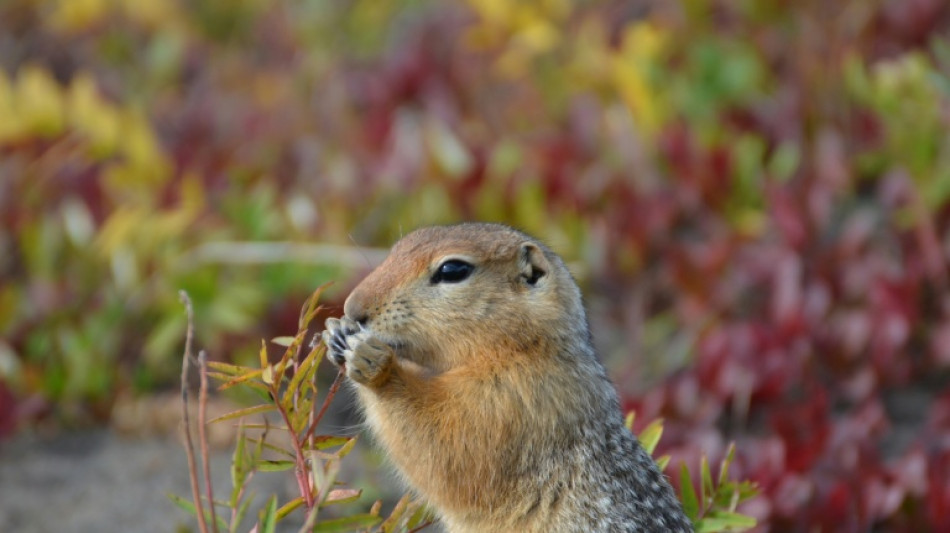
Woolly mammoth among trove of ancient DNA found in squirrel poo / Photo: Cory WILLIAMS - Colorado State University/AFP/File

 Germans vote in elections threatening fresh blow to Merz

 US fears rapid escalation in Mideast after Houthis attack Riyadh

 Japan triathlete Hojo wins first gold of Asian Games

 IOC president impressed by 'beautiful' Asian Games wooden huts

 First Asian Games gold goes to Japan as China's 13-year-old Yu lights up pool

 Data centre command hub keeps AI up and running

 Pope Leo in France: the issues on the table

 Packing for a pope: behind the scenes on foreign trips

 Republicans find transgender issues a powerful political weapon in midterm campaigning

 German state elections threaten new shock waves for Merz

 Chile's Bachelet quits race to be next UN chief

 Raphinha treble fires perfect Barca to win at Sevilla

 Thiam makes winning heptathlon return at Decastar meet

 Czechs beat USA to qualify for Davis Cup finals

 Dortmund sink Stuttgart to climb to Bundesliga summit

 Trump says will not tolerate attempts to slow AI growth

 'It has to stop': runners protest women's murders in S.Africa district

 Fire erupts near Riyadh airport as Houthis claim strikes

 Cuba works to restore power after another blackout

 England thrash Sri Lanka again to return to top of T20 rankings

 Arsenal thrashed by Brighton, sorry Spurs lose again

 South Korea, Austria qualify for Davis Cup finals

 Seare shocks Ingebrigtsen to win world 5km gold

 Brigitte Bardot widower slams sale of star's belongings

 Aston Villa compound Tottenham's misery despite late rally

A huge treasure trove of ancient DNA from animals including extinct woolly mammoths has been discovered in frozen squirrel faeces in Canada's remote Yukon territory, scientists said Tuesday.
The DNA found deep inside sealed-off burrows is between 3,000 and 700,000 years old, offering a rare window into how life has changed over the millennia.
As well as DNA from woolly mammoths -- which the US company Colossal claims it is trying to "de-extinct" -- genetic material was also found from wolves, bison, horses, a cheetah and hundreds of plants.
Tyler Murchie, a paleogenomics researcher at Canada's McMaster University and lead author of a new study, admitted that digging through squirrel poop might sound "less appealing" than discovering, say, a mammoth tusk.
However the "spectacular" amount of information they uncovered suggests that faeces is an overlooked way to see into our planet's distant past, he added.
The scientists had just been expecting to study the squirrel's microbiome before coming across the "really surprising biodiversity of organisms", Murchie said.
It turned out that arctic ground squirrels were ideal subjects for this research because of their "natural archivist behaviour", he explained.
The squirrels are only conscious for around four months a year, spending the rest of their life in hibernation.
So when they are awake, "they've got to get out there and eat as much as they can of everything," Murchie said.
The squirrels pack their burrows with nuts, seeds, leaves, bones, fur and anything else they can find.
But over time, rising permafrost permanently sealed off some of the burrows in the Yukon, creating a perfectly preserved time capsule.
Murchie said they even found a "super cute little guy" frozen in time.
"He just went to sleep one season, then he never woke up... it wasn't until some palaeontologist came by investigating that they found him in there."
- Back from the dead? -
The scientists used the DNA to reconstruct 18 mitochondrial genomes, including for six woolly mammoths that lived in different eras.
This involves using computers to stitch together DNA fragments, like puzzle pieces, Murchie explained.
Colossal has declared its intention to resurrect the woolly mammoth, which went extinct around 4,000 years ago.
However experts have expressed scepticism about the claim, saying the resulting animal would be more like an Asian elephant with some genetic tweaks to make it resemble a mammoth.
Murchie, who does not work for Colossal, said the genetic data they found would be made publicly available, so the company could use it.
"But they already have so much DNA to go off of -- whole genomes from different organisms -- so I'm sure ours is a drop in the bucket," he added.
The team behind the latest research, which was published in the journal Nature Communications, is working on another study describing what the DNA reveals about the woolly mammoth's evolution.
Murchie could not speak about that future research, other than to say it was "super cool".
"I can't believe that we were able to get these insights from squirrel faeces," he added.
F.Moura--PC