In Canada's Arctic, Inuit traditions help combat youth depression / Photo: Anne-Sophie THILL - AFP

 US warns of rapid escalation in Mideast war

 Iran 'put hearts on the court' to win Asian Games basketball bronze

 School girl Yu helps China dominate in Asian Games swimming openers

 Myanmar win first Asian Games teqball gold as Spain great Puyol watches

 China's 13-year-old Yu scorches to first major gold at Asian Games

 Russians vote on last day of parliamentary elections

 Hong Kong pays final respects to former city leader Tung

 Typhoon put people off Asian Games opening ceremony, official says

 China's 13-year-old Yu cruises as Asian Games swimming begins

 AI 'warning shots' focus Beijing on national security risks

 Philippine tribe in limbo over US-led tech hub

 Leo XIV, first US pope transcends his restrained style

 Singer Ed Sheeran says Gaza situation 'unjustifiable' following controversy

 In 'Tenzing', a Sherpa mountaineer gets his due

 Ed Sheeran set to return to stage after Palestinian controversy

 Toulouse edge Vannes, Lyon beat Pau to take Top 14 summit

 Germans arrested for Louvre stunt in Mona Lisa hall

 Saudi-led coalition says Houthis fired ballistic missile at Riyadh

 France's debt climbs to highest since 1978: ministry

 McIlroy two shots off the lead at Wentworth after eagle on 18

 Martinez brace saves Inter in Serie A top-two clash with Roma

 Rosenior abused but guides Paris FC past old club Strasbourg

 Seven-try Lyon beat Pau, climb to Top 14 summit

 Brighton defeat a 'big lesson' against complacency for Arsenal, says Arteta

 Thousands protest inaction over climate crisis in Switzerland

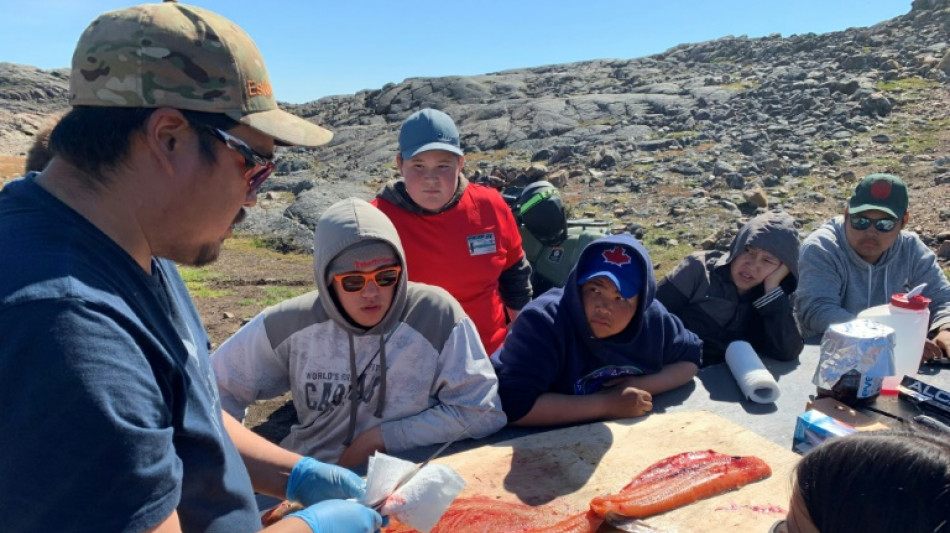
Filleting a fish, lighting a fire or building an igloo: In Canada's Arctic, Inuit youth are being encouraged to connect with their culture in an attempt to prevent severe depression and save lives.
A dozen teenagers and young adults gather around instructor Alex Flaherty. They don't want to miss any of the traditional hunter's precise gestures as he carves a fish or lights a fire.
"Our culture has changed so much in the last 50 years when people used to live in igloos... the change is happening so fast, (and) we are losing our culture," he tells AFP.
Flaherty blames the societal shifts for a series of social ills such as violent crime, substance abuse and a high rate of suicide.
Hoping to help remedy these problems, he's taken hundreds of teenagers hiking, camping and hunting in the vast tundra in the past three years.
In addition to keeping alive Inuit culture, his government-funded Polar Outfitting program also aims to bolster young people's mental health and teach them to adapt to a changing climate -- in a region that is warming much faster than elsewhere.
Flaherty says he takes mostly youth aged 12 to 20 years old, "because that's when their lifestyle starts changing (and) when they need help."
In the summer, they hike across the rocky, windswept lands near the bay city of Iqaluit that is home to some 7,000 residents -- and is accessible only by plane most months.
They also learn to make fishing nets to catch Arctic char and to navigate and survive in the pristine but unforgiving environment.
In the dead of winter, when sunlight is reduced to just a few hours per day, they will go out on the ice to fish, and build igloos.
- 'Not just about fishing' -
At 22, Annie Kootoo is the oldest in the current class. She gushes with joy after spending 10 days in the wilderness.
"I did a lot of activities that I don't usually do, and it's been very helpful for my mental health," she says.
Chris Laisa, a 14-year-old echoes the sentiment. "I feel great," he says after a lesson.
"It was fun because I learned how to fillet a fish, how to prepare it."
Flaherty, standing nearby, adds that it's "not just about fishing. It's about clearing your mind, being outdoors and sharing with others."
In the Nunavut territory of northern Canada, where the average age is 28, young people are deeply affected by the isolation and intergenerational traumas caused by past colonial policies.
Like many Indigenous peoples in Canada, the Inuit are haunted by memories of being forced into residential schools where they were stripped of their language and culture, and abused by teachers and headmasters.
Here the suicide rate is much higher than the rest of the country -- 76.6 per 100,000 inhabitants in 2020 compared to 10.1, according to Statistics Canada.
Camilla Sehti, the Nunavut government's head of mental health and addictions services, goes through a long list of what's contributed to the crisis: "It's just so many factors."
Healing, she says, "starts with reconnecting people to their culture."
"I think colonization had a huge impact on this territory and the ability for people to feel connected to self," she explains, describing new mental health initiatives that emphasize "family, culture and community."
After losing her best friend two years ago, Minnie Akeeagok started posting warnings on social media about depression and suicide.
"Everybody in Nunavut knows someone who has committed suicide or faced mental health issues. I personally know more than five," the 18-year-old told AFP.
"We need more resources, more accessibility within the mental health field in Nunavut," she says, noting that in the far off communities of this Arctic territory the situation is even more dire.
P.Sousa--PC