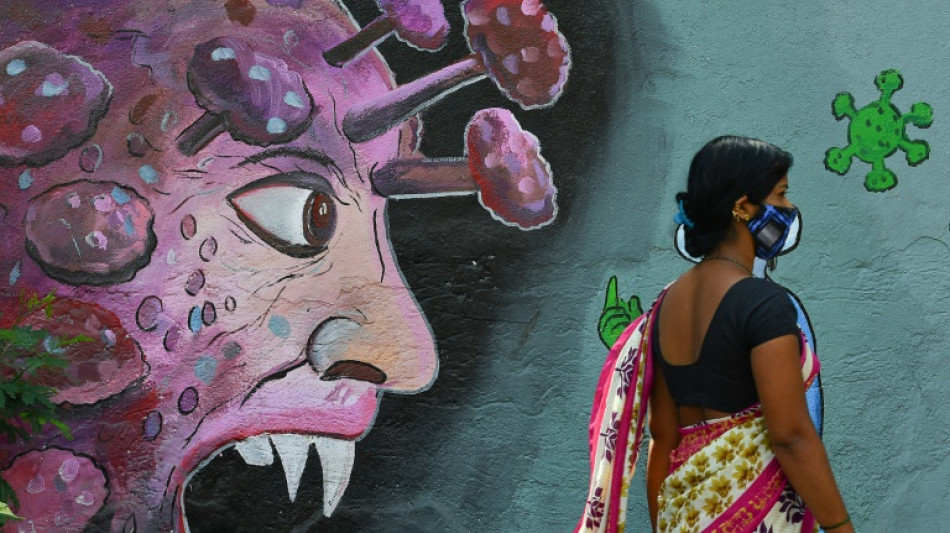
Long Covid remains a mystery, though theories are emerging / Photo: INDRANIL MUKHERJEE - AFP/File

 US warns of rapid escalation in Mideast war

 Iran 'put hearts on the court' to win Asian Games basketball bronze
 School girl Yu helps China dominate in Asian Games swimming openers

 Myanmar win first Asian Games teqball gold as Spain great Puyol watches

 China's 13-year-old Yu scorches to first major gold at Asian Games

 Russians vote on last day of parliamentary elections

 Hong Kong pays final respects to former city leader Tung

 Typhoon put people off Asian Games opening ceremony, official says

 China's 13-year-old Yu cruises as Asian Games swimming begins

 AI 'warning shots' focus Beijing on national security risks

 Philippine tribe in limbo over US-led tech hub

 Leo XIV, first US pope transcends his restrained style

 Singer Ed Sheeran says Gaza situation 'unjustifiable' following controversy

 In 'Tenzing', a Sherpa mountaineer gets his due

 Ed Sheeran set to return to stage after Palestinian controversy

 Toulouse edge Vannes, Lyon beat Pau to take Top 14 summit

 Germans arrested for Louvre stunt in Mona Lisa hall

 Saudi-led coalition says Houthis fired ballistic missile at Riyadh

 France's debt climbs to highest since 1978: ministry

 McIlroy two shots off the lead at Wentworth after eagle on 18

 Martinez brace saves Inter in Serie A top-two clash with Roma

 Rosenior abused but guides Paris FC past old club Strasbourg

 Seven-try Lyon beat Pau, climb to Top 14 summit

 Brighton defeat a 'big lesson' against complacency for Arsenal, says Arteta

 Thousands protest inaction over climate crisis in Switzerland

Millions of people around the world are believed to suffer from long Covid yet little remains known about the condition -- though research has recently proposed several theories for its cause.
Between 10 to 20 percent of people who contract coronavirus are estimated to have long Covid symptoms -- most commonly fatigue, breathlessness and a lack of mental clarity dubbed brain fog -- months after recovering from the disease.
The US-based Institute for Health Metrics and Evaluation (IHME) estimates that nearly 145 million people worldwide had at least one of those symptoms in 2020 and 2021.
In Europe alone, 17 million people had a long Covid symptom at least three months after infection during that time, according to IHME modelling for the World Health Organization (WHO) published earlier this month.
These millions "cannot continue to suffer in silence", WHO Europe director Hans Kluge said, calling for the world to act quickly to learn more about the condition.
Researchers have been racing to catch up but the vast array -- and inconsistency -- of symptoms has complicated matters.
More than 200 different symptoms have been ascribed to long Covid so far, according to a University College London study.
- 'Fatigue in the background' -
"There are no symptoms that are truly specific to long Covid but it does have certain characteristics that fluctuate," said Olivier Robineau, the long Covid coordinator at France's Emerging Infectious Diseases research agency.
"Fatigue remains in the background," he told AFP, while the symptoms "seem to be exacerbated after intellectual or physical effort -- and they become less frequent over time".
One thing we do know is that people who had more severe initial cases, including needing to be hospitalised, are more likely to get long Covid, according to the IHME.
Researchers have been pursuing several leads into exactly what could be behind the condition.
A study published in the journal Clinical Infectious Diseases in September found that Covid's infamous spike protein --- the key that lets the virus into the body's cells -- was still present in patients a full year after infection.
This suggests that viral reservoirs may persist in some people, potentially causing inflammation that could lead to long Covid-like symptoms, the researchers said.
If they are right, a test could be developed to identify the spike, potentially leading to one of the great and elusive goals of long Covid research -- a clear way to diagnose the condition.
However, their findings have not been confirmed by other research, and several other causes have been proposed.
- 'Data not very solid yet' -
One leading theory is that tissue damage from severe Covid cases triggers lasting disruption to the immune system.
Another suggests that the initial infection causes tiny blood clots, which could be related to long Covid symptoms.
However "for each of these hypotheses, the data is not very solid yet", Robineau said.
It is most likely that "we are not going to find a single cause to explain long Covid", he added.
"The causes may not be exclusive. They could be linked or even succeed each other in the same individual, or be different in different individuals."
A way to treat the condition also remains elusive.
For the last year, the Hotel-Dieu hospital in Paris has been offering long Covid patients a half-day treatment course.
"They meet an infectious disease specialist, a psychiatrist, then a doctor specialising in sports rehabilitation," said Brigitte Ranque, who runs the protocol dubbed CASPER.
"In the team's experience, a majority of the symptoms can be attributed to functional somatic syndromes," she said. These are a group of chronic disorders such as chronic fatigue and fibromyalgia that have no known cause.
Cognitive behavioural therapy, a psychological approach often used for those syndromes, is used to treat long Covid alongside supervised physical activity, Ranque said.
"The patients are brought back in three months later. The majority of them are better. More than half say they are cured," she told AFP.
"But about 15 percent did not improve at all."
Ferreira--PC