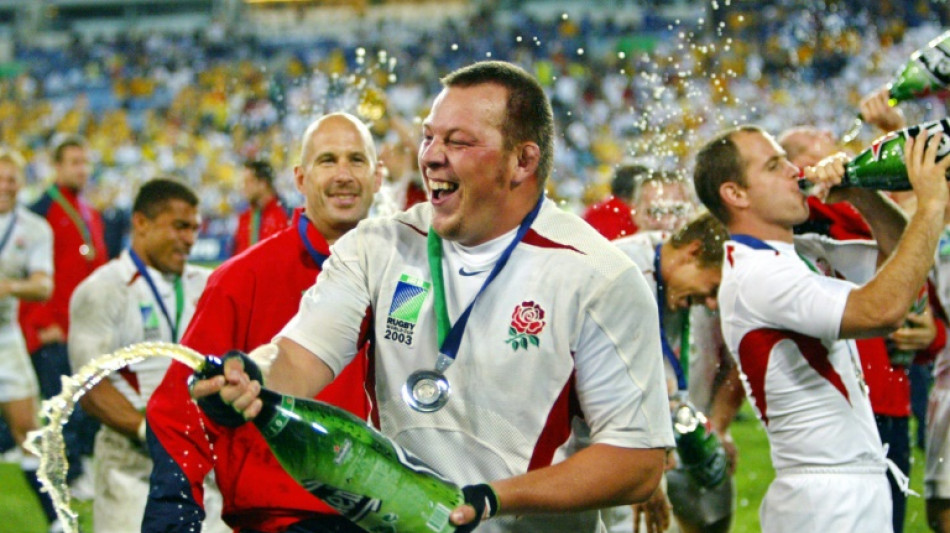
Rugby World Cup winner Thompson says dementia makes him feel 'phoney' / Photo: ODD ANDERSEN - AFP/File

 US warns of rapid escalation in Mideast war
 Iran 'put hearts on the court' to win Asian Games basketball bronze
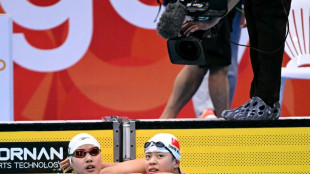 School girl Yu helps China dominate in Asian Games swimming openers

 Myanmar win first Asian Games teqball gold as Spain great Puyol watches

 China's 13-year-old Yu scorches to first major gold at Asian Games

 Russians vote on last day of parliamentary elections

 Hong Kong pays final respects to former city leader Tung

 Typhoon put people off Asian Games opening ceremony, official says

 China's 13-year-old Yu cruises as Asian Games swimming begins

 AI 'warning shots' focus Beijing on national security risks

 Philippine tribe in limbo over US-led tech hub

 Leo XIV, first US pope transcends his restrained style

 Singer Ed Sheeran says Gaza situation 'unjustifiable' following controversy

 In 'Tenzing', a Sherpa mountaineer gets his due

 Ed Sheeran set to return to stage after Palestinian controversy

 Toulouse edge Vannes, Lyon beat Pau to take Top 14 summit

 Germans arrested for Louvre stunt in Mona Lisa hall

 Saudi-led coalition says Houthis fired ballistic missile at Riyadh

 France's debt climbs to highest since 1978: ministry

 McIlroy two shots off the lead at Wentworth after eagle on 18

 Martinez brace saves Inter in Serie A top-two clash with Roma

 Rosenior abused but guides Paris FC past old club Strasbourg

 Seven-try Lyon beat Pau, climb to Top 14 summit

 Brighton defeat a 'big lesson' against complacency for Arsenal, says Arteta

 Thousands protest inaction over climate crisis in Switzerland

Former England rugby star Steve Thompson says he feels like a "phoney" because he cannot remember being part of the 2003 World Cup-winning team, two years after being diagnosed with early onset dementia.
The ex-hooker, 44, is one of scores of former players who have decided to sue a number of governing bodies for negligence.
Thompson features in a BBC documentary: "Head On: Rugby, Dementia and Me" to be aired on Wednesday -- a day after new research was published suggesting elite players could be at a significantly greater risk of developing neurodegenerative diseases such as motor neurone disease, Parkinson's and dementia.
Glasgow consultant neuropathologist Willie Stewart, who led the research team, has called for urgent action, saying the sport should minimise contact training and reduce its global calendar.
Thompson, diagnosed with early onset dementia and probable CTE (chronic traumatic encephalopathy) in November 2020, has packed away his medals and trophies.
"Around four years ago some of my strongest memories started disappearing, precious private moments and all the career highlights of two decades of rugby. So much so I packed away all my most precious memorabilia because having it around was just too painful," he said in the documentary.
He added: "When people say 'Oh, you got a World Cup medal' and all this I feel like a phoney.
"Because it feels like I haven't done it because I can't remember it and it doesn't feel like me so sometimes when people in public talk about it I get embarrassed by it."
Thompson, who sometimes forgets the names of his children in the film, said he believes he is suffering as a result of multiple head impacts he endured as a player, saying concussion protocols at the time were not safe.
"If you were knocked out and you came back to, you were just told to get on with it," he said.
"If you had a headache, you were just given headache pills. It wasn't known as an injury. It would be like: 'At least you haven't pulled your hamstring, so you can still run.'"
He said rugby authorities, including the Rugby Football Union (RFU), which is the game's governing body in England, could do more.
"There's been no support from the RFU," he said. "Since I started the legal action, they've even stopped sending me the birthday card I got every year."
World Rugby last year issued guidance advising limiting full contact training to just 15 minutes per week and in July extended its minimum concussion stand-down period to 12 days.
But Thompson feels the sport could go further.
"It's a little start, but, to be honest, it needs to be three weeks at least," he says, adding he would still not feel comfortable allowing his children to play full-contact rugby.
A.P.Maia--PC