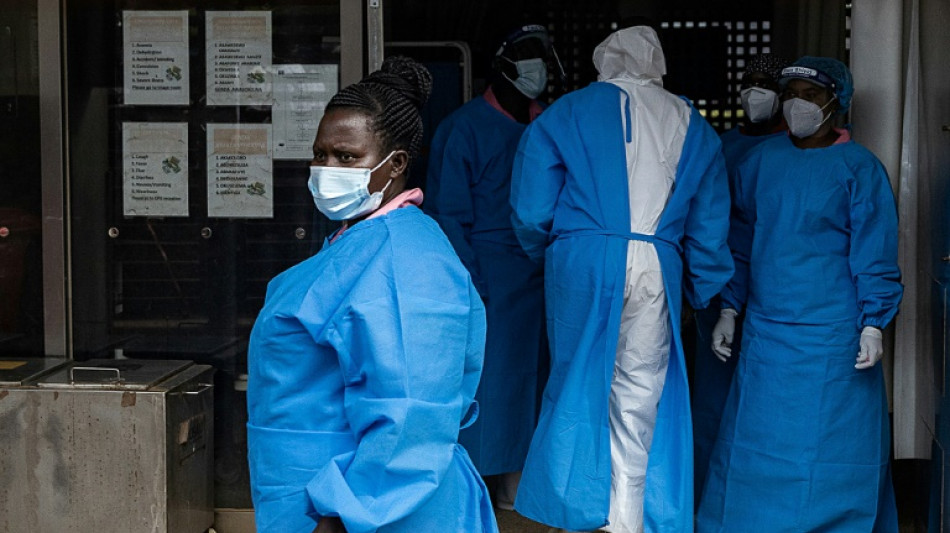
Uganda leader cracks down on traditional healers to stem Ebola / Photo: BADRU KATUMBA - AFP/File

 US warns of rapid escalation in Mideast war
 Iran 'put hearts on the court' to win Asian Games basketball bronze
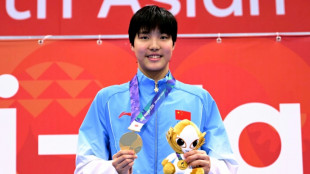
 School girl Yu helps China dominate in Asian Games swimming openers

 Myanmar win first Asian Games teqball gold as Spain great Puyol watches

 China's 13-year-old Yu scorches to first major gold at Asian Games

 Russians vote on last day of parliamentary elections

 Hong Kong pays final respects to former city leader Tung

 Typhoon put people off Asian Games opening ceremony, official says

 China's 13-year-old Yu cruises as Asian Games swimming begins

 AI 'warning shots' focus Beijing on national security risks

 Philippine tribe in limbo over US-led tech hub

 Leo XIV, first US pope transcends his restrained style

 Singer Ed Sheeran says Gaza situation 'unjustifiable' following controversy

 In 'Tenzing', a Sherpa mountaineer gets his due

 Ed Sheeran set to return to stage after Palestinian controversy

 Toulouse edge Vannes, Lyon beat Pau to take Top 14 summit

 Germans arrested for Louvre stunt in Mona Lisa hall

 Saudi-led coalition says Houthis fired ballistic missile at Riyadh

 France's debt climbs to highest since 1978: ministry

 McIlroy two shots off the lead at Wentworth after eagle on 18

 Martinez brace saves Inter in Serie A top-two clash with Roma

 Rosenior abused but guides Paris FC past old club Strasbourg

 Seven-try Lyon beat Pau, climb to Top 14 summit

 Brighton defeat a 'big lesson' against complacency for Arsenal, says Arteta

 Thousands protest inaction over climate crisis in Switzerland

Ugandan President Yoweri Museveni on Wednesday ordered traditional healers to stop treating sick people in a bid to halt the spread of Ebola, which has already claimed the lives of 19 individuals in the impoverished East African country.
In a televised speech to the nation, the veteran leader also directed security officials to arrest all people suspected of having contracted the often-fatal viral haemorrhagic fever if they refused to go into isolation.
His instructions followed a regional ministerial meeting in Kampala to discuss the emergency response to the outbreak after Uganda last month announced its first fatality from the highly contagious disease since 2019.
World Health Organization chief Tedros Adhanom Ghebreyesus had told the meeting from Geneva that clinical trials could start within weeks on drugs to combat the particular strain circulating in Uganda known as the Sudan ebola virus, for which there is currently no vaccine.
A statement issued by WHO said there were 54 confirmed cases and 19 deaths since the outbreak was first reported in the central district of Mubende on September 20.
Museveni said only one fatal case had been recorded in Kampala, a 45-year-old man of Congolese origin who had fled isolation in Mubende after a relative died, and had sought out the help of a witchdoctor.
He later succumbed to the disease in a hospital in the capital, Museveni said, adding that about two dozen people who had been in contact with the man were now in quarantine.
"Witchdoctors, traditionalists and herbalists should not accept sick people now. Suspend what you are doing," Museveni said.
"There is no witchcraft here. Ebola is a disease. The communities in the affected areas should know Ebola is deadly and spread through contacts with the affected person."
Since the initial outbreak in the largely rural landlocked country, infections have been found in five areas including Mubende, according to WHO.
- 'High' risk of spreading -
"Unfortunately, the Ebola vaccines that have been so effective in controlling recent outbreaks in DRC (Democratic Republic of Congo) are not effective against the type of ebola virus which is responsible for the current outbreak in Uganda," Tedros told Wednesday's meeting.
"Several vaccines are in various stages of development against this virus, two of which could begin clinical trials in Uganda in the coming weeks, pending regulatory and ethics approvals from the Ugandan government."
A WHO assessment has found the risk of the Sudan ebola virus spreading to neighbouring countries was "high due to cross border movements between Uganda and other countries".
"Our primary focus now is to support the government of Uganda to rapidly control and contain this outbreak, to stop it spreading to neighbouring districts, and neighbouring countries," Tedros told reporters.
Ebola is named after a river in DR Congo where it was discovered in 1976. Human transmission is through bodily fluids, with common symptoms being fever, vomiting, bleeding and diarrhoea. Outbreaks are difficult to contain, especially in urban environments.
People who are infected do not become contagious until symptoms appear, which is after an incubation period of between two and 21 days.
The worst epidemic in West Africa between 2013 and 2016 killed more than 11,300 people.
Uganda has experienced several Ebola outbreaks, most recently in 2019 when at least five people died.
The neighbouring DRC has had more than a dozen epidemics, the deadliest killing 2,280 people in 2020. Late last month it declared an end to an Ebola outbreak that had emerged in the eastern province of North Kivu six weeks previously.
Last week the United States announced tighter screening for people who had travelled to Uganda.
J.V.Jacinto--PC