Robotic suit gives paralyzed children gift of walking / Photo: CLAUDIO CRUZ - AFP

 US warns of rapid escalation in Mideast war

 Iran 'put hearts on the court' to win Asian Games basketball bronze

 School girl Yu helps China dominate in Asian Games swimming openers

 Myanmar win first Asian Games teqball gold as Spain great Puyol watches

 China's 13-year-old Yu scorches to first major gold at Asian Games

 Russians vote on last day of parliamentary elections

 Hong Kong pays final respects to former city leader Tung

 Typhoon put people off Asian Games opening ceremony, official says

 China's 13-year-old Yu cruises as Asian Games swimming begins

 AI 'warning shots' focus Beijing on national security risks

 Philippine tribe in limbo over US-led tech hub

 Leo XIV, first US pope transcends his restrained style

 Singer Ed Sheeran says Gaza situation 'unjustifiable' following controversy

 In 'Tenzing', a Sherpa mountaineer gets his due

 Ed Sheeran set to return to stage after Palestinian controversy

 Toulouse edge Vannes, Lyon beat Pau to take Top 14 summit

 Germans arrested for Louvre stunt in Mona Lisa hall

 Saudi-led coalition says Houthis fired ballistic missile at Riyadh

 France's debt climbs to highest since 1978: ministry

 McIlroy two shots off the lead at Wentworth after eagle on 18

 Martinez brace saves Inter in Serie A top-two clash with Roma

 Rosenior abused but guides Paris FC past old club Strasbourg

 Seven-try Lyon beat Pau, climb to Top 14 summit

 Brighton defeat a 'big lesson' against complacency for Arsenal, says Arteta

 Thousands protest inaction over climate crisis in Switzerland

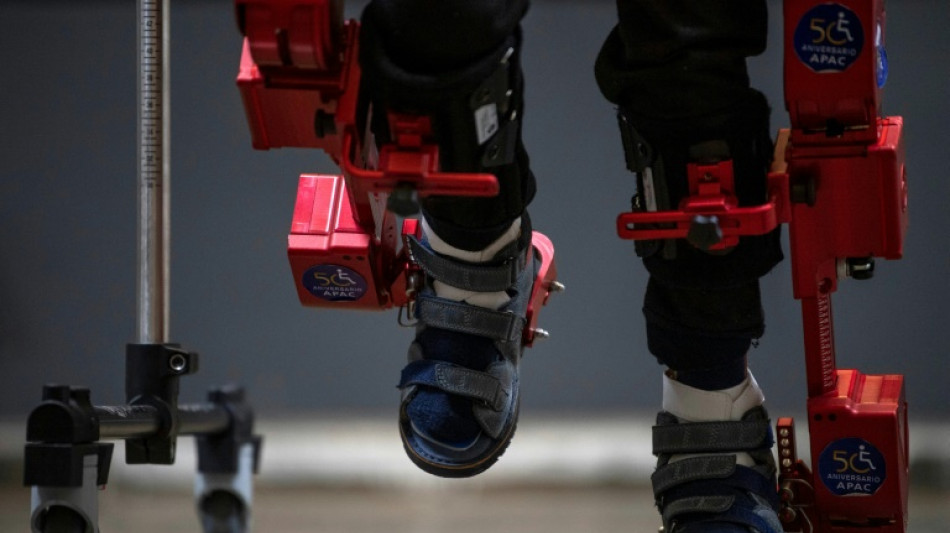
Wearing a robotic exoskeleton designed specially for children, an eight-year-old boy with cerebral palsy walked through a therapy room in Mexico City, smiling triumphantly at the once-unthinkable feat.
David Zabala uses a wheelchair due to his neurological condition, which also left him deaf and reliant on sign language.
But thanks to the Atlas 2030 exoskeleton, which won its creator a European Inventor Award this year, he was able to walk and stand in front of a mirror where he drew smiling faces with colored marker pens.
"He's taking his first steps. That's a joy for him," said the boy's mother, Guadalupe Cardoso, 41.
"At first it scared him and his hands were very tense, and now I see that he's already holding the marker pen and starting to draw or (play with) the ball," Cardoso added.
It makes the exhausting, near two-hour journey from their home in the south of Mexico City to the therapy center totally worth it, she said.
The exoskeleton was designed by Spanish professor Elena Garcia Armada to enable children who use wheelchairs to walk during muscle rehabilitation therapy.
The mechanical joints of the battery-powered titanium suit adapt intelligently to the motion of each child, according to the European Patent Office, which presented Garcia with the European Inventor Award.
Giving paralyzed children the opportunity to walk "not only extends their life expectancy and enhances their physical well-being, but also improves their self-esteem," it said.
- 'Changing lives' -
Mexico is the third country, after Spain and France, where the Atlas 2030 has been used to treat children.
The suit helps "to achieve in record time rehabilitation goals" that would take months to achieve with conventional therapies, said Guadalupe Maldonado, director of Mexico's Association for People with Cerebral Palsy.
The benefits include muscle strengthening, improvement of the digestive and respiratory systems and -- above all -- a major mood boost, Maldonado said.
The private organization, founded in 1970, has already seen positive results two weeks after acquiring its first exoskeleton, she said.
A second device, worth around $250,000, is due to arrive in Mexico City next month.
The association's initial goal is to offer rehabilitation to about 200 children with cerebral palsy.
"We want to continue working and empowering, so that more children in the city and the country have access to this type of rehabilitation... that radically changes their lives," Maldonado said.
The sessions also give joy to the therapists, who carefully fit the exoskeleton using its special corset, cuff and shoes and celebrate the children's progress with smiles and applause.
"It motivates us a lot as therapists that we will be able to achieve many things in the future," said Arturo Palafox, 28.
E.Paulino--PC