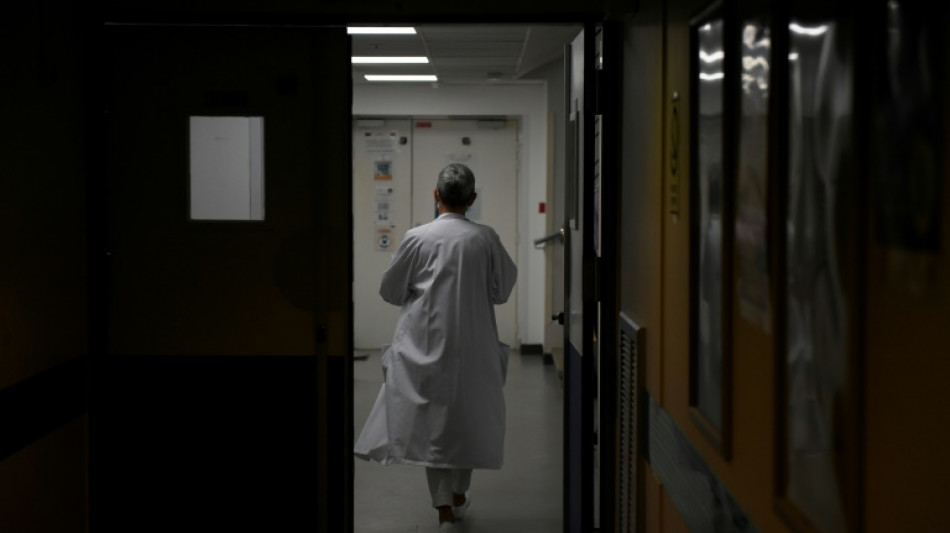
Monkeypox still global health emergency: WHO / Photo: JULIEN DE ROSA - AFP/File

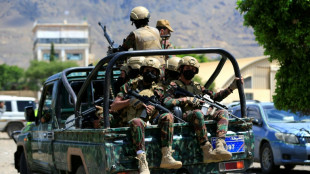 US warns of rapid escalation in Mideast war

 Iran 'put hearts on the court' to win Asian Games basketball bronze

 School girl Yu helps China dominate in Asian Games swimming openers

 Myanmar win first Asian Games teqball gold as Spain great Puyol watches

 China's 13-year-old Yu scorches to first major gold at Asian Games

 Russians vote on last day of parliamentary elections

 Hong Kong pays final respects to former city leader Tung

 Typhoon put people off Asian Games opening ceremony, official says

 China's 13-year-old Yu cruises as Asian Games swimming begins

 AI 'warning shots' focus Beijing on national security risks

 Philippine tribe in limbo over US-led tech hub

 Leo XIV, first US pope transcends his restrained style

 Singer Ed Sheeran says Gaza situation 'unjustifiable' following controversy

 In 'Tenzing', a Sherpa mountaineer gets his due

 Ed Sheeran set to return to stage after Palestinian controversy

 Toulouse edge Vannes, Lyon beat Pau to take Top 14 summit

 Germans arrested for Louvre stunt in Mona Lisa hall

 Saudi-led coalition says Houthis fired ballistic missile at Riyadh

 France's debt climbs to highest since 1978: ministry

 McIlroy two shots off the lead at Wentworth after eagle on 18

 Martinez brace saves Inter in Serie A top-two clash with Roma

 Rosenior abused but guides Paris FC past old club Strasbourg

 Seven-try Lyon beat Pau, climb to Top 14 summit

 Brighton defeat a 'big lesson' against complacency for Arsenal, says Arteta

 Thousands protest inaction over climate crisis in Switzerland

The World Health Organization said Tuesday that its emergency committee had determined that monkeypox should continue to be classified as a global health emergency.
Following a meeting on October 20 about the virus that suddenly started spreading across the world in May, the experts "held the consensus view that the event continues to meet the ... criteria for a Public Health Emergency of International Concern," WHO said in a statement.
The UN health agency first declared the so-called PHEIC -- its highest level of alarm -- on July 23, and the experts said that while some progress had been made in reining in the disease, it was too soon to declare the emergency over.
WHO chief Tedros Adhanom Ghebreyesus had accepted and agreed with the experts' advice, the statement said.
Since monkeypox suddenly began spreading beyond the West African countries where it has long been endemic six months ago, it has killed 36 people out of more than 77,000 cases across 109 countries, according to a WHO count.
The outbreak outside of West Africa has primarily affected young men who have sex with men.
But since peaking in July, the number of people infected with the disease that causes fever, muscular aches and large boil-like skin lesions, has consistently fallen, particularly in Europe and North America, the hardest hit areas in the early stages of the global outbreak.
The number of new global cases fell by 41 percent in the seven days up to Monday compared to the previous week, the WHO said.
But WHO's emergency committee stressed that there were a number of lingering causes for concern.
They listed ongoing transmission in some regions, continuing preparedness and response inequity within and between countries, and the potential for greater health impacts if the virus begins spreading more among more vulnerable populations.
They also pointed to the continuing risk of stigma and discrimination, weak health systems in some developing countries leading to under-reporting and the lack of equitable access to diagnostics, antivirals and vaccines.
J.V.Jacinto--PC