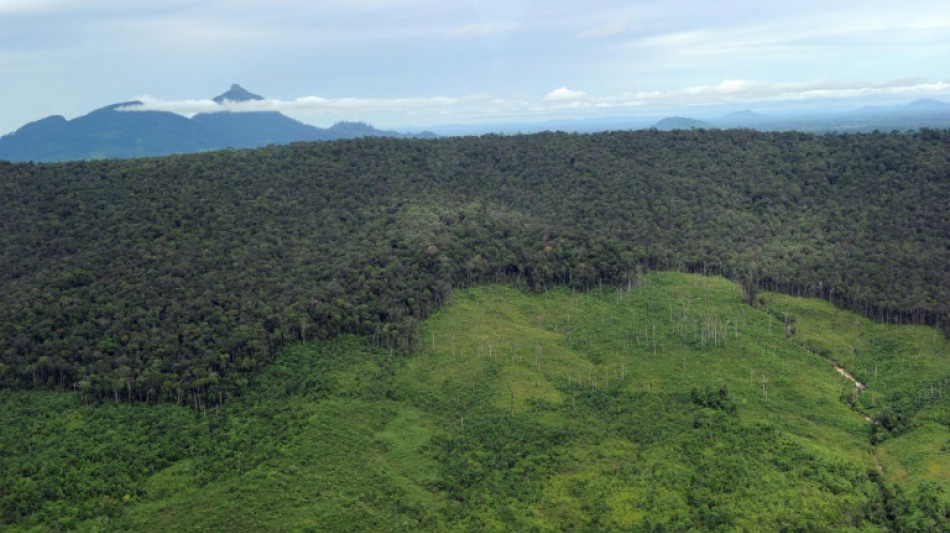
Mountain forests disappearing at alarming rate: study / Photo: ROMEO GACAD - AFP

 Ed Sheeran returns to stage after Palestinian controversy

 Asian Games to open in Japan after troubled build-up

 Drone owners rush to offload devices ahead of Beijing ban

 Trump's beef policies irk Texas ranchers, testing their loyalty

 Nvidia, OpenAI CEOs to attend Xi dinner at White House

 Anthropic picks Accenture for in-house AI safety evaluation

 Balogun returns as Monaco beat Lens to continue strong Ligue 1 start

 'Pause' on overt repression in Venezuela, but reforms still needed: HRW

 Global stocks mixed as yen falls despite Bank of Japan rate hike

 Cuba hit with seventh major blackout of the year

 Murray out with concussion so Wentz will start for Vikings

 UN chief 'deeply regrets' US visa refusal to Abbas for annual meeting

 England quick Carse to face no charges over alleged nightclub assault

 Mancini brings nine newcomers into the first squad of his Italy comeback

 Czechs level Davis Cup tie against USA as South Korea eye Finals

 New France boss Zidane confirms Mbappe as captain after naming first squad

 California governor signs order to explore AI 'kill switch'

 Head leads run spree as Australia win Zimbabwe ODI series

 In-form Raphinha wants to finish career at Barcelona

 Warren Buffett steps down as Berkshire Hathaway chairman

 Carrick confident Man Utd can 'work through' tough time

 Mbappe ends Nike partnership to join Swiss brand On

 Liverpool boss Iraola puts Bournemouth love affair on hold

 'A disaster' if Man City do not win says Maresca after flawless start

 Kerry James Marshall: American 'blackness' painter celebrated in Europe

Logging, wildfires and farming are causing mountain forests, habitat to 85 percent of the world's birds, mammals and amphibians, to vanish at an alarming rate, according to a study published on Friday.
Mountain forests covered 1.1 billion hectares (2.71 billion acres) of the planet in 2000, the authors of the study published in the Cell Press journal One Earth said.
But at least 78.1 million hectares -- an area larger than the US state of Texas -- have been lost between 2000 and 2018, with recent losses 2.7-fold greater than at the beginning of the century.
Key drivers of the loss are commercial logging, wildfires, "slash-and-burn" cultivation and commodity agriculture, said the authors from China's Southern University of Science and Technology and the University of Leeds.
Of particular concern, they said, is that heavy forest losses have occurred in mountain areas that are "tropical biodiversity hotspots" -- refuges for rare and endangered species.
High elevations and steep slopes have historically restricted human exploitation of mountain forests, the authors said. But they have increasingly been targeted for timber and used for agriculture since the turn of the century.
Commercial forestry was responsible for 42 percent of mountain forest loss, followed by wildfires (29 percent), shifting cultivation (15 percent), and permanent or semi-permanent commodity agriculture (10 percent), the study said.
Shifting cultivation involves growing a crop on a plot of land for a few years and then abandoning it until it becomes fertile again.
"The drivers are different for different regions," said Zhenzhong Zeng, a co-author of the study, with wildfires the main cause of loss in boreal forests found in high latitudes.
"For boreal areas, it's caused by climate change, because there's an increase in temperature and a decrease in precipitation," Zeng told AFP.
"We have to reduce the use of fossil fuels to slow down global warming."
Commodity agriculture was a main driver of mountain forest loss in Southeast Asia, the authors said.
"People plant more rubber or palm farms to make more product," Zeng said. "People need to have more land to grow corn to feed their chickens."
Shifting cultivation is preeminent in tropical Africa and South America.
- 'Impact is huge' -
The authors said the greatest amount of forest loss observed during the study period using satellite data was in Asia -- 39.8 million hectares -- more than half the global total.
South America, Africa, Europe and Australia also all suffered significant losses.
"The mountain forest loss in the tropical areas is increasing very fast, much higher than other regions," Zeng said. "And the biodiversity is very rich there so the impact is huge."
"For tropical areas, we have to make people live with the forest, not cut the forest," he said.
Xinyue He, another co-author, said that regrowth has been observed in some areas but it does not always involve native species and is not keeping pace with forest loss.
She said there needed to be greater forest management including stricter enforcement of laws and regulations.
"Protecting areas can help to reduce the loss," she said.
L.Torres--PC



