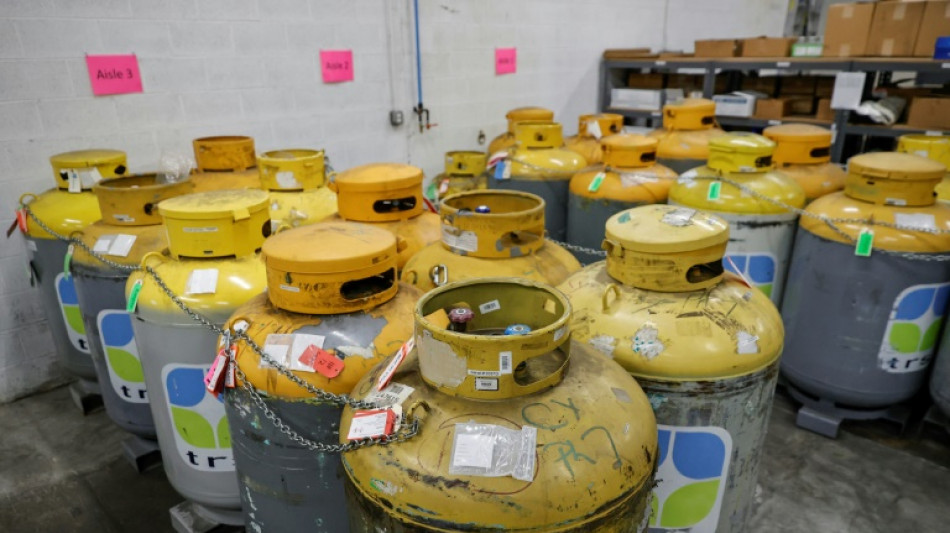
Ozone-depleting CFCs hit record despite ban: study / Photo: KAMIL KRZACZYNSKI - AFP

 Ed Sheeran returns to stage after Palestinian controversy

 Asian Games to open in Japan after troubled build-up

 Drone owners rush to offload devices ahead of Beijing ban

 Trump's beef policies irk Texas ranchers, testing their loyalty

 Nvidia, OpenAI CEOs to attend Xi dinner at White House

 Anthropic picks Accenture for in-house AI safety evaluation

 Balogun returns as Monaco beat Lens to continue strong Ligue 1 start

 'Pause' on overt repression in Venezuela, but reforms still needed: HRW

 Global stocks mixed as yen falls despite Bank of Japan rate hike

 Cuba hit with seventh major blackout of the year

 Murray out with concussion so Wentz will start for Vikings

 UN chief 'deeply regrets' US visa refusal to Abbas for annual meeting

 England quick Carse to face no charges over alleged nightclub assault

 Mancini brings nine newcomers into the first squad of his Italy comeback

 Czechs level Davis Cup tie against USA as South Korea eye Finals

 New France boss Zidane confirms Mbappe as captain after naming first squad

 California governor signs order to explore AI 'kill switch'

 Head leads run spree as Australia win Zimbabwe ODI series

 In-form Raphinha wants to finish career at Barcelona

 Warren Buffett steps down as Berkshire Hathaway chairman

 Carrick confident Man Utd can 'work through' tough time

 Mbappe ends Nike partnership to join Swiss brand On

 Liverpool boss Iraola puts Bournemouth love affair on hold

 'A disaster' if Man City do not win says Maresca after flawless start

 Kerry James Marshall: American 'blackness' painter celebrated in Europe

Their power to dissolve the ozone layer shielding Earth from the Sun prompted a worldwide ban, but scientists on Monday revealed that some human-made chlorofluorocarbons have reached record levels, boosting climate-changing emissions.
Despite being banned under the Montreal Protocol, the five chlorofluorocarbons (CFCs) measured increased rapidly in the atmosphere from 2010 to 2020, reaching record-high levels in 2020, according to the study published in the journal Nature Geoscience.
It said the increase was probably due to leakage during the production of chemicals that are meant to replace CFCs, including hydrofluorocarbons (HFOs).
Although at current levels they do not threaten the recovery of the ozone layer, they contribute to a different threat, joining other emissions in heating the atmosphere.
"If you are producing greenhouse gases and ozone-depleting substances during the production of these next-generation compounds, then they do have an indirect impact on the climate and the ozone layer," said co-author Isaac Vimont of the Global Monitoring Laboratory at the US National Oceanic and Atmospheric Administration.
CFCs are potent greenhouse gases that trap heat up to 10,000 times more efficiently than carbon dioxide -- the biggest cause of the global warming that drives climate change, according to data from the Global Carbon Project.
In the 1970s and 1980s, CFCs were widely used as refrigerants and in aerosol sprays.
But the discovery of the hole in the ozone layer over Antarctica as a result of their use led to the global agreement in 1987 to eliminate them.
After the Montreal Protocol entered into force, global concentrations of CFCs declined steadily.
- Ozone 'early warning' -
The study analysed five CFCs with no or few current uses, beginning at the point of their total global phase-out in 2010.
In 2020 all five gases were at their highest abundance since direct measurements began.
Those emissions have so far resulted in a modest impact on the ozone layer and slightly larger climate footprint, said co-author Luke Western of Bristol University and the Global Monitoring Laboratory.
They are equivalent to the 2020 CO2 emissions of Switzerland -- about one percent of the total greenhouse gas emissions of the United States.
But if the rapid upward trend continues, their impact will increase.
The researchers called their findings "an early warning" of a new way in which CFCs are endangering the ozone layer.
The emissions are likely due to processes that are not subject to the current ban and unreported uses.
The class of industrial aerosols developed to replace those banned by the Montreal Protocol is to be phased out over the next three decades under a recent amendment to the 1987 treaty.
- Unknown source -
The protocol curbs the release of ozone-depleting substances that could disperse, but does not ban their use in the production of other chemicals as raw materials or by-products.
It was not the first time that unreported production had an impact on CFC levels. In 2018 scientists discovered that the pace of CFC slowdown had dropped by half from the preceding five years.
Evidence in that case pointed to factories in eastern China, the researchers said. Once CFC production in that region stopped, the draw-down appeared to be back on track.
The study said further research was needed to know the precise source of the recent rise in CFC emissions.
Nationwide data gaps make it difficult to determine where the gases are coming from and for some of the CFCs analysed there are no known uses.
But "eradicating these emissions is an easy win in terms of reducing greenhouse gas emissions," said Western.
V.Fontes--PC



