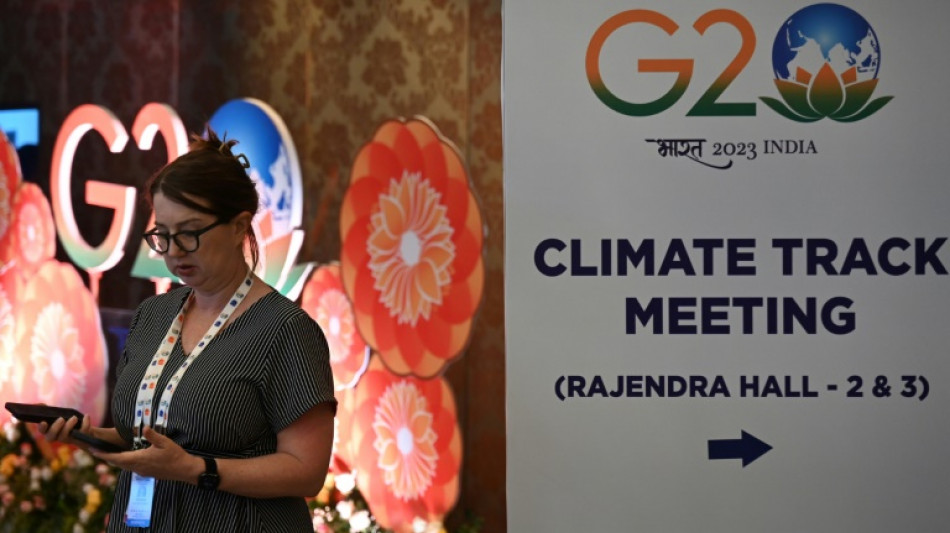
G20 environment meeting ends without agreement on climate crisis / Photo: R.Satish BABU - AFP

 Indians living in Japan on stand-by to house Asian Games athletes

 Trump signs bill authorizing sweeping Russia sanctions

 Protesters form human chain at Kennedy Center after Trump threat

 Death toll from attack at police HQ in Pakistan rises to 31

 Trump says Denmark to give US 'permanent control' over Greenland security

 Kennedy Center: future unclear for iconic Washington arts hub

 Trump claims 'infinite' Greenland security deal with Denmark

 Helicopters battle wildfire threatening Ecuador's capital

 Brentford batter Chelsea to undo Alonso's promising start

 Kane hits Bundesliga century as Bayern rout Union

 Trump says CNN, MS NOW, Politico banned from White House

 Hushing and hedging: US companies retreat on climate

 Springboks to face Fiji before 2027 Rugby World Cup

 Nigeria miners struggled to breathe in cell before 37 died: survivors

 McIlroy on the charge at PGA Championship as Reed withdraws

 McIlroy on the charge at PGA Championship

 Crisis-wracked Volkswagen warns of 10-bn-euro hit to profits

 Costa Rica's Grynspan tops third informal poll for UN chief: diplomat

 Stock markets retreat after central bank rate hikes

 Russia labels director of Cannes Grand Prix winner a 'foreign agent'

 Macron warns of Russian 'hybrid' threat after meeting presidential hopefuls

 UN holds third informal poll for new chief

 Kulusevski return can spark Spurs: De Zerbi

 Shakira to cap off world tour with Madrid 12-gig run

 Isolated Syrian-Druze city blames Damascus for shortages

Environment ministers from G20 nations failed to agree on peaking global emissions by 2025 and other crucial issues to address the global climate crisis at their meeting in India on Friday, France's representative said.
No breakthrough was possible on several key points ahead of this year's COP28 climate talks, with negotiations also failing to reach a consensus on drastically scaling up renewable energy use.
"I am very disappointed," France's ecological transition minister Christophe Bechu told AFP after the meeting.
"We are not able to reach an agreement of increasing drastically renewable energies, we are not able to reach an agreement on phasing out or down fossil fuels, especially coal," he said.
"Records of temperatures, catastrophes, giant fires, and we are not able to reach an agreement on the peaking (of) emissions by 2025."
The discussions with China, Saudi Arabia, and on climate issues with Russia had been "complicated", he added.
The Chennai meeting comes days after energy ministers from the bloc -- which represents more than 80 percent of global GDP and CO2 emissions -- failed to agree on a roadmap to cut fossil fuels from the global energy mix.
That was seen as a blow to mitigation efforts even as climate experts blame record global temperatures for triggering floods, storms and heatwaves.
Some major oil producers -- such as Russia and Saudi Arabia -- were blamed for the lack of progress.
All present at Friday's conference understood "the severity of the crisis" facing the world, Adnan Amin, chief executive of this year's COP28 climate talks, told AFP.
"But I think there's a kind of political understanding that still needs to be achieved," he added.
Amin said it was clear that questions of "national interests" still had to be resolved before firmer commitments could be made on fossil fuels.
"It's very clear that every country in the world will start by looking at its immediate self-interest," he said.
Most delegations were led by their environment and climate change ministers, while the US delegation was headed by Special Presidential Envoy for Climate John Kerry.
Also at the talks was Emirati oil boss Sultan Al Jaber, who will lead the upcoming COP28 talks in the United Arab Emirates starting in late November.
He has been heavily criticised for his apparent conflict of interest as head of the Abu Dhabi National Oil Company because burning fossil fuels is the main driver of global warming.
- Livelihoods destroyed -
With raging wildfires in Greece and a heatwave in Italy, European Union environment commissioner Virginijus Sinkevicius said ahead of the gathering that there was "growing evidence on the ground of devastating climate impact" and "the livelihoods of people are being destroyed".
But progress in global negotiations has been slow, with the G20 polarised by Russia's war in Ukraine and sharp divisions on key issues.
Questions on financing the transition and ameliorating its short-term impacts have long been a point of contention between developing and wealthy nations.
Major developing countries like India argue that legacy emitters need to spend more to underwrite global mitigation efforts in poorer nations.
Big energy-producing nations have resisted stronger commitments on emissions cuts over concerns about the impact of drastic mitigation on their economies.
Ferreira--PC



