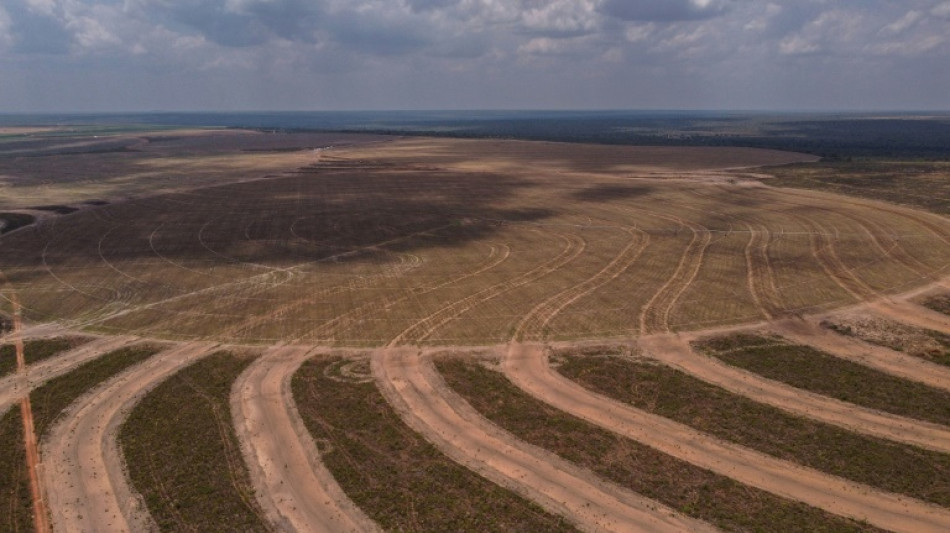
Race to save the Amazon leaves out Brazil's crucial savanna / Photo: Nelson ALMEIDA - AFP

 Indonesia accepts Malaysia's help to tackle wildfires
 Indians living in Japan on stand-by to house Asian Games athletes
 Trump signs bill authorizing sweeping Russia sanctions

 Protesters form human chain at Kennedy Center after Trump threat

 Death toll from attack at police HQ in Pakistan rises to 31

 Trump says Denmark to give US 'permanent control' over Greenland security

 Kennedy Center: future unclear for iconic Washington arts hub

 Trump claims 'infinite' Greenland security deal with Denmark

 Helicopters battle wildfire threatening Ecuador's capital

 Brentford batter Chelsea to undo Alonso's promising start

 Kane hits Bundesliga century as Bayern rout Union

 Trump says CNN, MS NOW, Politico banned from White House

 Hushing and hedging: US companies retreat on climate

 Springboks to face Fiji before 2027 Rugby World Cup

 Nigeria miners struggled to breathe in cell before 37 died: survivors

 McIlroy on the charge at PGA Championship as Reed withdraws

 McIlroy on the charge at PGA Championship

 Crisis-wracked Volkswagen warns of 10-bn-euro hit to profits

 Costa Rica's Grynspan tops third informal poll for UN chief: diplomat

 Stock markets retreat after central bank rate hikes

 Russia labels director of Cannes Grand Prix winner a 'foreign agent'

 Macron warns of Russian 'hybrid' threat after meeting presidential hopefuls

 UN holds third informal poll for new chief

 Kulusevski return can spark Spurs: De Zerbi

 Shakira to cap off world tour with Madrid 12-gig run

People thought she was crazy when Carminha Maria Missio and her family bought what was considered "sterile" land in the Brazilian savanna to farm soybeans, she says.
Missio, a beaming grandmother named one of the most powerful women in agriculture by Forbes Brasil, remembers the surprised reactions when her poor southern family sold their land in 1979 and moved across the country to the "Cerrado," a huge savanna below the Amazon rainforest.
Little-known outside Brazil, the Cerrado is Earth's most biodiverse savanna, nicknamed the "cradle of waters" for its vital rivers and aquifers.
But it is disappearing at a record rate, its twisted trees and grasslands replaced by endless fields of grains and cotton.
Even as Brazil races to stop Amazon deforestation, experts warn environmental destruction is surging in the Cerrado, fueling violent land-grabs and exacerbating the climate crisis.
Some scientists say the Amazon and Cerrado are equally important for the planet.
But when she arrived in the northeastern state of Bahia, the Cerrado was widely seen as a "wasteland," says Missio, 67.
"Locals said the only thing you could grow here was lizards," she laughs.
Sleeping under tarps and sweating in the tropical sun, her family joined a stream of pioneers who literally bet the farm on transforming this once-vast wilderness.
It worked: the Cerrado is now a global breadbasket, making Brazil the world's top exporter of soybeans and, this year, corn.
It grew half the 155 million metric tons of soy Brazil produced last year, used in the animal feed that puts beef, chicken and pork on plates worldwide.
- Spillover effect -
Today, half the Cerrado is farmland.
In places like Sao Desiderio, Bahia, the county leading Brazil in deforestation this year, the landscape after harvest season looks like a giant quilt, the green patches of remaining savanna surrounded by vast brown fields.
The savanna is typically cleared using a "correntao" -- a large chain strung between two bulldozers and dragged across the ground, razing everything in its path.
Fire is also used. A Switzerland-sized area has burned in the Cerrado this year, according to research group MapBiomas.
Farming the sandy, nutrient-poor soil is all about scale: producers invest big in irrigation, fertilizer and pesticides, financed by global commodity giants like US-based Bunge and Cargill.
But experts warn irrigation and soil degradation are drying the region. A recent study found river flows have decreased 15 percent from their historic averages, and will fall 34 percent by 2050.
The Cerrado has become a "sacrificial ecosystem," says Leticia Verdi, of Brazilian environmental group ISPN.
President Luiz Inacio Lula da Silva has largely delivered on his promise to protect the world's biggest rainforest, halving deforestation in the Brazilian Amazon since taking office in January. But destruction has increased 27 percent in the Cerrado from last year, including 659 square kilometers (254 square miles) razed in September, a record for the month.
"There's been a spillover of deforestation from the Amazon to the Cerrado," says Verdi.
- 'Upside-down Amazon' -
Yet "the Cerrado is just as important as the Amazon in confronting the climate crisis," Rodrigo Agostinho, head of Brazil's environmental agency, IBAMA, told AFP.
Scientists say the two are intricately linked.
The savanna depends on the precipitation generated by the rainforest. The rainforest meanwhile depends on the savanna to feed the rivers crisscrossing its southern half.
Both remove greenhouse gases from the atmosphere -- the rainforest through its billions of trees, the savanna via its deep, carbon-absorbing root systems, dubbed an "upside-down Amazon."
The Cerrado is a mirror-image of the Amazon in other ways, too.
In the Amazon, an estimated 95 percent of deforestation is illegal. In the Cerrado, around 95 percent is officially authorized, according to IBAMA -- a result, environmentalists say, of outsize agribusiness influence on regional authorities.
Brazilian law allows landowners in the Amazon to deforest just 20 percent of their property. The opposite applies in most of the Cerrado: farmers must preserve just 20 percent of their land.
- 'Green land-grabbing' -
In some cases, that law is being brutally twisted.
Joao da Silva lives in a shack in a rural community with no indoor plumbing or electricity. But the 50-year-old smallholder has five security cameras mounted outside, powered by solar panels.
He had them installed after gunmen surrounded his home in 2018 while he was out, threatening his mother at gunpoint.
Gunmen in a pickup later tried to ram his car and threatened to kill him, he says.
"They told me to get off my land, that the 'owners' were evicting us," says the father of five.
He also survived a stabbing attack at a local market in 2016.
Activists say Da Silva -- whose name has been changed for his safety -- and his neighbors are victims of "green land-grabbing," in which landholders seize un-deforested territory to claim it as their 20-percent protected reserves.
Leaders of several traditional cattle-herding communities told AFP of being targeted by gunmen who killed their cows, torched their farm buildings and opened fire on them.
Such violence is common in Brazil, where 377 land and environmental defenders have been killed since 2012, according to rights group Global Witness.
- Three little words -
Working the room with a preacher's charisma, Mario Alberto dos Santos is giving 40 middle-school students a crash course in sustainable agriculture in the poor Cerrado town of Ponte de Mateus.
Dos Santos, 43, a professor at the Federal University of Western Bahia, teaches teenagers eco-friendly techniques like growing native species, organic farming and interspersing crops with trees.
The program aims to train the next generation to farm with nature, not against it.
It is a "long road to walk," Dos Santos admits.
"We need to profoundly change the food system, not just in Brazil, but worldwide," he says.
Climate campaigners are meanwhile pushing commodity-importing countries to demand clean environmental and human-rights records from suppliers.
The European Union adopted a regulation this year requiring companies to show products are deforestation-free.
The policy is a "game-changer" for the Amazon, says Daniel Santos, of environmental group WWF-Brasil.
But it excludes most of the Cerrado -- not technically "forest."
Environmentalists are pushing the EU to extend the policy to "other wooded lands."
Adding those three words could transform the Cerrado, Santos says.
"It's a major opportunity to transition to more sustainable farming."
G.Machado--PC



