
-
 Inter Milan and Italy icon Mazzola dies aged 83
-
UK actor Naomi Watts honoured at Spain film festival

-
 Saudi capital issues first air raid alert since renewed fighting in Yemen
-
Japan emperor declares Asian Games open after turbulent build-up

-
 Martin edges title rival Marquez for Austrian MotoGP pole
-
Asian Games open with unity message after troubled build-up

-
 Indonesia accepts Malaysia's help to tackle wildfires
-
Denmark hails 'binding' Greenland deal with Trump

-
 Indians living in Japan on stand-by to house Asian Games athletes
-
We don't want Games host Japan losing money, says Asian Olympic official

-
 Trump signs bill authorizing sweeping Russia sanctions
-
Ed Sheeran returns to stage after Palestinian controversy

-
 Protesters form human chain at Kennedy Center after Trump threat
-
Asian Games to open in Japan after troubled build-up

-
 Death toll from attack at police HQ in Pakistan rises to 31
-
Drone owners rush to offload devices ahead of Beijing ban

-
 Trump says Denmark to give US 'permanent control' over Greenland security
-
Trump's beef policies irk Texas ranchers, testing their loyalty

-
 Kennedy Center: future unclear for iconic Washington arts hub
-
Nvidia, OpenAI CEOs to attend Xi dinner at White House

-
 Trump claims 'infinite' Greenland security deal with Denmark
-
Anthropic picks Accenture for in-house AI safety evaluation

-
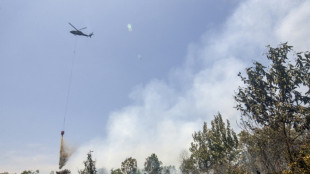
 Helicopters battle wildfire threatening Ecuador's capital
-
Balogun returns as Monaco beat Lens to continue strong Ligue 1 start

-
 Brentford batter Chelsea to undo Alonso's promising start
-
'Pause' on overt repression in Venezuela, but reforms still needed: HRW

-
 Kane hits Bundesliga century as Bayern rout Union
-
Global stocks mixed as yen falls despite Bank of Japan rate hike

-
 Trump says CNN, MS NOW, Politico banned from White House
-
Cuba hit with seventh major blackout of the year

-
 Hushing and hedging: US companies retreat on climate
-
Murray out with concussion so Wentz will start for Vikings

-
 Springboks to face Fiji before 2027 Rugby World Cup
-
UN chief 'deeply regrets' US visa refusal to Abbas for annual meeting

-
 Nigeria miners struggled to breathe in cell before 37 died: survivors
-
England quick Carse to face no charges over alleged nightclub assault

-
 McIlroy on the charge at PGA Championship as Reed withdraws
-
Mancini brings nine newcomers into the first squad of his Italy comeback

-
 McIlroy on the charge at PGA Championship
-
Czechs level Davis Cup tie against USA as South Korea eye Finals

-
 Crisis-wracked Volkswagen warns of 10-bn-euro hit to profits
-
New France boss Zidane confirms Mbappe as captain after naming first squad

-
 Costa Rica's Grynspan tops third informal poll for UN chief: diplomat
-
California governor signs order to explore AI 'kill switch'

-
 Stock markets retreat after central bank rate hikes
-
Head leads run spree as Australia win Zimbabwe ODI series

-
 Russia labels director of Cannes Grand Prix winner a 'foreign agent'
-
In-form Raphinha wants to finish career at Barcelona

-
 Macron warns of Russian 'hybrid' threat after meeting presidential hopefuls
-
Warren Buffett steps down as Berkshire Hathaway chairman

Increasingly hot European summers are harming health, report says
Heat stress in Europe is increasingly threatening people's health as global warming makes summers there hotter and deadlier, two leading climate monitors warned on Monday.
The year 2023 saw record levels of heat stress in Europe -- environmental conditions under which the human body struggles to cope, said the EU's Copernicus Climate Change Service and the UN's World Meteorological Organization (WMO) in a report.
Prolonged exposure to heat stress -- which comes not just from high temperatures but factors like humidity, wind and heat bouncing off concrete -- can seriously compromise health and even cause death.
Heat-related deaths have soared around 30 percent in the last 20 years in Europe as summer heatwaves have become longer and stronger, Copernicus and the WMO said.
"We're seeing an increasing trend in the number of days with heat stress across Europe and 2023 was no exception," said Rebecca Emerton, a climate scientist at Copernicus.
There was a record number of "extreme heat stress" days last year, she said.
"This is equivalent to a feels-like temperature of more than 46 degrees Celsius, at which point it's imperative to take actions to avoid health risks such as heat stroke," she said.
On July 23, at the peak of a summer heatwave, an unprecedented 41 percent of southern Europe was experiencing strong, very strong or extreme heat stress.
"This is the largest area of southern Europe -- and in fact Europe as a whole -- that has seen these levels of heat stress on any one day in the era of record," Emerton said.
Some parts of Spain, France, Italy, Greece and Turkey saw up to 10 days of extreme heat stress, Copernicus said.
Southern Spain, meanwhile, saw up to 80 days of very strong heat stress, it added.
- 'Extended summer' -
Heat stress is particularly dangerous for vulnerable people such as children and the elderly, outdoor workers, and those with pre-existing health conditions.
The effect is stronger in cities, where there is less vegetation to cool the air, and heat is absorbed by concrete and radiated off footpaths and buildings.
Radhika Khosla, an urban climatologist from the University of Oxford, said northern Europe in particular was "largely unprepared for any sort of extreme heat".
"Our buildings, cities, and lifestyles are built around moderate to cold temperatures. As the mercury rises due to human activity, northern Europe faces an unprecedented adaptation challenge," said the associate professor at the Smith School of Enterprise and Environment.
Summer 2023 was not the hottest in Europe -- in fact, it was the fifth -- but the continent sweltered from heatwaves during an "extended summer" between June and September, Emerton said.
September was the warmest on record for Europe as a whole, she added.
Longer and more powerful heatwaves -- coupled with ageing populations and more people moving to cities -- will have "serious consequences for public health", the report added.
Extreme heat is already the leading cause of climate-related death in Europe, and 23 of the 30 worst-recorded heatwaves on the continent have occurred this century.
The data on deaths in Europe from extreme heat in 2023 is not available yet.
But tens of thousands of people are estimated to have died due to heatwaves during equally sweltering European summers in 2003, 2010 and 2022, the report said.
"We see that there is excess mortality when we see such extreme heatwaves like was the case in 2023," said Alvaro Silva, a climatologist from the WMO.
"This increase in mortality... is affecting (the) big majority of European regions. This is a big concern."
- 'Beyond extreme' -
Scientists agree that greenhouse gas emissions are warming the planet, causing more intense and frequent extreme weather events.
A warmer atmosphere can hold greater water vapour, causing immense rain and flooding when it is released.
Europe is warming twice as fast as the global average, the report said, and apart from scorching heatwaves the continent witnessed a host of contrasting climate extremes last year.
2023 was one of Europe's wettest years, with major flooding affecting 1.6 million people, and storms another 550,000.
Glaciers in all parts of Europe saw a loss of ice, while Greece suffered the largest wildfire in the history of the EU.
Globally, it was the hottest year on record and oceans, which absorb 90 percent of excess heat produced by carbon dioxide emissions, also warmed to new highs.
Average sea surface temperatures in Europe were the warmest on record, the report said, with a severe marine heatwave in part of the Atlantic Ocean described as "beyond extreme".
Emerton said that the economic cost of these extreme events was 13.4 billion euros ($14.3 billion) -- about 80 percent attributed to flooding.
R.J.Fidalgo--PC



