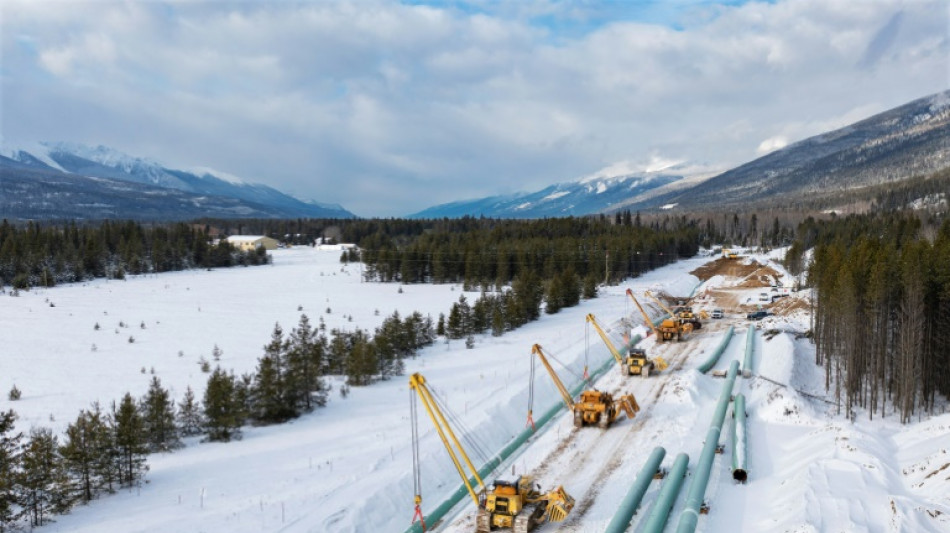
Canada's first new oil pipeline in decades starts operating / Photo: Handout - Trans Mountain Corporation/AFP

 Inter Milan and Italy icon Mazzola dies aged 83

 Saudi capital issues first air raid alert since renewed fighting in Yemen

 Martin edges title rival Marquez for Austrian MotoGP pole

 Indonesia accepts Malaysia's help to tackle wildfires

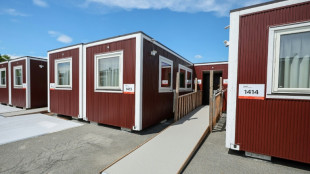
 Indians living in Japan on stand-by to house Asian Games athletes
 Trump signs bill authorizing sweeping Russia sanctions

 Protesters form human chain at Kennedy Center after Trump threat

 Death toll from attack at police HQ in Pakistan rises to 31

 Trump says Denmark to give US 'permanent control' over Greenland security

 Kennedy Center: future unclear for iconic Washington arts hub

 Trump claims 'infinite' Greenland security deal with Denmark

 Helicopters battle wildfire threatening Ecuador's capital

 Brentford batter Chelsea to undo Alonso's promising start

 Kane hits Bundesliga century as Bayern rout Union

 Trump says CNN, MS NOW, Politico banned from White House

 Hushing and hedging: US companies retreat on climate

 Springboks to face Fiji before 2027 Rugby World Cup

 Nigeria miners struggled to breathe in cell before 37 died: survivors

 McIlroy on the charge at PGA Championship as Reed withdraws

 McIlroy on the charge at PGA Championship

 Crisis-wracked Volkswagen warns of 10-bn-euro hit to profits

 Costa Rica's Grynspan tops third informal poll for UN chief: diplomat

 Stock markets retreat after central bank rate hikes

 Russia labels director of Cannes Grand Prix winner a 'foreign agent'

 Macron warns of Russian 'hybrid' threat after meeting presidential hopefuls

The first major new oil pipeline to be built in Canada in decades is set to open on Wednesday, praised by proponents but panned by environmentalists worried about the consequences of more crude production.
The Can$34-billion (US$25 billion) Trans Mountain pipeline expansion project was a troubled private sector plan taken over by Prime Minister Justin Trudeau's government in 2018 to ensure it went ahead. It will carry 600,000 additional barrels per day of oil from Alberta to Canada's Pacific coast for shipping overseas.
Built alongside an existing 1,150-kilometer (715-mile) line erected in 1953 that already moves about 300,000 barrels of oil per day, it was meant to increase market access for the world's fourth largest oil exporter and get a better return for Canadian crude.
But along the way it faced regulatory delays, cost overruns, legal challenges and protests by environmental and some Indigenous groups.
On the eve of its opening, University of British Columbia professor George Hoberg said it represents "a big win for Alberta but a huge loss for environmentalists concerned about the climate crisis and possible spills" from the pipeline itself or tankers navigating Canadian waters -- with devastating consequences for wildlife including endangered orcas, or killer whales.
It also risked delivering "a really big blow" to the Trudeau government's attempts at reconciliation with First Nations who went to court to try to block it but lost, he told AFP.
- Contrary to energy transition -
Canada ranks among the world's largest per capita emitters of greenhouse gases. According to the latest government data, emissions rose 13.9 percent to 670 megatonnes per year from 1990 to 2021.
And due to its location, Canada is warming faster than the rest of the planet. This has led to devastating droughts and wildfires that last year scorched more than 15 million hectares of forests.
University of Moncton environmental studies professor Jean-Philippe Sapinski said the Trans Mountain pipeline expansion project "is completely contradictory" with Ottawa's stated commitment to cut greenhouse gas emissions by up to 45 percent by 2030.
"If we look at a real ecological transition, if we do something concrete to counter the climate crisis, it is completely useless. It is even counterproductive," he said.
Pierre-Olivier Pineau, an HEC Montreal professor specializing in energy policies, said he agrees.
"It is not through pipelines that we'll make an energy transition" away from fossil fuels, he told AFP.
- Cost overruns -
To salvage what was then a troubled project, Ottawa nationalized the pipeline, paying Can$4.5 billion to buy it from Kinder Morgan in 2018.
Ottawa intended to offload the conduit once construction was completed, but the costs -- estimated in 2017 at Can$7.4 billion -- have ballooned, increasing to Can$34 billion.
Parliament's budget officer estimated in 2022 that the project had become a "net loss" for Canada.
But Deputy Prime Minister Chrystia Freeland insisted this "great national project" will add a quarter of a percentage point to Canada's gross domestic product in the second quarter.
"It's good for the Canadian economy and for Canadian oil producers," concluded Pineau.
Until now, almost all Canadian oil has been sold to the United States at a discount, mainly because of a lack of pipeline capacity and other infrastructure to ship landlocked Alberta province's growing output.
Opening new markets in Asia will increase competition, leading to improved prices for Canadian crude. However, its impact will not be large enough to upend the current geopolitical balance or overseas dominance of Russia and producers in the Middle East, Pineau said.
H.Portela--PC



