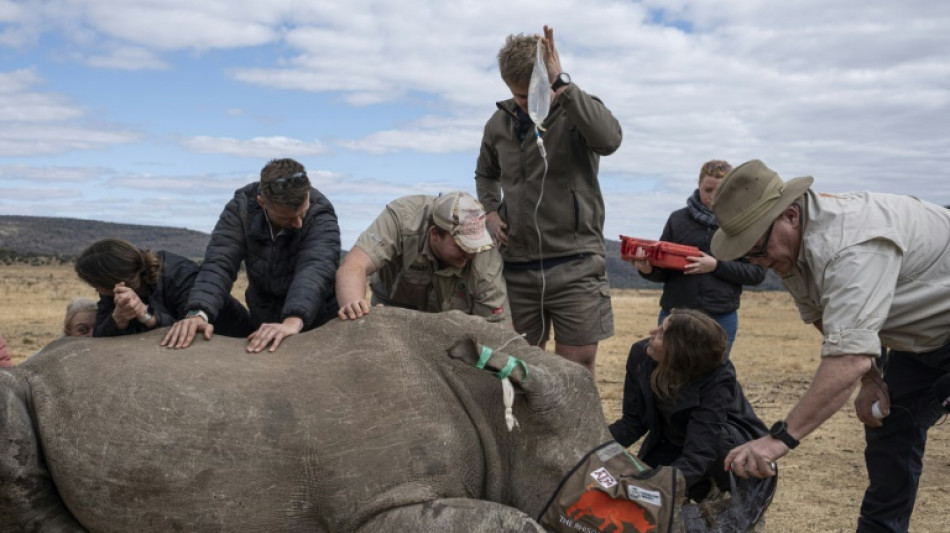
First radioactive rhino horns to curb poaching in S.Africa / Photo: EMMANUEL CROSET - AFP

 Inter Milan and Italy icon Mazzola dies aged 83

 Saudi capital issues first air raid alert since renewed fighting in Yemen

 Martin edges title rival Marquez for Austrian MotoGP pole

 Indonesia accepts Malaysia's help to tackle wildfires

 Indians living in Japan on stand-by to house Asian Games athletes

 Trump signs bill authorizing sweeping Russia sanctions

 Protesters form human chain at Kennedy Center after Trump threat

 Death toll from attack at police HQ in Pakistan rises to 31

 Trump says Denmark to give US 'permanent control' over Greenland security

 Kennedy Center: future unclear for iconic Washington arts hub

 Trump claims 'infinite' Greenland security deal with Denmark

 Helicopters battle wildfire threatening Ecuador's capital

 Brentford batter Chelsea to undo Alonso's promising start

 Kane hits Bundesliga century as Bayern rout Union

 Trump says CNN, MS NOW, Politico banned from White House

 Hushing and hedging: US companies retreat on climate

 Springboks to face Fiji before 2027 Rugby World Cup

 Nigeria miners struggled to breathe in cell before 37 died: survivors

 McIlroy on the charge at PGA Championship as Reed withdraws

 McIlroy on the charge at PGA Championship

 Crisis-wracked Volkswagen warns of 10-bn-euro hit to profits

 Costa Rica's Grynspan tops third informal poll for UN chief: diplomat

 Stock markets retreat after central bank rate hikes

 Russia labels director of Cannes Grand Prix winner a 'foreign agent'

 Macron warns of Russian 'hybrid' threat after meeting presidential hopefuls

South African scientists on Tuesday injected radioactive material into live rhino horns to make them easier to detect at border posts in a pioneering project aimed at curbing poaching.
The country is home to a large majority of the world's rhinos and as such is a hotspot for poaching driven by demand from Asia, where horns are used in traditional medicine for their supposed therapeutic effect.
At the Limpopo rhino orphanage in the Waterberg area, in the country's northeast, a few of the thick-skinned herbivores grazed in the low savannah.
James Larkin, director of the University of the Witwatersrand's radiation and health physics unit who spearheaded the initiative, told AFP he had put "two tiny little radioactive chips in the horn" as he administered the radioisotopes on one of the large animals' horns.
The radioactive material would "render the horn useless... essentially poisonous for human consumption" added Nithaya Chetty, professor and dean of science at the same university.
The dusty rhino, put to sleep and crouched on the ground, did not feel any pain, Larkin said.
The radioactive material's dose was so low it would not impact the animal's health or the environment in any way, he said.
In February the environment ministry said that, despite government efforts to tackle the illicit trade, 499 of the giant mammals were killed in 2023, mostly in state-run parks. This represents an 11 percent increase over the 2022 figures.
Twenty live rhinos in total would be part of the pilot Rhisotope project whereby they would be administered a dose "strong enough to set off detectors that are installed globally" at international border posts originally installed "to prevent nuclear terrorism", a pleased Larkin said, sporting a green hat and a khaki shirt.
Border agents often have handheld radiation detectors which can detect contraband in addition to thousands of radiation detectors installed at ports and airports, the scientists said.
-'Best idea'-
Rhino horns are highly sought after on black markets, where the price by weight rivals that of gold and cocaine.
According to Arrie Van Deventer, the orphanage's founder, dehorning the rhino and poisoning the horns have failed to deter poachers.
"Maybe this is the thing that will stop poaching", the tall, slim-built conservationist said. "This is the best idea I've ever heard".
Wildebeest, warthogs and giraffe roamed the vast conservation area as more than a dozen team members performed the delicate process on another rhino.
Larkin meticulously drilled a small hole into the horn, hammered in the radioisotope, then finished off by spraying 11,000 microdots all over the horn.
About 15,000 rhinos live in the southern African nation, according to an estimate by the international Rhino foundation.
The last phase of the project would be the animal's aftercare following "proper scientific protocol and ethical protocol", said the project's COO, a bubbly Jessica Babich.
The team would then take follow-up blood samples to ensure the rhinos were effectively protected.
The material would last five years on the horn, which was cheaper than dehorning every 18 months, Larkin said.
E.Ramalho--PC



